
Introduction
Calgary’s rental market is buzzing. With population growth driven by interprovincial migration and new jobs in tech, energy, and healthcare, more investors are eyeing multi-family properties. But here’s the catch: buying your first 12-unit apartment building isn’t about just finding the right property; it’s about securing the right financing.
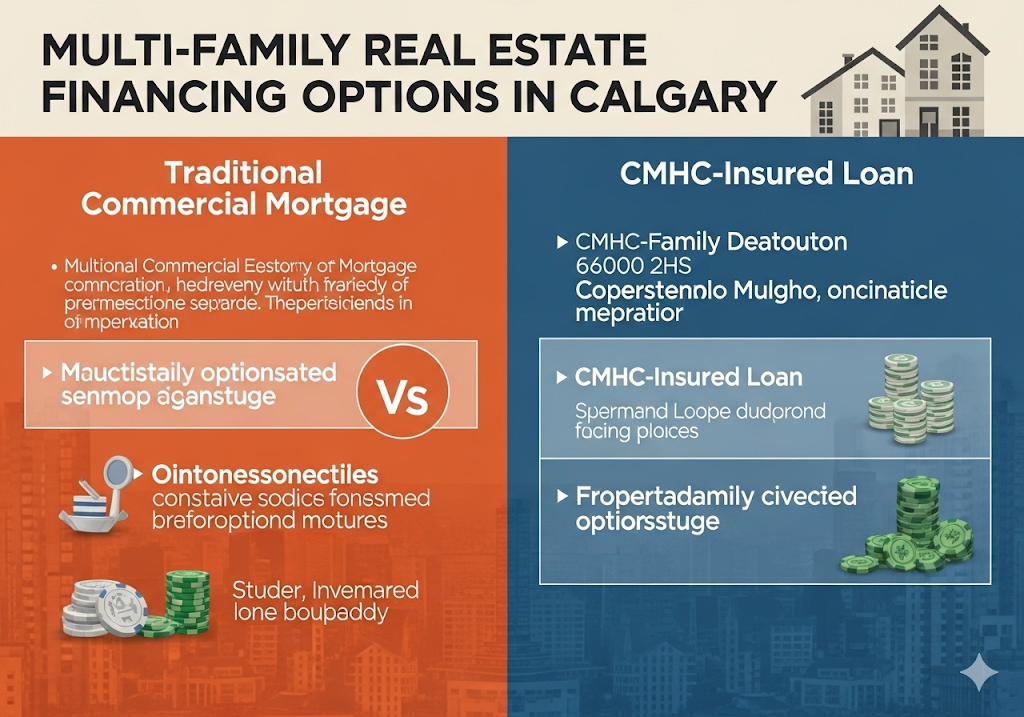
The way you finance your purchase will shape your monthly cash flow, your risk exposure, and your ability to scale into future deals. In Alberta, two options dominate: traditional commercial mortgages and CMHC-insured loans. Each comes with advantages, drawbacks, and timelines you need to fully understand before diving in.
The Traditional Commercial Mortgage Route
How it works:
Banks or credit unions lend you the majority of the purchase price. You typically bring in:
- Down payment: 25–30% of the purchase price
- Amortization period: 20–25 years
- Loan term: 3–10 years (renewable upon expiry)
Pros of this path:
- Speed: Banks move faster than CMHC. Approval can be done in weeks, which makes sellers more confident in your offer.
- Flexibility: No federal underwriting requirements. As long as the deal makes sense financially, lenders can work with you.
- Good for value-add investors: If you plan to renovate and refinance in 18–24 months, conventional financing avoids long wait times.
Cons of this path:
- Heavier upfront capital: With a 25–30% down payment, you’ll tie up significant cash, money that could otherwise be used for improvements or a second property.
- Shorter amortization = higher payments: This tightens monthly cash flow, especially if rents are not maximized yet.
- Interest rate exposure: Conventional loans may come with slightly higher rates, which impact returns if the market shifts.
The CMHC-Insured Loan Advantage
How it works:
The Canada Mortgage and Housing Corporation provides insurance on multi-family loans, lowering the lender’s risk. In exchange, lenders give you better terms. The MLI Select program makes this even more appealing.
Key terms:
- Down payment: As low as 15% (and in some cases, as low as 5% with MLI Select if your property meets energy, accessibility, or affordability goals).
- Amortization: Up to 40–50 years, the longest available in Canada.
- Rates: Usually lower than conventional loans because of CMHC’s backing.
Pros of this path:
- Lower capital entry: A smaller down payment means you keep more cash in hand for future deals.
- Improved cash flow: Longer amortization spreads out payments, lowering monthly obligations.
- Favorable interest rates: CMHC-insured loans often have the lowest rates on the market.
- Encourages sustainability: Programs like MLI Select reward you for creating more energy-efficient or affordable housing.
Cons of this path:
- Long approval times: Underwriting can take 3–6 months. In Calgary’s competitive market, some sellers won’t wait that long.
- Extra costs: Insurance premiums (often 2–4% of the loan amount) and application fees add to your expenses.
- Strict requirements: Not every property qualifies, especially older buildings needing major upgrades.
Real-World Example: A 12-Unit Calgary Apartment
Let’s say you’re purchasing a 12-unit building priced at $2.4 million.
Option 1 – Traditional Commercial Loan
- Down payment: $600,000 (25%)
- Amortization: 25 years
- Monthly mortgage: ~$10,600
- Cash flow: Tight unless rents are at market levels
Option 2 – CMHC Loan (MLI Select, 15% down)
- Down payment: $360,000
- Amortization: 40 years
- Monthly mortgage: ~$7,400
- Cash flow: Stronger, with $3,000 more breathing room every month
That $240,000 you don’t put into the down payment could be used for renovations, reserves, or even as a seed for your second building.
Alberta-Specific Insights
- Less red tape vs Ontario/BC: No rent control caps mean rental income can grow with market demand, giving lenders more confidence in your pro forma numbers.
- Lower property taxes: Calgary’s property taxes are more investor-friendly compared to major Ontario cities, which helps reduce annual carrying costs.
- Local lender experience: Alberta-based lenders are comfortable underwriting smaller multi-family deals, giving you more options to shop around.
Final Thoughts
- If you value speed and flexibility, conventional financing is often the smarter first step.
- If your priority is long-term cash flow and scaling into more buildings, a CMHC-insured loan will likely serve you better.
Either way, Calgary’s growing rental demand, favorable yields, and investor-friendly policies make financing a first apartment building less daunting than it seems, provided you match your financing strategy to your investment goals.