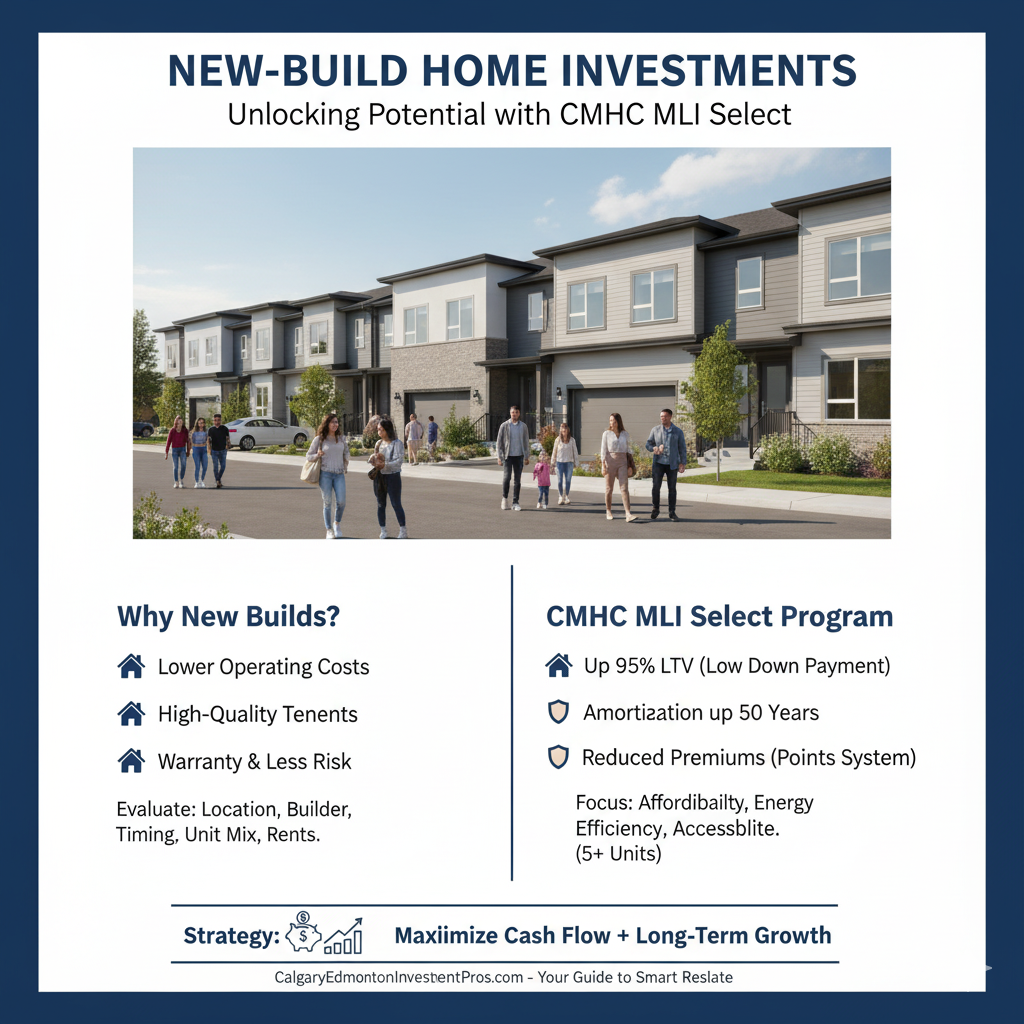

Introduction
As rental demand continues to rise in the Calgary/Edmonton corridor, and rising building costs push older stock toward obsolescence, the strategy of investing in new-build rental homes (or well-positioned new-build communities) is gaining traction. At the same time, the CMHC MLI Select program has emerged as a powerful financing tool that can transform deals, especially for multi-unit properties (5 + units). In this blog, I’ll cover why new builds are attractive, how to evaluate them, and then deep-dive into the MLI Select program: how it works, how the points system operates, practical investor steps, and how this applies to Calgary/Edmonton markets.
Why New-Build Home Investments Make Sense
Advantages
- Lower operating expenses: Modern homes are built with better insulation, high-efficiency mechanicals (HVAC, ventilation), possibly solar / EV-charging, etc. This reduces long-term maintenance and energy cost burden, which supports higher net operating income (NOI) and better cash flow.
- Tenant appeal & retention: Brand-new homes (or nearly new) attract higher-quality tenants, lower turnover, and less deferred maintenance, which means you spend less on repairs and get more consistent rent payments.
- Warranty & less initial risk: Many new builds come with builder warranties, fewer immediate renovation costs, and fewer surprises like major plumbing or roof replacement right away.
- Better for scalability/portfolios: When you buy new or near-new, you can standardize systems (same floor plans, same finishes, same maintenance schedule), which simplifies property management and lowers cost per unit as you scale.
Key Factors to Evaluate
- Location: Even new homes in weak locations may struggle. Look for upcoming communities with good access to transit/highways, schools, and amenities.
- Builder reputation & quality: New builds vary widely. Choose builders who deliver on finishes, warranty, and resale/lease-up history.
- Timing: Buy too early (pre-construction) and risk delays or market shifts; too late and the entry price may be elevated.
- Unit mix & target tenant: In the Calgary region, think about tenants: young professionals (1-2 bed), families (3-4 bed). Build accordingly.
- Projected rents & expense model: Use conservative rent estimates (not “optimistic top-of-market”), build in vacancy buffer, maintenance, and property management.
- Exit/holding strategy: New builds may have less upside from “value add” (you’re buying with minimal deficiency), so upside is more from growth + scale rather than renovation arbitrage.
Understanding CMHC MLI Select Program
What is it?
The MLI Select program by CMHC is a mortgage-loan insurance product designed for multi-unit residential properties (5 + units) that commit to one or more of the following: affordability, energy efficiency/climate compatibility, or accessibility. The program rewards these projects with enhanced financing terms: higher LTV, longer amortizations, and reduced premiums. assets.cmhc-schl.gc.ca+1
Key Benefits for Investors
- Low down payment: Program allows up to ~95% loan-to-value (so ~5% down) for qualifying projects. mliselect.ca+1
- Long amortization: Up to 50 years of amortization, which spreads debt servicing over a long period and lowers monthly payments, improving cash flow. assets.cmhc-schl.gc.ca+1
- Reduced insurance premiums / better financing terms: If your project scores well on the points system, you can reduce premium costs, which further boosts net returns. Can Ener Tech+1
- Scalability: Because of high leverage and lower monthly debt load, you can deploy capital more efficiently and scale more properties with the same equity base.
The Points System: How It Works
- Projects must commit to measurable outcomes in three “pillars”: Affordability, Energy/Efficiency (climate‐compatible), and Accessibility. Can Ener Tech
- You earn points for each pillar based on metrics (e.g., units offered at below-market rents, energy-use reduction, units with accessible design features). Higher point totals unlock better terms (premium reduction, higher LTV, more favorable amortization). mliselect.ca
- Minimum property size: 5 units (for standard rental housing). New or existing builds qualify, though energy/efficiency criteria differ for retrofit vs new. assets.cmhc-schl.gc.ca+1
- Example case-study: A project upgraded insulation, installed solar, improved accessibility; achieved 40-year amortization, lower premium, improved cash flow. mliselect.ca
Eligibility & Requirements for Investors
- Must be multi-unit (5+ units).
- Must meet CMHC’s eligibility criteria (borrower experience, net worth, liquidity). For example: minimum 5% deposit, plus additional liquidity (often additional ~5% contingency), and typically a net worth threshold (e.g., investor must have total net worth ~25% of purchase price) according to promotional sites. MLI
- Project documentation is more involved: energy modeling, unit design/accessibility specs, affordability commitments, etc.
- Underwriting may take longer due to complexity and documentation requirements. As one practitioner noted: “More complex and lengthier application process.” Reddit
How This Benefits Calgary/Edmonton Investors Specifically
- In the Calgary region, where rental markets are strong and new builds are being constructed, these incentives can reduce the “gap” between rent levels and the cost of capital.
- For example, A 10-unit rental building in Calgary with 95% financing and 50-year amortization has a much lower monthly mortgage burden, making it more cash-flow viable.
- Combining this financing with new build premiums (modern finishes, low maintenance) improves the investor’s risk profile.
- Because Alberta has many growth-oriented commuter towns plus infill inner-city areas, you can match property type (multi-unit rentals) to location and financing (MLI Select) to maximize returns.
Practical Step-by-Step for Investors
- Identify property/project: Multi-unit building (existing or new build) in a favorable location (Calgary inner-city or growth suburb).
- Pre-assess points eligibility: Work with an energy modeler/accessibility specialist/affordability consultant to estimate how many points your project can score under the MLI grid.
- Engage CMHC or a CMHC-approved broker early: Understand application timeline, documentation, and approvals needed.
- Calculate financing structure:
- Down payment ~5% of value (subject to project strength).
- Amortization up to 50 years (choose the max if you need cash flow).
- Loan amount ~95% LTV (subject to risk and CMHC approval).
- Factor in property income, expense, debt service, vacancy, and reserve fund.
- Underwrite conservatively: Don’t assume ultra-high rents; build a buffer. Consider potential rent downturns or increased competition.
- Plan exit & hold horizon: Because your amortization is long and leverage high, you may hold for 10–20 years, focusing on cash flow and value growth rather than quick flips.
- Operate efficiently: With higher leverage, property operations need to be tight (maintenance, tenant screening, management). Consider property management, especially if scaling across multiple properties.
- Monitor compliance: Ensure you meet your affordability/accessibility/energy commitments as required by CMHC; failing those may impact your benefits.
Illustrative Example (Simplified)
Imagine you purchase a 10-unit rental property in Calgary for $3,000,000. Using the MLI Select framework you secure:
- 95% LTV → loan of ~$2.85 m, down payment ~$150k (5%).
- Amortization 50 years → much lower debt service than a typical 25-yr amortization.
- Suppose you commit to several energy-efficiency upgrades and some units at slightly below-market rent (earning your points). Because of this, your insurance premium is lower, saving you $X per year in costs.
- The combination of lower debt service + lower risk = better cash flow, enabling you to hold and scale.
Of course, you must still budget for operations, vacancy, maintenance, and manage risk.
Aligning New Builds with MLI Select + Calgary-Region Markets
Here’s how you bring it all together:
- Location: New build multi-units in growth towns (Cochrane, Airdrie) or inner-city communities with redevelopment potential (Killarney) can both work.
- Build quality: Target properties designed for rental (not luxury condos where owner-occupier dominates). That means durable finishes, a good maintenance plan.
- Unit size & tenant profile: For commuter towns, more 3-4 bedrooms may be appropriate; for inner-city, 1-2 bedrooms could dominate.
- Use of MLI Select: Because the program rewards affordability and energy, choose a project/structure that allows you to commit to one or more pillars. For example: Make 30% of units accessible (accessibility pillar) + efficient building envelope (energy pillar) → higher points → better terms.
- Financing model: With 95% LTV and 50-year amortization, your debt-service ratio drops significantly. This gives you margin for operation, upgrades, and turnover.
- Exit strategy: Because you’re using long amortization and high leverage, you may plan to hold long-term, refinance after 5–7 years, or reposition once the community matures and rents rise.
Challenges & Risk Management
- Application complexity/time: The MLI Select process is more involved, so the timeline may be longer. As one Reddit user noted: “The application is a more involved process … and is subject to further changes.” Reddit
- Market risk: Even with high leverage, you’re exposed to rental market downturns, regulatory shifts (zoning, rent control), and supply surges. Example commenter: “I see a lot of purpose-built rentals getting built. … I feel like some of these builds will not be able to get taken out successfully or smoothly.” Reddit
- Affordability/accessibility/energy commitments: Failing to meet your commitment may reduce or revoke benefits; important to monitor.
- Cash-flow sensitivity: With high leverage, small changes in vacancy, repair costs, or rental income can significantly impact net return, ensure adequate contingency reserves.
- Exit liquidity: With high debt and long amortization, your net equity build may be slower; ensure you understand the hold horizon and exit mechanics (refinance, sale, portfolio consolidation).
Final Summary
For investors in the Calgary region who are ready to scale and think long-term, the new-build + MLI Select strategy offers one of the most compelling risk/reward profiles in Canadian real estate. By combining the best location, modern construction, favorable financing, and careful underwriting, you align multiple favorable elements.
If I were to summarise the “three critical success factors” in this strategy:
- Location + product-type match – New build multi-units in the right market (inner-city or growth suburb/commuter town)
- Financing structure – Use MLI Select or equivalent to minimize down payment, maximize amortization, and reduce risk
- Operational rigor – Because you’re using leverage and expecting cash flow growth, you must execute on management, maintenance, and tenant selection, and monitor your assumptions.