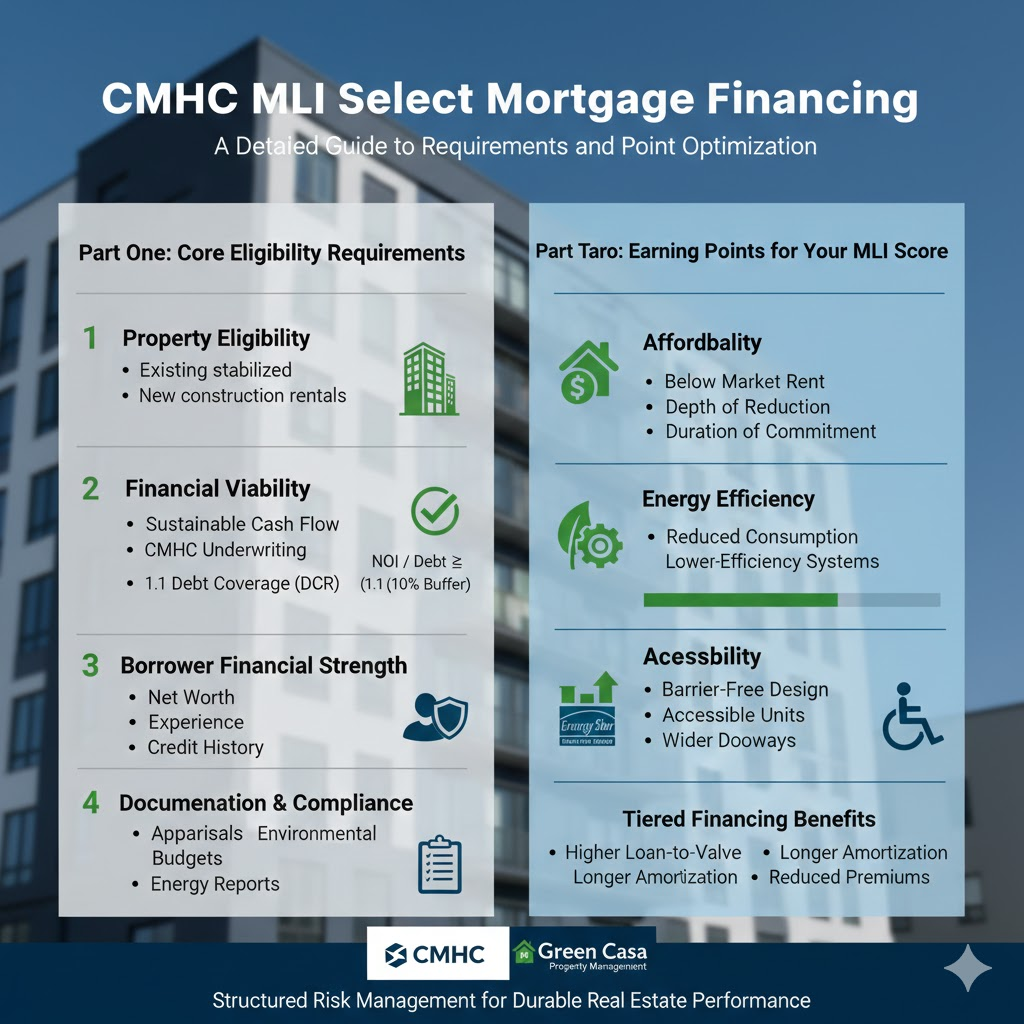

The CMHC MLI Select Program has reshaped multifamily mortgage financing in Canada by linking improved loan terms to measurable social and environmental performance. For investors and developers, the program offers powerful financial advantages. However, qualification requires careful planning, disciplined underwriting, and a clear understanding of how points are earned.
This guide explores both the core eligibility requirements and the strategic steps that can improve your MLI score.
Part One: Meeting the Core Eligibility Requirements
Before a project can benefit from enhanced financing terms, it must satisfy foundational standards that ensure financial stability and responsible risk management.
1 Property Eligibility
MLI Select applies to multi-unit residential rental properties. These typically include:
Purpose-built apartment buildings
Existing stabilized multifamily properties
New construction rental developments
The property must generate rental income and meet minimum unit thresholds as determined by the lender and CMHC guidelines.
2 Financial Viability and Income Stability
The most critical requirement is proof of sustainable cash flow.
CMHC performs its own underwriting analysis rather than relying solely on the borrower’s projections. This includes:
Reviewing current or projected rental income using verified market comparables
Applying regional vacancy assumptions
Benchmarking operating expenses against industry standards
Evaluating long-term capital reserve planning
A central requirement is the minimum debt coverage ratio of 1.1. This means projected net operating income must be at least 110 percent of projected annual mortgage payments.
For example:
If annual debt service equals one million dollars,
The property must demonstrate at least one million one hundred thousand dollars in projected net operating income.
This ten percent buffer ensures resilience against unexpected market shifts or cost increases.
3 Borrower Financial Strength
In addition to property performance, borrower qualifications are assessed. Lenders and CMHC evaluate:
Net worth relative to project size
Liquidity to cover deposits and contingencies
Experience managing multifamily assets
Credit history and financial stability
A strong borrower profile increases confidence in long-term project success.
4 Documentation and Compliance
Applicants must submit detailed documentation, including:
Appraisal reports
Environmental assessments
Construction budgets for new builds
Energy modeling reports, if applicable
Affordability agreements, if offered
Accuracy and transparency are essential. CMHC applies conservative assumptions if projections appear overly optimistic.
Part Two: Earning Points to Improve Your MLI Score
Once baseline eligibility is confirmed, the focus shifts to maximizing your point total. The MLI Select scoring system determines the level of financing benefits available.
Projects earn points across three core categories.
Affordability
Affordability is one of the strongest drivers of point accumulation.
Points are awarded based on:
The percentage of units offered below market rent
The depth of the rent reduction relative to local median rents
The duration of the affordability commitment
For example, offering a portion of units at reduced rent for ten years earns fewer points than offering deeper reductions over twenty years.
Investors must balance affordability commitments with financial performance. However, improved financing terms often offset some of the revenue tradeoffs.
Energy Efficiency
Energy performance improvements are another powerful pathway to earning points.
CMHC assesses how the building performs relative to baseline standards. Points may be awarded for:
Reducing overall energy consumption
Lowering greenhouse gas emissions
Installing high-efficiency heating and cooling systems
Improving insulation and window performance
Using advanced building envelope designs
Energy modeling reports are typically required to verify performance improvements.
Beyond point accumulation, energy-efficient buildings often benefit from reduced operating expenses, strengthening long-term cash flow.
Accessibility
Accessibility features contribute to both social impact and market flexibility.
Points are awarded for:
Barrier-free entrances and common areas
Accessible unit layouts
Wider doorways and hallways
Adaptable kitchen and bathroom designs
Incorporating accessible units broadens the tenant base and future-proofs the asset.
Tiered Financing Benefits
As total points increase, borrowers gain access to progressively stronger financing terms. These may include:
Higher loan-to-value ratios
Longer amortization periods
Reduced insurance premiums
Improved overall leverage
This tiered structure allows investors to intentionally design projects that align with both community impact and financial goals.