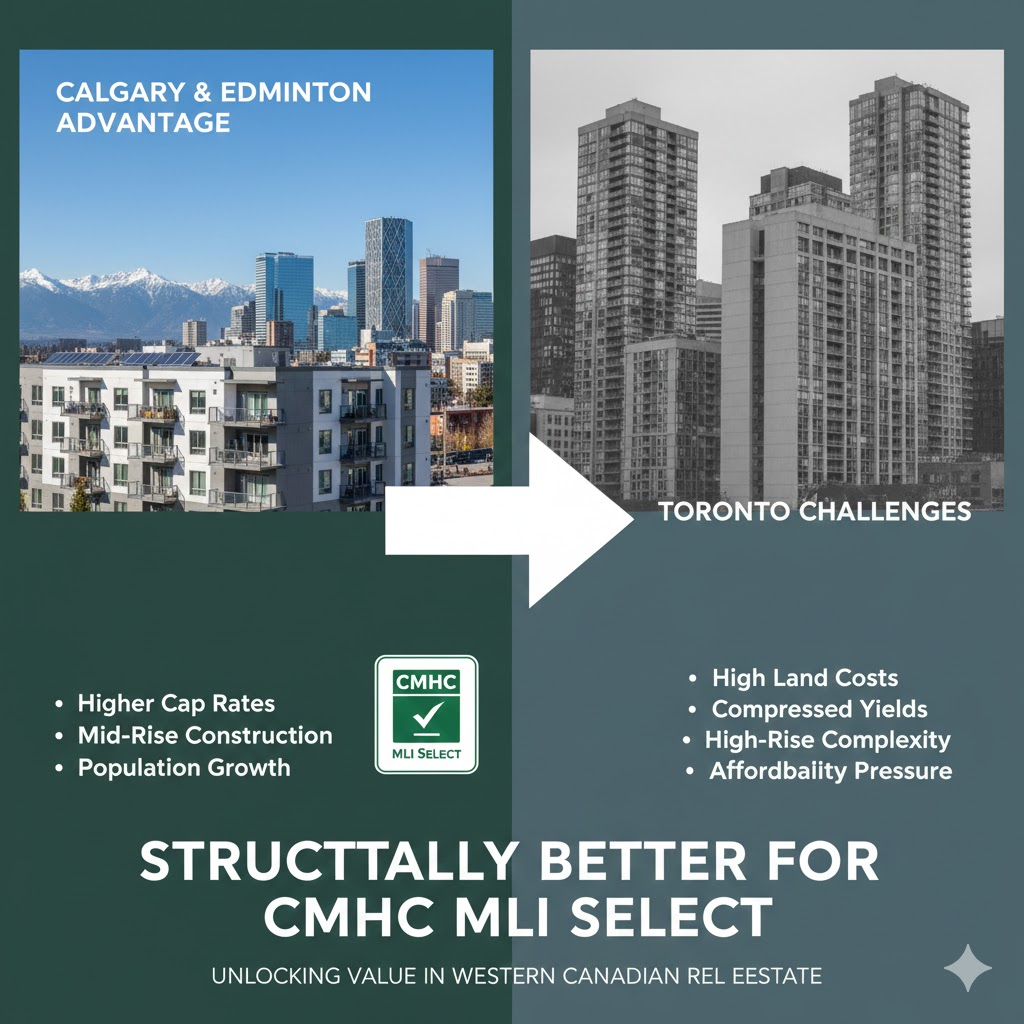

To fully understand why Alberta markets often outperform Toronto within structured mortgage insurance programs, we must examine the intersection of geography, capital allocation, regulatory friction, and operating fundamentals.
This is not a question of which city is stronger overall. It is a question of which market aligns more effectively with a disciplined multifamily investment strategy.
Capital Allocation Efficiency
In Toronto, institutional competition for multifamily assets has driven valuations upward. Capital inflows from pension funds, private equity, and REITs compress returns.
For private and mid-scale investors, this creates barriers:
Higher equity requirements
Reduced acquisition volume
Limited portfolio scalability
Calgary and Edmonton offer more accessible entry points. Investors can:
Acquire multiple mid-scale assets
Maintain healthier leverage ratios
Diversify risk across properties
Portfolio scalability improves resilience and long-term growth potential.
Regulatory Friction and Development Timelines
Toronto development approvals are often lengthy and complex. Zoning challenges, community consultation, and layered regulatory requirements increase carrying costs.
Extended timelines create:
Interest rate exposure risk
Escalating construction costs
Delayed revenue generation
Alberta municipalities typically maintain more predictable approval processes. While no market is frictionless, shorter timelines reduce capital uncertainty and improve financing confidence.
For programs requiring defined affordability commitments and performance benchmarks, predictability matters.
Income Stability Versus Speculative Growth
Toronto investors frequently rely on appreciation-driven strategies. While appreciation can generate significant equity gains, it may not always align with conservative underwriting models focused on cash flow.
Performance-based mortgage insurance prioritizes:
Sustainable net operating income
Reliable tenant demand
Manageable vacancy assumptions
Adequate reserve planning
Calgary and Edmonton’s income-to-value ratios often produce stronger operating fundamentals relative to acquisition cost.
This improves debt coverage ratios and reduces underwriting friction.
Energy and Accessibility Integration Economics
Programs such as MLI Select incentivize energy performance and accessible design.
In high-cost construction environments like Toronto, integrating these components may further strain feasibility margins.
In Alberta markets, where per-unit cost structures are often more balanced, developers can:
Incorporate energy-efficient systems
Design adaptable units
Allocate units for affordability
Without materially compromising overall return thresholds.
Strategic Implications for Investors
For investors seeking long-term cash-flowing rental portfolios, Alberta offers:
Balanced acquisition economics
Migration supported demand growth
Construction flexibility
Alignment with performance-based financing
Toronto remains globally competitive and capital-rich. However, its structural dynamics often favor large institutional players and appreciation-focused strategies.
Alberta markets offer a different proposition. They combine growth potential with operational stability and financing compatibility.
Final Analysis
Geography influences economics. Economics influence feasibility. Feasibility determines financing success.
When evaluating CMHC MLI Select multifamily financing through a structural lens, Calgary and Edmonton frequently provide a more natural alignment with the program’s objectives and underwriting framework.
For investors prioritizing stable income, scalable growth, and financing optimization, the geographic advantage of Alberta markets is not incidental. It is foundational.