

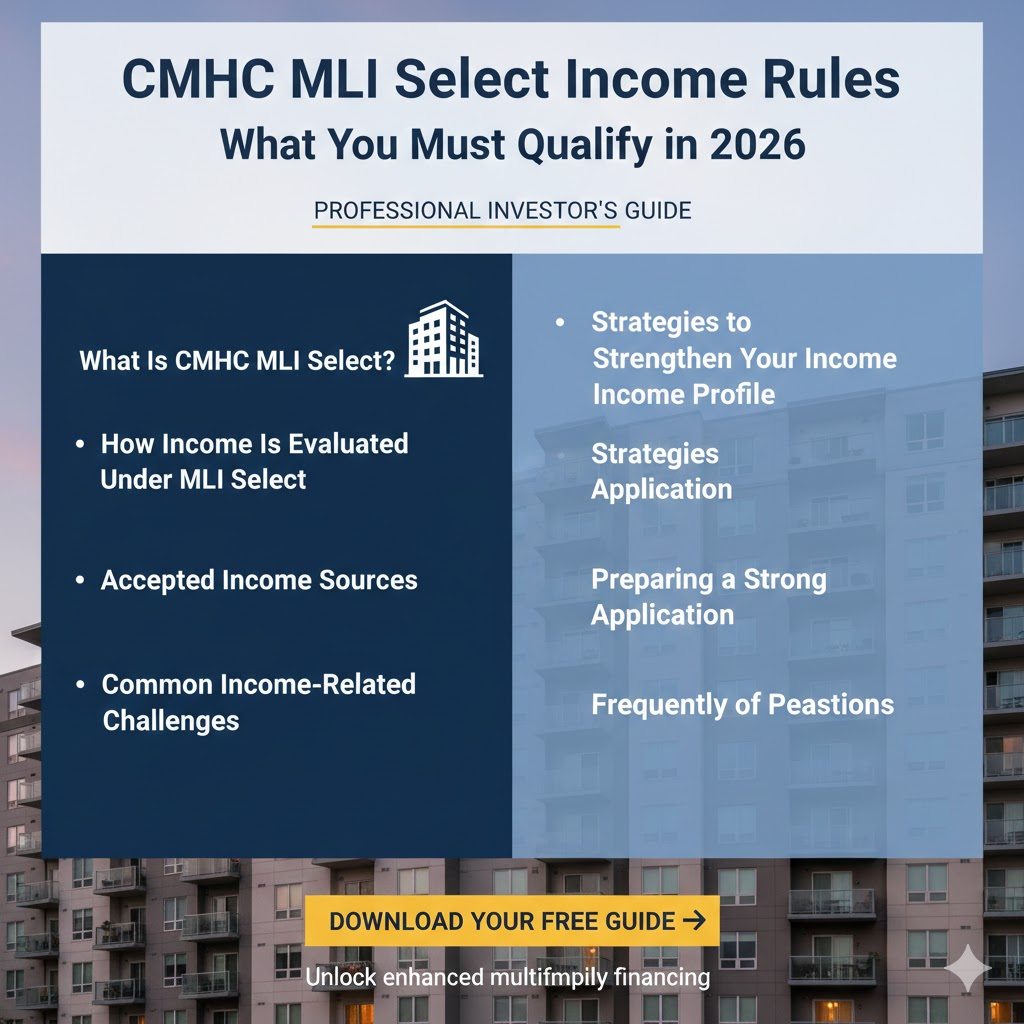
Understanding the income criteria for the Canada Mortgage and Housing Corporation MLI Select program is essential for any investor pursuing insured multifamily financing in Canada.
Unlike standard residential mortgages, MLI Select evaluates income at the property level, not just the borrower level. That distinction changes how eligibility is calculated, how leverage is structured, and how investors prepare their applications.
This guide breaks down how income qualification works, what documentation is required, and how to strengthen your approval profile.
What Is CMHC MLI Select?
MLI Select is a financing program designed for multi-unit residential properties. It offers enhanced loan terms, such as higher loan-to-value ratios and longer amortization periods, when projects meet scoring criteria related to:
- Affordability
- Energy efficiency
- Accessibility
Because the program provides high leverage, CMHC applies disciplined income analysis to ensure long-term loan stability.
How Income Is Evaluated Under MLI Select
1. Property Income Comes First
For multifamily properties, CMHC focuses primarily on:
- Gross rental income
- Vacancy assumptions
- Operating expenses
- Net Operating Income (NOI)
The property must meet a required Debt Coverage Ratio (DCR) typically around 1.20 or higher, depending on the project and risk profile.
In simple terms, the building must generate enough income to comfortably cover mortgage payments.
2. Borrower Income Still Matters
Although property performance is central, borrower financial strength is still reviewed. CMHC and lenders assess:
- Net worth
- Liquidity
- Credit history (minimum score typically around 600+)
- Experience managing similar assets
For smaller properties or first-time investors, personal income may play a larger role in underwriting.
Accepted Income Sources
When borrower income is reviewed, lenders may consider:
Employment Income
Salary, bonuses, and consistent overtime (usually averaged over two years).
Self-Employment Income
Net business income supported by financial statements and tax filings from the past two to three years.
Rental Income
Existing rental properties can strengthen your profile. Lenders typically include a portion of verified rental income after expense adjustments.
Investment Income
Dividends, interest, pension income, and other recurring revenue streams may also be included if properly documented.
Documentation is critical. CMHC requires a clear, consistent, and verifiable income history.
How Household or Ownership Structure Impacts Eligibility
For joint ventures or corporate ownership structures, CMHC evaluates:
- Combined net worth
- Liquidity contributions
- Proportional guarantees
- Experience of key principals
Stronger partners can enhance approval strength, particularly for larger acquisitions.
Common Income-Related Challenges
Insufficient Debt Coverage
If projected rental income does not meet DCR thresholds, loan sizing may be reduced.
Overstated Pro Forma Rents
CMHC underwriters rely on market rent comparisons. Unrealistic rent projections weaken applications.
Inconsistent Income History
Fluctuating business income or undocumented cash flow can create friction in approval.
Weak Liquidity Position
Even if income qualifies, insufficient post-closing liquidity may result in conditions or reduced leverage.
Strategies to Strengthen Your Income Profile
- Stabilize rents before application
- Reduce operating inefficiencies
- Improve tenant mix and lease quality
- Consolidate personal debt to improve the net worth presentation
- Partner with experienced investors
- Provide conservative, well-supported pro forma projections
Professional underwriting preparation significantly increases approval probability.
Preparing a Strong Application
A disciplined submission includes:
- Two to three years of financial statements
- Rent rolls and lease agreements
- Operating expense breakdown
- Property condition details
- Net worth and liquidity statements
- Credit verification
A well-structured application reduces underwriting back-and-forth and accelerates approval timelines.
Why Professional Guidance Matters
MLI Select is not a standard mortgage product. It is a structured financing program requiring:
- Financial modeling
- Energy or affordability scoring analysis
- Accurate DCR forecasting
- Risk presentation strategy
Working with a broker experienced in CMHC multifamily underwriting can materially improve terms and approval outcomes.
Final Thoughts
Understanding income criteria for CMHC MLI Select is about more than showing a salary. It requires demonstrating that the property generates stable income and that the ownership group has the financial strength to manage risk responsibly.
Investors who approach MLI Select with disciplined financial preparation, realistic projections, and structured documentation position themselves for stronger leverage, better amortization, and long-term portfolio growth.
If you would like, I can next create a technical version tailored specifically for experienced multifamily investors.
Frequently Asked Questions for CMHC MLI Select Income Rules
Q. What income is required to qualify for CMHC MLI Select?
There is no fixed personal income minimum. Qualification is primarily based on the property’s Net Operating Income and its ability to meet required Debt Coverage Ratios.
Q.Does my personal salary matter for multifamily financing?
For stabilized larger assets, property income is primary. However, lenders still assess your net worth, liquidity, and credit profile.
Q. What credit score is needed?
A minimum score of around 600 is typically required, though stronger credit improves approval strength and terms.
Q. How is rental income calculated?
Lenders analyze current rent rolls and apply vacancy and expense assumptions to determine Net Operating Income.
Q. Can self-employed investors qualify?
Yes. Two to three years of consistent tax filings and financial statements are generally required.
Q. Does CMHC consider projected rent increases?
Yes, but projections must be supported by market data and realistic assumptions.
Q. What is the most common reason applications are reduced or declined?
Insufficient Debt Coverage Ratio or overstated pro forma income assumptions.
Tags
Written by Hafil Perincheeri | Connect: LinkedIn | Contact: Email