

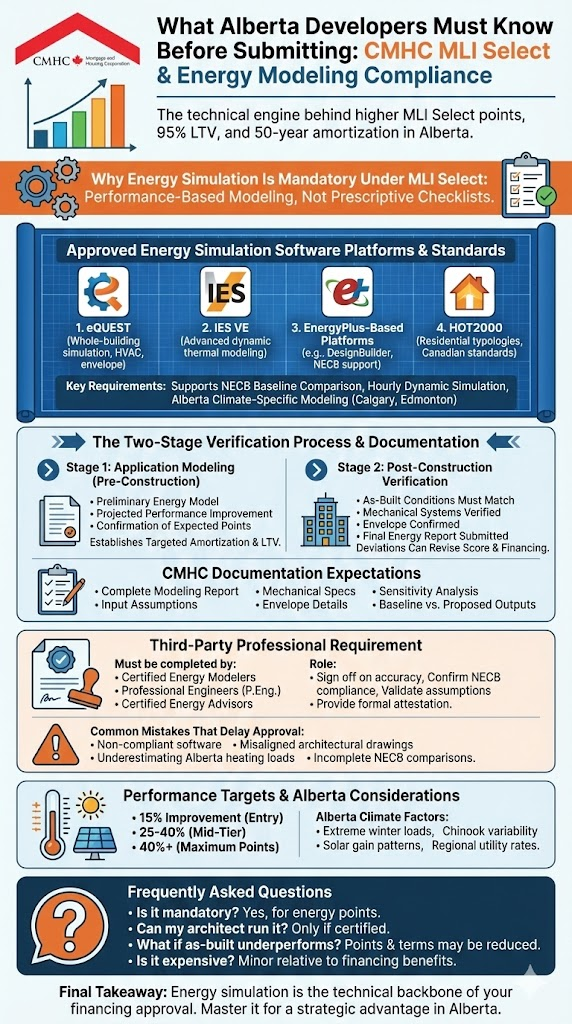
The Canada Mortgage and Housing Corporation (CMHC) MLI Select program has transformed multi-family financing across Alberta. While accessibility and affordability often receive the spotlight, energy performance is the technical engine behind higher point thresholds and potentially unlocking 95% Loan-to-Value and extended amortizations.
At the center of the energy pillar lies one critical requirement: approved energy simulation software and certified modeling professionals.
This guide breaks down what software is required, who can run it, what documentation CMHC expects, and how developers in markets like Calgary and Edmonton can structure projects for compliance and approval.
Why Energy Simulation Is Mandatory Under MLI Select
MLI Select does not rely on prescriptive checklists alone. It requires performance-based modeling.
That means:
- Simulating total building energy consumption
- Comparing performance against National Energy Code benchmarks
- Demonstrating percentage improvement above baseline
- Providing measurable reductions in greenhouse gas emissions
Energy modeling determines how many points your project earns under the Energy Efficiency pillar up to 50 points in some cases.
Without approved software and proper documentation, those points are not awarded.
Approved Energy Simulation Software Platforms
CMHC requires software that complies with nationally recognized modeling standards, including compliance with the National Energy Code for Buildings (NECB).
Commonly accepted platforms include:
1. eQUEST
A widely used whole-building energy simulation tool capable of modeling HVAC systems, envelope performance, lighting loads, and occupancy schedules.
2. IES VE (Integrated Environmental Solutions Virtual Environment)
Advanced simulation software capable of detailed dynamic thermal modeling and renewable integration analysis.
3. EnergyPlus-Based Platforms
Software that uses the EnergyPlus calculation engine (such as DesignBuilder) and supports NECB compliance modeling.
4. HOT2000 (for applicable residential typologies)
Often used in residential energy modeling aligned with Canadian standards.
The key requirement is that the platform:
- Supports the NECB baseline comparison
- Provides an hourly dynamic simulation
- Allows climate-specific modeling (critical in Alberta)
- Generates detailed performance reports
Not all energy tools qualify. Spreadsheet estimates or simplified calculators are not acceptable.
Performance Targets You Must Meet
Energy simulation must demonstrate a measurable improvement over the NECB baseline.
Typical performance targets include:
- 15% improvement (entry-level energy points)
- 25–40% improvement (mid-tier scoring)
- 40%+ improvement (maximum energy scoring)
Higher performance unlocks more MLI Select points, which directly influences:
- Loan-to-Value ratios
- Amortization length
- Insurance premium reductions
For projects targeting 100 total points, energy performance often carries the largest scoring weight.
Alberta Climate Considerations

Energy modeling in Alberta is not generic.
Simulation software must account for:
- Extreme winter heating loads
- Chinook temperature variability
- Solar gain patterns
- Regional utility rates
- Carbon intensity of grid electricity
Modeling assumptions must reflect actual climate files for Calgary, Edmonton, or other Alberta municipalities.
Failure to use the correct weather data can invalidate results.
Documentation Requirements
Submitting energy simulation results requires more than a summary page.
CMHC expects:
- Complete modeling report
- Input assumptions documentation
- Mechanical system specifications
- Envelope performance details
- Sensitivity analysis (in some cases)
- Baseline vs. proposed comparison outputs
Additionally, modeling files must be available for review if requested.
Transparency is critical.
Third-Party Professional Requirement
Energy simulations must be completed by qualified professionals, typically:
- Certified Energy Modelers
- Professional Engineers (P.Eng.)
- Certified Energy Advisors
The professional must:
- Sign off on modeling accuracy
- Confirm NECB compliance
- Validate assumptions
- Provide formal attestation
Self-prepared models without credentials are not accepted.
Two-Stage Verification Process
Energy modeling under MLI Select operates in two phases.
Stage 1: Application Modeling (Pre-Construction)
At the financing application stage, you must submit:
- Preliminary energy model
- Projected performance improvement
- Confirmation of expected point total
This establishes your targeted amortization and LTV.
Stage 2: Post-Construction Verification
After completion:
- As-built conditions must match modeled assumptions
- Mechanical systems must be verified
- Envelope specifications confirmed
- Final energy report submitted
If actual construction deviates from the model, CMHC may revise your energy score.
Financing terms can be adjusted if performance targets are not achieved.
Ongoing Performance Monitoring

Some projects may integrate:
- Energy benchmarking systems
- Utility data tracking
- Smart building management platforms
Advanced simulation platforms support integration with operational monitoring tools, aligning predicted and actual performance over time.
This strengthens long-term asset valuation and investor confidence.
Cost-Benefit Analysis Integration
Modern simulation platforms do more than predict energy use.
They allow developers to:
- Compare insulation upgrade ROI
- Model HVAC system alternatives
- Evaluate solar PV payback periods
- Analyze lifecycle cost savings
Energy modeling becomes a financial planning tool, not just a compliance requirement.
In Alberta’s competitive multi-family market, this analysis often identifies upgrades that improve both MLI Select scoring and long-term NOI.
Common Mistakes That Delay Approval
- Using non-compliant or simplified modeling tools
- Failing to align architectural drawings with modeled assumptions
- Underestimating Alberta heating loads
- Ignoring mechanical system efficiencies in documentation
- Submitting incomplete NECB baseline comparisons
Energy modeling errors can delay underwriting or reduce point allocations.
Final Takeaway
Energy simulation software is not a formality in MLI Select; it is the technical backbone of your financing approval.
Approved platforms, NECB-aligned modeling, qualified professionals, and accurate documentation determine how many energy points you earn. Those points directly impact amortization length, leverage, and long-term returns.
For developers and investors in Alberta, mastering energy modeling requirements is no longer optional. It is a strategic advantage in structuring high-performance, finance-optimized multi-family assets.
Frequently Asked Questions for Alberta Developers
Q. Is energy modeling mandatory for all MLI Select projects?
Yes, if you are pursuing energy efficiency points. Performance must be demonstrated using approved simulation software.
Q. Can my architect run the model?
Only if they are properly certified or qualified in energy modeling and NECB compliance.
Q. What happens if the as-built building underperforms?
CMHC may reduce awarded energy points, potentially affecting amortization or insurance terms.
Q. Is energy modeling expensive?
Costs vary by building size and complexity, but modeling is typically minor relative to the financing advantages unlocked.
Q. Do Alberta climate conditions make it harder to score high?
Cold climates increase heating loads, but high-performance envelopes and efficient systems can still achieve strong improvement percentages.
Q. Can renewable energy systems increase my score?
Yes. Solar, geothermal, and advanced HVAC systems can improve modeled performance and increase energy points.
Tags
Written by Hafil Perincheeri | Connect:LinkedIn | Contact: Email