

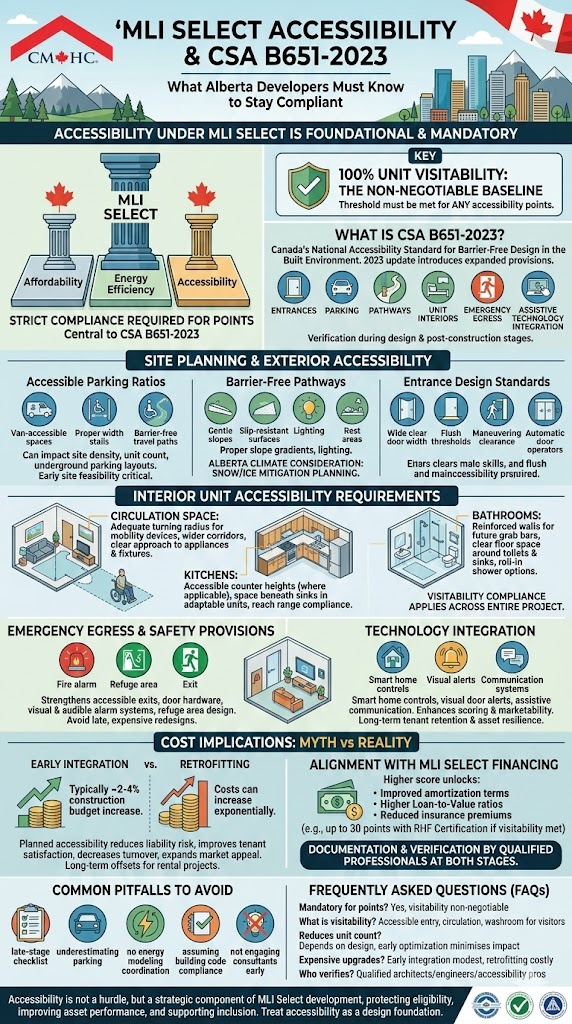
What Alberta Developers Must Know to Stay Compliant
Accessibility under MLI Select is not optional it is foundational.
The Canada Mortgage and Housing Corporation (CMHC) requires strict accessibility compliance for projects seeking points under the MLI Select program. Central to this requirement is adherence to CSA B651-2023, Canada’s national standard for accessible design in the built environment.
For developers in Alberta, understanding how CSA B651 integrates with MLI Select scoring can determine whether a project qualifies for enhanced financing, including extended amortization and higher leverage.
This guide explains how CSA B651-2023 applies within MLI Select, what has changed in the 2023 update, and how to structure projects for both compliance and long-term value.
Why Accessibility Matters in MLI Select
MLI Select is built around three performance pillars:
- Affordability
- Energy Efficiency
- Accessibility
Accessibility points can significantly strengthen financing terms. However, there is a non-negotiable baseline requirement:
100% of units must meet visitability standards under CSA B651-2023 to qualify for accessibility points.
If this threshold is not met, accessibility points are not awarded regardless of other design features.
What Is CSA B651-2023?
CSA B651 is Canada’s national accessibility standard for barrier-free design. The 2023 update introduces expanded and more detailed provisions affecting:
- Entrances
- Parking
- Pathways
- Unit interiors
- Emergency egress
- Assistive technology integration
For MLI Select projects, CSA B651-2023 compliance must be verified during both design and post-construction stages.
Site Planning & Exterior Accessibility Requirements
Accessibility begins before construction.
1. Accessible Parking Ratios
CSA B651-2023 requires:
- Clearly designated accessible parking stalls
- Van-accessible spaces with proper width
- Barrier-free travel paths from parking to entrances
These requirements can impact:
- Site density
- Unit count
- Underground parking layouts
Early site feasibility analysis is critical.
2. Barrier-Free Pathways
Exterior pathways must include:
- Proper slope gradients
- Slip-resistant surfaces
- Adequate lighting
- Rest areas are where required
In Alberta’s climate, snow and ice mitigation planning becomes part of accessibility compliance.
3. Entrance Design Standards
Updated standards mandate:
- Minimum clear door widths
- Flush thresholds
- Maneuvering clearance on both sides of the doors
- Automatic door operators in common entrances
These specifications must be coordinated with building envelope and energy efficiency targets.
Interior Unit Accessibility Requirements
Within each unit, CSA B651-2023 influences:
1. Circulation Space
- Adequate turning radius for mobility devices
- Wider corridors
- Clear approach space to appliances and fixtures
2. Kitchens
- Accessible counter heights (where applicable)
- Space beneath sinks (in adaptable units)
- Reach range compliance for controls and switches
3. Bathrooms
- Reinforced walls for future grab bars
- Clear floor space around toilets and sinks
- Roll-in shower options in designated accessible units
Even where full accessibility is not required in every unit, visitability compliance applies across the entire project.
Emergency Egress & Safety Provisions
The 2023 update strengthens:
- Accessible emergency exits
- Door hardware requirements
- Visual and audible alarm systems
- Refuge area design, where applicable
Corridor widths and stairwell access planning must align with these standards.
Failure to integrate these provisions early can lead to expensive redesigns.
Technology Integration & Modern Accessibility
CSA B651-2023 recognizes advancements in:
- Smart home controls
- Visual door alerts
- Assistive communication systems
- Adjustable lighting controls
While not always mandatory, integrating technology can enhance scoring and marketability.
For MLI Select projects, forward-thinking accessibility design supports long-term tenant retention and asset resilience.
Cost Implications: Myth vs. Reality

Developers often assume accessibility significantly increases costs.
In reality:
- Early-stage integration typically increases construction budgets by approximately 2–4%.
- Retrofitting after design completion can increase costs exponentially.
When properly planned, accessibility features can:
- Reduce liability risk
- Improve tenant satisfaction
- Decrease turnover
- Expand market appeal
For rental projects, long-term operational stability often offsets initial costs.
Alignment with MLI Select Financing
Accessibility under CSA B651-2023 interacts directly with financing outcomes.
Projects earning higher accessibility scores may unlock:
- Improved amortization terms
- Higher Loan-to-Value ratios
- Reduced insurance premiums
Additionally, projects pursuing Rick Hansen Foundation Certification may earn up to 30 accessibility points provided visitability standards are fully met.
Accessibility compliance must be documented and verified by qualified professionals at both application and post-construction stages.
Common Pitfalls to Avoid
- Treating accessibility as a late-stage checklist item
- Underestimating parking and site planning impact
- Failing to coordinate accessibility with energy modeling
- Assuming basic building code compliance equals CSA B651 compliance
- Not engaging qualified accessibility consultants early
Accessibility compliance is technical, and documentation-heavy proactive planning is essential.
Final Thoughts
Accessibility under CSA B651-2023 is not simply a regulatory hurdle it is a strategic component of successful MLI Select development.
For Alberta developers, integrating accessibility early protects financing eligibility, improves long-term asset performance, and supports inclusive community development.
Projects that treat accessibility as a design foundation rather than a compliance afterthought are better positioned to secure stronger financing terms, attract stable tenants, and retain long-term value in an evolving housing landscape.
Frequently Asked Questions for MLI Select Accessibility & CSA B651-2023
Q. Is CSA B651-2023 mandatory for all MLI Select projects?
If pursuing accessibility points, yes. Additionally, visitability compliance is mandatory to qualify for those points.
Q. What is visitability?
Visitability ensures that all units can be entered and used at a basic level by someone with mobility limitations, including accessible entry, circulation space, and a usable washroom.
Q. Does accessibility reduce the number of units I can build?
Potentially, depending on parking and circulation requirements. Early design optimization minimizes impact.
Q. Are accessibility upgrades expensive?
When integrated during design, costs are modest. Retrofitting is significantly more expensive.
Q. Who verifies compliance?
Qualified architects, engineers, or certified accessibility professionals must provide documentation and sign off for CMHC.
Q. Does exceeding minimum standards improve financing?
Higher accessibility scoring can enhance overall MLI Select point totals, improving financing incentives.
Written by Hafil Perincheeri | Connect: Linkedin | Contact: Email