

In multifamily real estate, cash flow is not just a financial metric. It is the foundation that determines whether a property can operate smoothly, maintain its quality, and deliver long term returns.
The CMHC MLI Select Program was designed with this reality in mind. Rather than focusing only on property value or maximum borrowing limits, the program places strong emphasis on income sustainability.
Administered by Canada Mortgage and Housing Corporation, the program incorporates financial safeguards directly into its approval process. The goal is simple but important. Ensure that projects have the ability to support their debt while maintaining stable operations over time.
But the value of these safeguards becomes clearer when viewed from multiple perspectives, including investors, lenders, and even tenants.
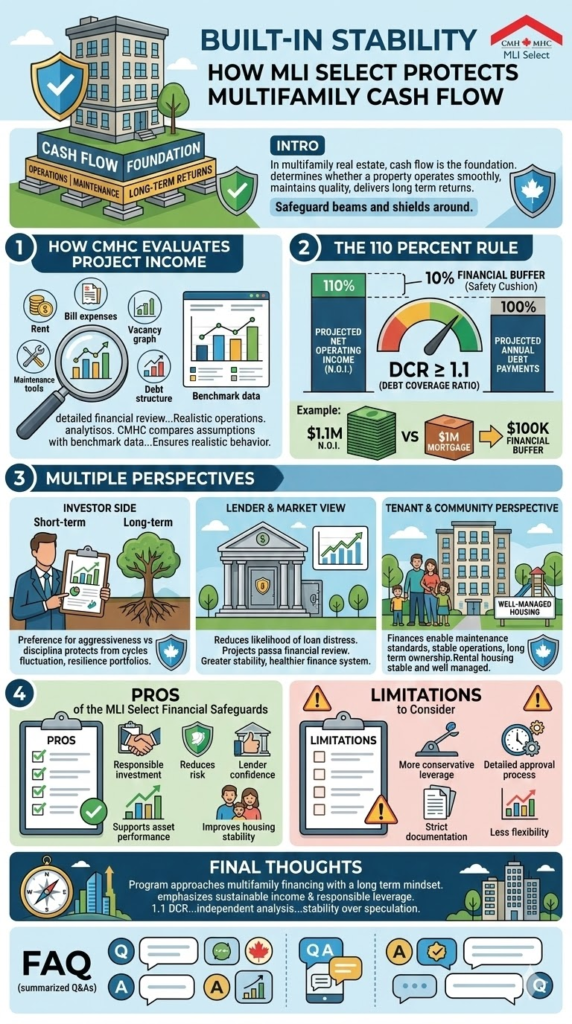
How CMHC Evaluates Project Income
When a project applies for MLI Select financing, it undergoes a detailed financial review. This review looks beyond basic loan calculations and examines whether the property can realistically sustain its operations.
CMHC evaluates several core financial factors, including
- Projected rental income
- Operating expenses
- Regional vacancy trends
- Property maintenance costs
- Overall debt structure
The purpose of this review is not to create an ideal financial scenario. Instead, CMHC attempts to understand how the property will perform under normal market conditions.
To accomplish this, the agency compares the project’s assumptions with benchmark data from comparable properties and regional housing trends. This ensures that rent expectations and expense estimates reflect real market behavior rather than optimistic projections.

Understanding the 110 Percent Rule
A key requirement within the program is often referred to as the 110 percent rule.
To qualify for financing, a project’s projected net operating income must equal at least 110 percent of its projected annual debt payments.
For example
- If annual mortgage payments are one million dollars
- The building must generate at least one million one hundred thousand dollars in net operating income
This requirement creates a ten percent financial buffer. The resulting metric is known as the debt coverage ratio, and under MLI Select, it must be at least 1.1.
This margin acts as a built-in safety cushion that helps properties absorb unexpected financial pressures.
A Different Perspective From the Investor Side
From an investor’s perspective, the 1.1 debt coverage ratio may initially appear conservative. Some investors prefer higher leverage or more aggressive financing structures to maximize short term returns.
However, the discipline built into MLI Select often protects investors from risks that are easy to overlook during optimistic market cycles.
By requiring realistic projections and stable income margins, the program encourages developers and property owners to structure deals that remain viable even if rents fluctuate or expenses increase.
For long term investors, this discipline often leads to stronger and more resilient portfolios.
1. A Lender and Market Perspective
From a lender’s viewpoint, the financial safeguards in MLI Select reduce the likelihood of loan distress.
Projects approved through the program have already passed a detailed financial review. This lowers risk and helps create greater stability in the broader multifamily lending market.
By encouraging responsible borrowing and sustainable development, the program contributes to a healthier housing finance system.
2. A Tenant and Community Perspective
Although the program is primarily designed for investors and lenders, tenants indirectly benefit as well.
Properties with stable finances are more likely to maintain consistent maintenance standards, stable operations, and long-term ownership. Buildings that are financially stressed often struggle to maintain quality services.
By supporting financially sustainable projects, MLI Select helps ensure that rental housing remains stable and well-managed for the people who live there.
Pros of the MLI Select Financial Safeguards
Encourages responsible investment structures
Projects must demonstrate realistic income and expenses before approval.
Reduces risk of financial distress
The 1.1 debt coverage ratio provides a cushion against market changes.
Strengthens lender confidence
Rigorous financial analysis helps lenders feel more comfortable supporting projects.
Supports long term asset performance
Disciplined financing often leads to more stable property operations.
Improves housing stability
Financially healthy properties can maintain better service and maintenance standards for tenants.
Potential Limitations to Consider
More conservative leverage
Some investors may find the requirements limit aggressive borrowing strategies.
Detailed approval process
The financial review can take longer compared with traditional financing programs.
Strict documentation requirements
Applicants must provide detailed projections and market comparisons.
Less flexibility in financial modeling
Optimistic revenue assumptions are unlikely to pass CMHC’s review.
Final Thoughts
The CMHC MLI Select Program approaches multifamily financing with a long term mindset. Rather than focusing only on loan size or property value, it emphasizes sustainable income and responsible leverage.
By requiring projects to demonstrate a minimum 1.1 debt coverage ratio and by conducting independent financial analysis, CMHC creates a financing structure that prioritizes stability over speculation.
For multifamily investors, this approach may feel conservative at first. But over time, it helps create stronger properties, healthier portfolios, and more resilient rental housing markets.
Frequently Asked Questions for How MLI Select Protects Multifamily Cash Flow
Q. What is the CMHC MLI Select Program?
It is a financing program offered by Canada Mortgage and Housing Corporation that supports rental housing projects focusing on affordability, energy efficiency, and accessibility while offering improved loan terms.
Q. What does the 110 percent rule mean?
It means a project’s net operating income must be at least 110 percent of its annual debt payments, creating a financial buffer.
Q. What is the minimum debt coverage ratio required?
Projects must meet a minimum debt coverage ratio of 1.1 to qualify for financing under the program.
Q. Why does CMHC review financial projections independently?
The agency verifies rent assumptions, vacancy rates, and operating costs to ensure the project reflects realistic market conditions.
Q. Is the requirement mainly for lenders or investors?
It benefits both. Lenders gain risk protection, while investors gain more stable long-term property performance.
Q. Does this requirement guarantee positive cash flow?
No financing structure can guarantee profits, but the safeguards significantly increase the likelihood of stable and sustainable cash flow.