

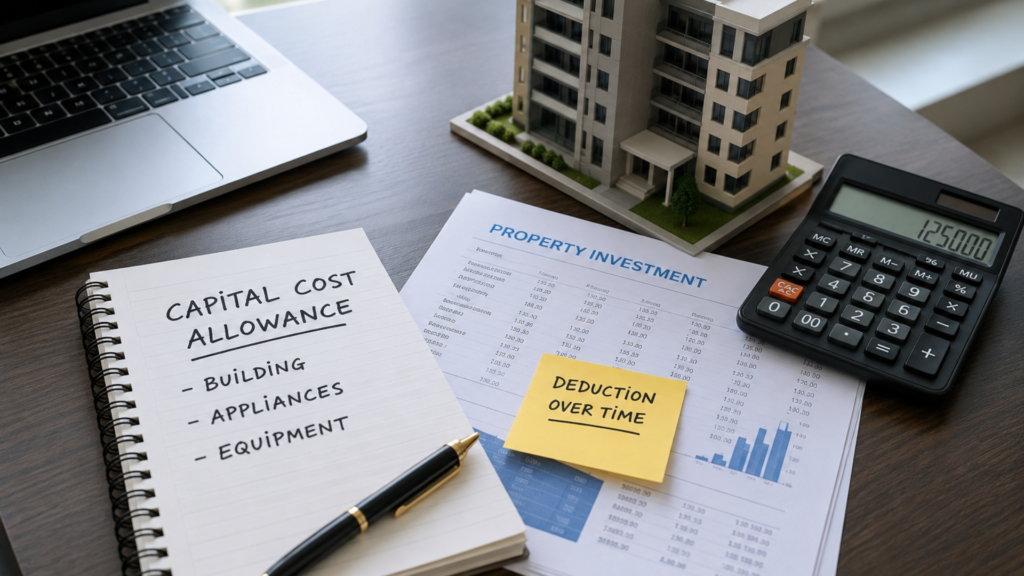
When you look at your property tax return do you ever wonder if you are leaving money on the table? I have been in that situation. The truth is, understanding Capital Cost Allowance is a very powerful tool for Canadian landlords. Whether you own a rental property or a big portfolio of apartment buildings Capital Cost Allowance lets you deduct the depreciation of your rental property over time. This reduces your income and puts more money back in your pocket.. Here is the thing. Claiming Capital Cost Allowance is not as simple as just filling in a number. If you get it wrong you could face problems like recapture or audits. In this guide I will walk you through everything you need to know about Capital Cost Allowance.
What Is Capital Cost Allowance?
Let me explain this in simple terms. Capital Cost Allowance is like depreciation. It is a deduction that lets you recover the cost of items like your rental building, appliances, and equipment over their useful lives. Think of it this way: your rental property does not stay in condition forever. Roofs wear out appliances break down. Buildings get old. The government recognizes this reality by allowing you to deduct a portion of your propertys cost each year.
You need to know that the Capital Cost Allowance applies only to the building itself, not the land. When you buy a property you must decide how much of the purchase price is for the land and how much is for the building. Only the building part qualifies for Capital Cost Allowance. Also claiming Capital Cost Allowance is optional. You do not have to claim the amount. In fact many landlords choose to claim nothing at all depending on their tax situation.
How Capital Cost Allowance Is Calculated
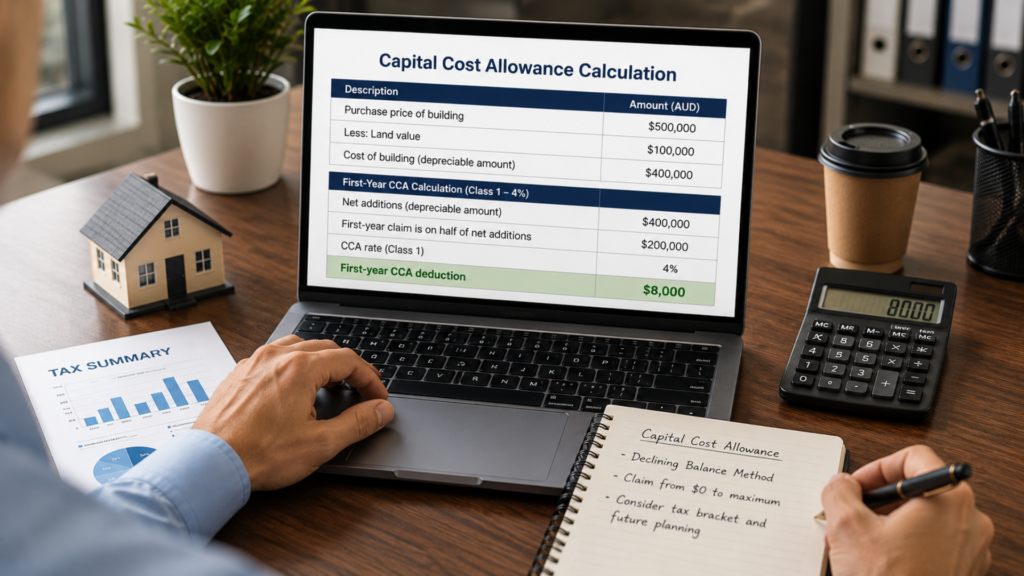
The calculation for Capital Cost Allowance uses the declining balance method. This means your Capital Cost Allowance claim is based on the remaining undepreciated capital cost of your asset.
Here is how it works. Lets say you buy a building for $500,000 with $100,000 for the land and $400,000 for the building. If your building falls into Class 1, the annual rate is 4%. In the year you would typically be eligible to claim Capital Cost Allowance on only half of your net additions. So your first-year Capital Cost Allowance would be calculated on $200,000 at 4% giving you a deduction of $8,000.
Here is where it gets important. You can claim any amount from zero up to the maximum. If you are in a tax bracket claiming the maximum Capital Cost Allowance might make sense. If you are already in a bracket or have other deductions you might want to claim less to preserve your undepreciated capital cost for future years.
CCA Classes: Which One Applies to Your Property?
One of the confusing things about Capital Cost Allowance is figuring out which class your property belongs to. The government groups things into classes each with its own depreciation rate.
Here are the common classes for rental properties:
- Class 1: This is the common class. Most buildings fall into Class 1 regardless of what they’re made of.
- Class 3: Buildings made of brick, stone or concrete typically fall into this class.
- Class 6: Wood-frame. Structures made of galvanized iron belong here.
- Class 8: This class covers things like furniture, appliances and equipment.
- Class 50: Computer equipment and systems software fall into this class.
Each rental building that costs than $50,000 must be in its own separate Capital Cost Allowance class. This ensures that when you sell the property all previously claimed Capital Cost Allowance is properly taken care of.
The Half-Year Rule: What You Need to Know
The half-year rule is one of those Capital Cost Allowance details that catches landlords off guard. In the year you buy a property you can usually claim Capital Cost Allowance on only one-half of your net additions to a class.
For example if you buy a building for $400,000 in December you would not be able to claim Capital Cost Allowance on the $400,000 in that tax year. Instead you would calculate your Capital Cost Allowance on $200,000 at the rate.
CCA Recapture: The Hidden Trap Every Landlord Must Understand
Here is where Capital Cost Allowance gets really interesting. And potentially dangerous. Capital Cost Allowance is not a tax deduction. It is a deferral.. When you sell your rental property that deferral can come back to bite you.
Recapture happens when you sell a property for more than its capital cost. The Capital Cost Allowance you claimed over the years gets added back to your income in the year of sale. This is taxed as income at your full marginal rate. Not as a capital gain.
Let me give you an example. You buy a building for $400,000. Claim $60,000 of Capital Cost Allowance over several years, leaving an undepreciated capital cost of $340,000. You later sell the building for $400,000. The difference between your undepreciated capital cost and the sale proceeds is $60,000. That entire amount is recaptured and fully taxable.
The New Accelerated CCA for Purpose-Built Rental Housing
Here is some news for developers and investors. The government introduced an increase in the Capital Cost Allowance rate from 4% to 10% for eligible new purpose-built residential rental buildings.
If you are building rental housing this is a big deal. A 10% Capital Cost Allowance rate versus 4% means larger deductions in the early years of ownership.
Strategic Tips for Maximizing Your Capital Cost Allowance
Based on what I have learned here are my top tips for making Capital Cost Allowance work for you:
- Consider your plans: If you plan to hold the property term claiming Capital Cost Allowance now might make sense.
- Do not. Increase a loss. You cannot use Capital Cost Allowance to create or increase a loss.
- Keep classes for each building. If you own properties make sure each building is in its own separate Capital Cost Allowance class.
- Document everything. The government requires you to keep records for least six years.
- Consider advice. Capital Cost Allowance rules are complex. The consequences of getting them wrong can be significant.
Conclusion:

Capital Cost Allowance is one of the powerful tax tools available, to Canadian landlords. But it is also one of the most misunderstood. When used strategically it can significantly reduce your rental income and improve your cash flow. Claiming Capital Cost Allowance without understanding the long-term consequences can lead to unexpected tax bills when you sell. The key is to understand the rules and develop a Capital Cost Allowance strategy that aligns with your investment goals.
Read More.
Frequently Asked Questions (FAQs)
The Canadian tax system has something called Capital Cost Allowance. This is a depreciation deduction that helps landlords. It lets them deduct some of the cost of things like buildings and equipment for their properties each year.
No. You can only claim Capital Cost Allowance on the building part of your property. The land itself does not count because it does not lose value over time. So you cannot include the land in your Capital Cost Allowance calculation.
Most buildings that were bought after 1987 are in Class 1 which means you can deduct 4 percent of the cost each year. If you bought your building before 1988 it might be in Class 3 or Class 6 which means you can deduct 5 percent or 10 percent. Things like appliances and furniture usually fall into Class 8 which means you can deduct 20 percent.
This happens when you sell your property for more money than its undepreciated capital cost. The Capital Cost Allowance you claimed over the years gets added back to your income. You have to pay tax on it at your regular tax rate.
It depends on your situation. Claiming Capital Cost Allowance can reduce the taxes you pay now but it might cause problems when you sell the property. You should think about how tax you pay now how much you might make in the future and how long you plan to keep the property before you decide.
In the 2024 budget the government introduced a rule that lets you deduct 10 percent of the cost of new rental buildings, which is more than the usual 4 percent. This only applies to new buildings that are specifically for renting and construction has to start after April 15, 2024 and, before 2031.

Hafil Perincheeri
Co-Founder & Director
Hafil Perincheeri is an engineer-turned-realtor, investor, and builder based in Calgary, Canada. As Co-Founder and Director of Greencasa, he specializes in home flips, property development, and investment strategies. Since 2019, he has guided clients in home buying, multifamily investing, and financing options like CMHC and MLI Select, ensuring transparent, informed decisions.