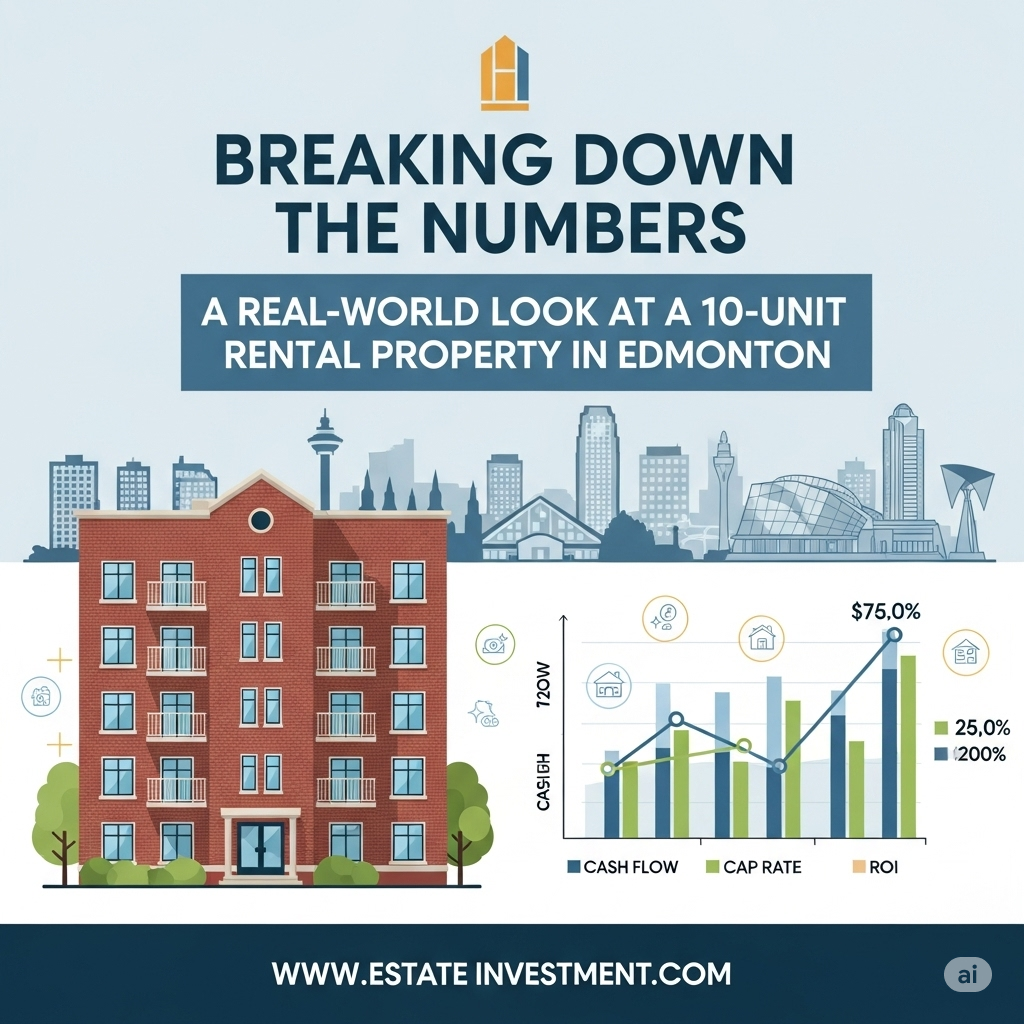
Investing in Real Estate? Here’s How to Run the Numbers Like a Pro
Edmonton’s multi-family real estate market is quietly becoming one of the best-kept secrets in Canada. While markets like Vancouver or Toronto often grab headlines, savvy investors are discovering that Edmonton offers a rare combination of affordability, strong rental demand, and landlord-friendly policies.
But before diving into your first (or next) apartment building, there’s one thing you must master: the numbers.
Whether you’re a seasoned landlord or new to real estate investing, understanding the key financial metrics can be the difference between a winning investment and a costly mistake.
In this blog, we’ll break down a real-world example of a 10-unit apartment building in Edmonton, walking you through every step of the financial analysis process just like we do at Green Casa Property Management.
🔍 Step 1: Estimate Rental Income
Let’s assume you’re looking at a 10-unit apartment, each unit being a 2-bedroom suite located in a mid-range neighbourhood near Edmonton’s downtown or a high-traffic suburban corridor.
Each unit rents for $1,300/month, which is quite reasonable in today’s Edmonton rental market (as of mid-2025).
- Monthly Gross Rental Income = 10 units × $1,300 = $13,000
- Annual Gross Income = $13,000 × 12 months = $156,000
This is your top-line revenue, the total amount of rent you’d collect in an ideal year with full occupancy.
📝 Pro Tip: Always review the rent roll. If rents are under market, there could be value-add potential. If they’re too high, be cautious of inflated numbers used to justify a high asking price.
💰 Step 2: Estimate Operating Expenses
Every rental property comes with ongoing costs, and underestimating these is where many investors get burned. Let’s break down typical annual expenses for a property of this size:
| Expense | Annual Cost |
| Property Taxes | $18,000 |
| Insurance | $6,000 |
| Maintenance & Repairs | $7,500 |
| Property Management (8%) | $9,360 |
| Utilities (Landlord-paid) | $12,000 |
| Miscellaneous/Contingency | $2,500 |
Total Operating Expenses: ~$55,360/year
These are non-financing costs, meaning they’re incurred regardless of whether the property is mortgaged or bought in cash.
✅ Quick Check: For a typical Edmonton rental, expenses range from 35–45% of gross income. Here, we’re at 35.5%, which is reasonable.
📊 Step 3: Calculate Net Operating Income (NOI)
The Net Operating Income is what’s left after paying all property-related expenses but before making mortgage payments.
NOI = Gross Income – Operating Expenses
$156,000 – $55,360 = $100,640
This figure is crucial because lenders use it to determine how much debt the property can support, and investors use it to evaluate potential returns.
📈 Step 4: Analyze Key Investment Metrics
Now that you have your NOI, it’s time to look at two foundational metrics:
1. Capitalization Rate (Cap Rate)
This tells you how much return you’re getting relative to the property’s price if you bought it in cash.
Let’s say the property is listed at $1.3 million.
Cap Rate = NOI ÷ Purchase Price
$100,640 ÷ $1,300,000 = 7.74%
This is a strong cap rate, especially compared to cities where cap rates dip below 4%.
2. Gross Rent Multiplier (GRM)
The GRM compares the purchase price to the annual gross rent. It’s a quick, back-of-the-napkin metric to spot overpriced properties.
GRM = Purchase Price ÷ Gross Rent
$1,300,000 ÷ $156,000 = 8.33
Generally, a GRM under 10 in a stable market like Edmonton suggests solid income potential.
📌 Note: GRM doesn’t account for expenses, so always use it alongside NOI and Cap Rate.
🧮 What About Cash Flow with Financing?
Let’s run a quick financing scenario:
- Down payment (25%) = $325,000
- Mortgage amount = $975,000
- Interest rate = 6.25%
- Amortization = 25 years
- Monthly Payment ≈ $6,400
- Annual Debt Service ≈ $76,800
Cash Flow = NOI – Debt Service
$100,640 – $76,800 = $23,840/year or $1,986/month
That’s a 7.3% cash-on-cash return, not including appreciation or mortgage paydown.
🌟 Why Edmonton?
Alberta’s capital city has quietly become a standout market for several reasons:
- Low cost per door: You can still find properties under $150,000 per unit, a rarity in Canada.
- No rent control: Alberta gives landlords more flexibility to adjust rents based on market value.
- Growing population: Edmonton is one of Canada’s fastest-growing cities, especially with immigration-driven demand.
- Stable economy: Anchored by energy, education, healthcare, and government sectors.
🛠️ How Green Casa Helps You Succeed
At Green Casa Property Management, we don’t just manage your building, we help you build a business.
Here’s what we bring to the table:
- Market research: We help you identify high-performing submarkets in Edmonton and Calgary.
- Pro forma analysis: Our team creates accurate cash flow projections so you know exactly what you’re getting into.
- Leasing and operations: We handle tenant screening, rent collection, maintenance, and more.
- Local insight: We live and work where your properties are giving you boots-on-the-ground peace of mind.
🔚 Final Word: Don’t Just Buy Property. Buy the Right Numbers.
Numbers are the truth-tellers of real estate. If the math works, the investment works.
With the right property, smart financing, and an experienced local team like Green Casa, a 10-unit apartment in Edmonton can deliver consistent income, long-term appreciation, and true financial freedom.
Ready to explore Edmonton’s multi-family opportunities?
📞 Contact Green Casa today, and we’ll help you break down the numbers and build up your future.