
Calgary has quietly become one of the most attractive real estate markets for multifamily investors in Canada. Over the past several years the city has experienced strong population growth, rising rental demand, and increasing investor attention from across the country.
While the market is evolving, the fundamentals that drive long term multifamily performance remain strong. Understanding where the market is heading can help investors position themselves to take advantage of new opportunities while managing risk effectively.
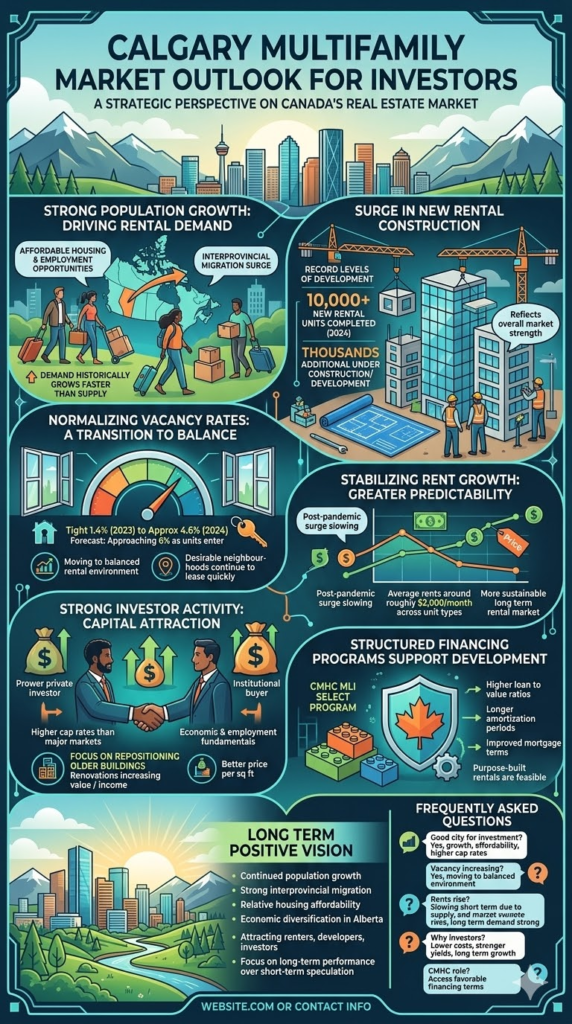
Population Growth Continues to Drive Rental Demand
One of the strongest drivers of Calgary’s multifamily market is population growth. The city has attracted significant migration from other Canadian provinces as people search for more affordable housing and strong employment opportunities.
This migration has increased demand for rental housing and contributed to strong rent growth over the past few years. Even with new construction entering the market, the number of people per rental unit has continued to rise, indicating that demand has historically grown faster than supply.
For investors, this demographic trend remains one of the most important indicators of long term rental demand.
Record Levels of New Rental Construction
The Calgary rental market has recently seen a surge in new development. In 2024 alone, more than 10,000 new rental units were completed, significantly higher than the previous year as delayed projects reached completion.
Thousands of additional units remain under construction or in development. This wave of new supply is expected to temporarily increase vacancy rates as the market absorbs the additional inventory.
While this may create short term competition among landlords, it also reflects the strength of the market. Developers would not be building at this pace if long term demand was not expected to remain strong.
Vacancy Rates Are Normalizing
After several years of extremely tight rental conditions, vacancy rates in Calgary are gradually increasing as new projects are delivered.
The city’s rental vacancy rate rose from around 1.4 percent in 2023 to approximately 4.6 percent in 2024, with forecasts suggesting it could approach 6 percent as additional units enter the market.
For investors, this does not necessarily signal weakness. Instead, it represents a transition from an overheated market toward a more balanced rental environment.
Properties located in desirable neighbourhoods close to transit, employment centres, and universities continue to lease quickly, even as overall vacancy increases.
Rent Growth Is Stabilizing
Rental rates in Calgary increased significantly during the post pandemic migration surge. As new supply enters the market, rent growth is beginning to stabilize.
Average rents have recently stabilized around roughly two thousand dollars per month across unit types, offering greater predictability for both investors and tenants.
While rent increases may slow in the near term, stable pricing can actually benefit investors by creating a more sustainable long term rental market.
Investor Activity Remains Strong

Despite higher interest rates and increased construction activity, investor interest in Calgary multifamily properties remains strong.
Private investors and institutional buyers continue to view the city as attractive due to:
Lower property prices compared to Toronto and Vancouver
Higher cap rates relative to other major Canadian markets
Strong employment and economic fundamentals
Calgary also offers a better price per square foot compared with other major Canadian cities, which continues to attract capital seeking higher yields.
In many cases, investors are focusing on repositioning older apartment buildings where renovations can increase rental income and long term property value.
Financing Programs Supporting Development
Another factor supporting multifamily investment in Calgary is the availability of structured financing programs such as the CMHC MLI Select program.
These financing options provide investors with:
Higher loan to value ratios
Longer amortization periods
Improved mortgage terms
Programs like this have made purpose built rental development and long term ownership more financially feasible for many investors.
Long Term Outlook for Calgary Multifamily Real Estate
Although the market may experience short term fluctuations as new supply enters the market, the long term outlook for Calgary multifamily real estate remains positive.
Key drivers supporting the sector include:
Continued population growth
Strong interprovincial migration
Relative housing affordability compared with other major cities
Economic diversification in Alberta
These factors suggest that Calgary will continue to attract renters, developers, and real estate investors for years to come.
For investors focused on long term performance rather than short term speculation, Calgary’s multifamily market remains one of the most promising opportunities in Canada.
Frequently Asked Questions for Calgary Multifamily Market Outlook
Q. Is Calgary a good city for multifamily investment?
Yes. Calgary offers strong population growth, relatively affordable real estate, and higher cap rates compared to other major Canadian markets.
Q. Are rental vacancy rates increasing in Calgary?
Yes. Vacancy rates are rising as new rental developments are completed, moving the market toward a more balanced environment.
Q. Will rents continue to rise in Calgary?
Rent growth may slow in the short term due to increased supply, but long term demand remains strong due to migration and population growth.
Q. Why are investors interested in Calgary multifamily properties?
Investors are attracted to Calgary because of lower acquisition costs, stronger yields, and long term population growth.
Q. What role does CMHC financing play in multifamily development?
Programs such as CMHC MLI Select help developers and investors access favourable financing terms, making multifamily construction and ownership more feasible.