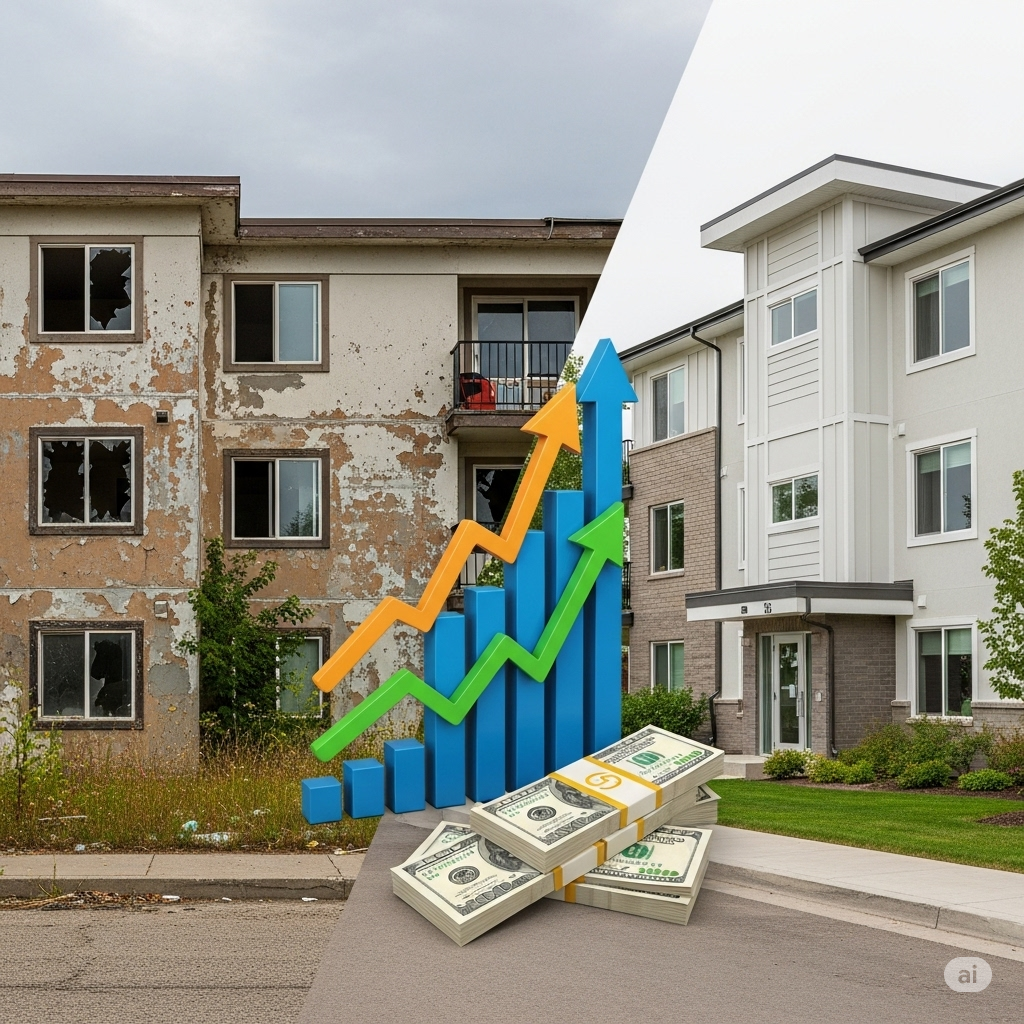
Introduction: Not Every Deal is Pretty: But the Profits Can Be
Walk into an old apartment building in Edmonton’s McCauley or Central McDougall and you might see yellowing cabinets, warped floors, and a tired boiler that’s seen one too many winters.
A rookie investor might run.
A savvy investor leans in.
Why? Because those are signs of untapped value.
In this blog, we’ll explore the “heavy value-add” strategy: a hands-on real estate investment model where you buy underperforming properties, renovate aggressively, and turn them into high-performing assets.
It’s not passive. It’s not always easy. But in Edmonton’s high-cap-rate market, it works.
🧱 What Is Heavy Value-Add Investing?
Heavy value-add means significant upgrades, not just paint and new cabinet handles. You’re targeting buildings that are structurally sound but visibly neglected.
We’re talking:
- Full unit turns (flooring, appliances, cabinetry)
- Plumbing and electrical updates
- Exterior repairs (roofing, windows, facades)
- Common area revamps
- Sometimes, even adding units or reconfiguring layouts
These buildings are typically under-rented because the condition scares away premium tenants.
But once improved, they command higher rents and attract longer-term renters.
💰 Where’s the Money Made?
Let’s run a quick example:
- You purchase a 16-unit building in Eastwood for $1.76M
- Each unit rents for $850, far below the market
- You invest $30K/unit to renovate = $480K in upgrades
- After renovation, you lease units at $1,250/month
Rent uplift:
$400 x 16 units = $6,400/month = $76,800/year
At a 5.75% cap rate, your added value =
👉 $76,800 ÷ 0.0575 = $1.33M in new value created
Subtract your $480K reno cost, and you’ve still forced over $850K in equity.
You can refinance, pull cash out, and hold for long-term income.
🏙️ Why This Works in Edmonton
Edmonton has a unique combination of traits that make heavy value-add deals possible:
- Abundance of 1960s–1980s walk-ups needing updates
- Cap rates in the 5.5% to 6.5% range
- Lower per-unit prices than major cities
- No rent control, giving investors room to raise rents post-renovation
- A large population of renters and newcomers is looking for quality housing
If you’ve got vision and a construction plan, you can turn a $2M mess into a $3M income machine.
⚠️ The Risks You Can’t Ignore
Let’s be honest, this strategy is not for the hands-off investor.
Here’s what to prepare for:
- Vacancy loss during renovations
- Construction surprises (mold, outdated wiring, city code changes)
- Permit delays or inspection reworks
- Lender limitations may not finance heavy renovations without solid experience
- Tenant turnover headaches if you’re buying a partially occupied building
Heavy value-add is about risk mitigation, not avoidance.
🤝 The Key to Success: The Right Team
To win in this game, you need more than capital. You need:
- A strong GC (general contractor)
- A designer who understands rental ROI
- A property manager (like Green Casa) to stabilize the building
- A broker who knows the local zoning, rental comps, and market dynamics
This is a team sport. But when is the team aligned? The results are real and repeatable.
🧭 Final Thought: The Best Deals Don’t Come Polished
Heavy value-add investing in Edmonton isn’t glamorous.
You’ll walk through buildings with busted baseboards and cracked linoleum, but if you can see past the surface, you’ll see profit potential others miss.
And with the right renovations, the right management, and the right mindset, these buildings can become cornerstones of your portfolio.