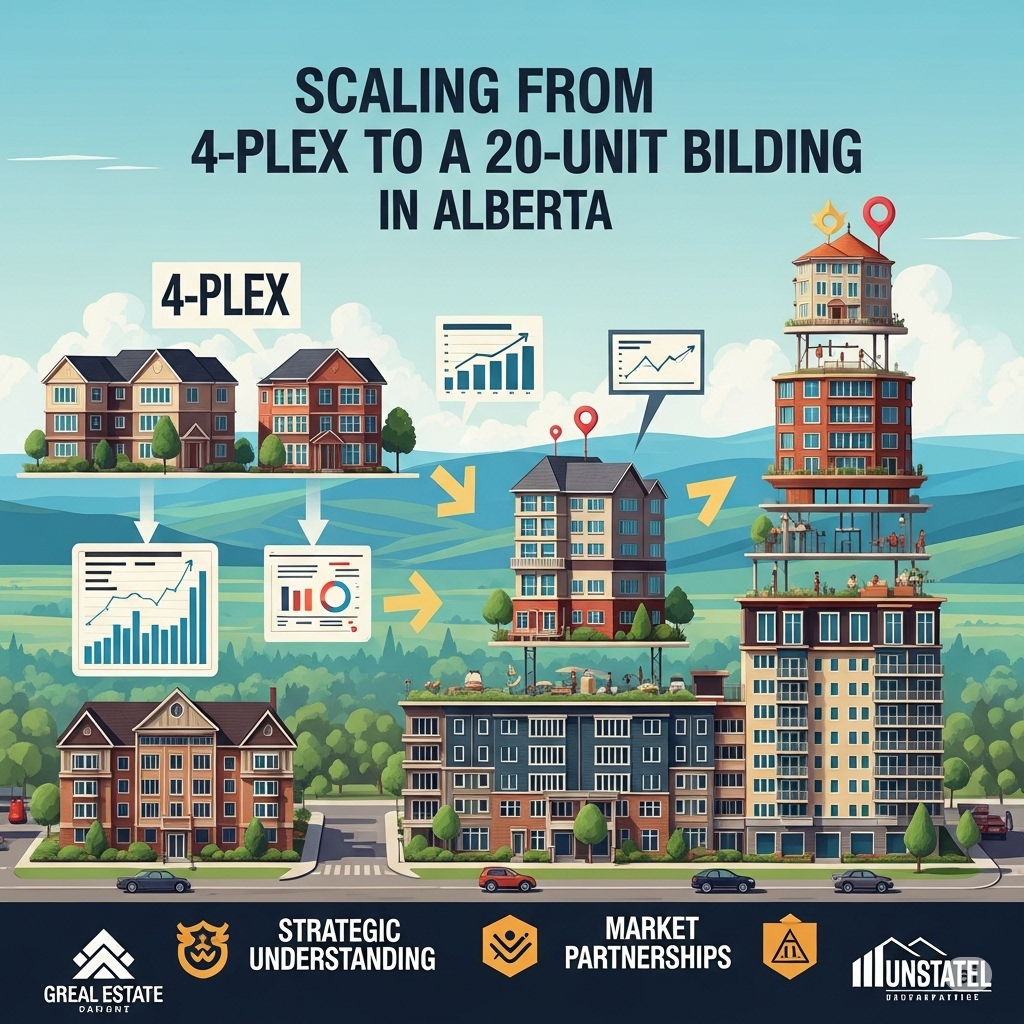
Going from a small residential investment to a mid-sized apartment building is a milestone in any real estate journey. But it also comes with new rules, new challenges, and new rewards.
Here’s a step-by-step breakdown of how Alberta real estate investors can scale from a 4-plex to a 20-unit multi-family building and why now might be the perfect time to do it.
1. What Changes at 5+ Units?
The difference between buying a 4-unit and a 20-unit building isn’t just scale—it’s category.
- 1–4 units = Residential
- 5+ units = Commercial Multi-Family
This affects how you qualify for financing, how properties are valued, and what kind of professionals you’ll need on your team.
Key differences:
| Feature | Residential (1–4 Units) | Commercial (5+ Units) |
| Loan Basis | Borrower’s income | Property’s income (NOI) |
| Appraisal Method | Comparable sales | Capitalization rate (Cap Rate) |
| Down Payment | As low as 5–20% | 15–35% (lower with MLI Select) |
| Amortization | Up to 30 years | Up to 50 years (MLI Select) |
2. Build Your Exit and Entry Strategy
Before jumping into a 10–20 unit building, ask:
- Can I refinance my existing property to fund the down payment?
- Will I self-manage or hire a property manager?
- Is my next building stabilized, or does it need renovations?
A successful scale-up involves leveraging past investments to fund future growth. Whether you’re selling your 4-plex or refinancing it, this is your launch pad.
3. Cash Flow and Cap Rates Matter More Than Ever
Unlike residential properties, where emotional appeal and comps drive value, commercial multifamily properties are primarily driven by income.
Your job becomes finding buildings where:
- Rent can be increased
- Expenses can be optimized
- Vacancies can be reduced
That’s how you raise Net Operating Income (NOI)—and when you do that, the building’s value goes up.
For example,
Increase NOI by $20,000/year in a market with a 5% cap rate, and you’ve just added $400,000 to your building’s appraised value. This is known as forced appreciation, and it’s where mid-sized investors can create real wealth.
4. Prepare for Bigger Operational Demands
20 doors mean more moving parts:
- Tenants calling at odd hours
- Snow removal, lawn care, and boiler inspections
- Coordinating insurance, utilities, and common area repairs
It’s no longer just collecting rent, it’s running a business.
This is where working with an experienced property management company becomes less of a luxury and more of a necessity.
5. Why Alberta Is a Great Place to Scale Right Now
With relatively low property taxes, no rent control, and strong population growth, Alberta continues to attract smart investors from across Canada.
- Calgary is experiencing a surge in demand for rental units, particularly near LRT lines and in newer suburbs.
- Edmonton offers value buys in established rental neighborhoods with strong cash flow.
Pair this with programs like CMHC MLI Select, and you have a recipe for responsible, accelerated growth.
Final Thoughts: Think Bigger, But Think Smarter
The move from a 4-plex to a 20-unit building doesn’t happen overnight. However, with strategic planning, a deep understanding of the market, and the right partnerships, it’s absolutely within reach.
You’re not starting over, you’re scaling up. And Alberta is one of the best places in Canada to do it.
Scaling Up in Alberta: What Investors Need to Know Before Buying a 20-Unit Building
Going from a small residential investment to a mid-sized apartment building is a milestone in any real estate journey. But it also comes with new rules, new challenges, and new rewards.
Here’s a step-by-step breakdown of how Alberta real estate investors can scale from a 4-plex to a 20-unit multi-family building and why now might be the perfect time to do it.
1. What Changes at 5+ Units?
The difference between buying a 4-unit and a 20-unit building isn’t just scale, it’s category.
- 1–4 units = Residential
- 5+ units = Commercial Multi-Family
This affects how you qualify for financing, how properties are valued, and what kind of professionals you’ll need on your team.
Key differences:
| Feature | Residential (1–4 Units) | Commercial (5+ Units) |
| Loan Basis | Borrower’s income | Property’s income (NOI) |
| Appraisal Method | Comparable sales | Capitalization rate (Cap Rate) |
| Down Payment | As low as 5–20% | 15–35% (lower with MLI Select) |
| Amortization | Up to 30 years | Up to 50 years (MLI Select) |
2. Build Your Exit and Entry Strategy
Before jumping into a 10–20 unit building, ask:
- Can I refinance my existing property to fund the down payment?
- Will I self-manage or hire a property manager?
- Is my next building stabilized, or does it need renovations?
A successful scale-up involves leveraging past investments to fund future growth. Whether you’re selling your 4-plex or refinancing it, this is your launch pad.
3. Cash Flow and Cap Rates Matter More Than Ever
Unlike residential properties, where emotional appeal and comps drive value, commercial multifamily properties are primarily driven by income.
Your job becomes finding buildings where:
- Rent can be increased
- Expenses can be optimized
- Vacancy can be reduced
That’s how you raise Net Operating Income (NOI), and when you do that, the building’s value goes up.
For example:
Increase NOI by $20,000/year in a market with a 5% cap rate, and you’ve just added $400,000 to your building’s appraised value. This is known as forced appreciation, and it’s where mid-sized investors can create real wealth.
4. Prepare for Bigger Operational Demands
20 doors mean more moving parts:
- Tenants calling at odd hours
- Snow removal, lawn care, and boiler inspections
- Coordinating insurance, utilities, and common area repairs
It’s no longer just collecting rent, it’s running a business.
This is where working with an experienced property management company becomes less of a luxury and more of a necessity.
5. Why Alberta Is a Great Place to Scale Right Now
With relatively low property taxes, no rent control, and strong population growth, Alberta continues to attract smart investors from across Canada.
- Calgary is experiencing a surge in demand for rental units, particularly near LRT lines and in newer suburbs.
- Edmonton offers value buys in established rental neighborhoods with strong cash flow.
Pair this with programs like CMHC MLI Select, and you have a recipe for responsible, accelerated growth.
Final Thoughts: Think Bigger, But Think Smarter
The move from a 4-plex to a 20-unit building doesn’t happen overnight. However, with strategic planning, a deep understanding of the market, and the right partnerships, it’s absolutely within reach.
You’re not starting over, you’re scaling up. And Alberta is one of the best places in Canada to do it.