
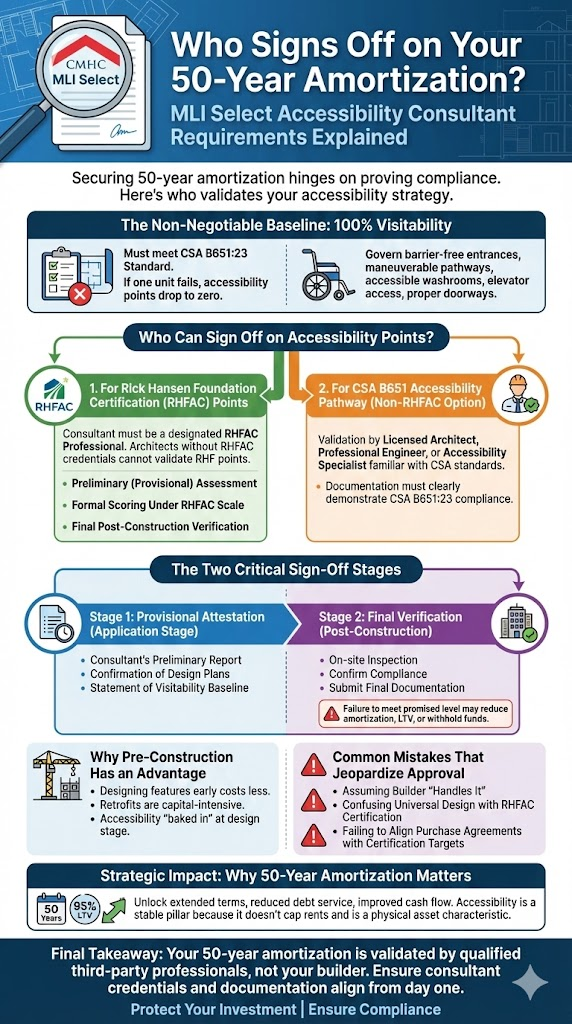
MLI Select Accessibility Consultant Requirements Explained
Securing a 50-year amortization under the Canada Mortgage and Housing Corporation (CMHC) MLI Select program is not simply about hitting a points threshold; it is about proving compliance.
When pursuing accessibility points, particularly through Rick Hansen Foundation certification, your financing hinges on one critical question:
Who is qualified to sign off on your accessibility strategy?
The answer directly impacts whether your application is approved, delayed, or rejected.
This guide breaks down exactly who can validate your accessibility points, what credentials they must hold, and how to structure your Alberta project to protect your 50-year amortization approval.
Why Accessibility Consultants Matter in MLI Select
Under CMHC’s MLI Select framework, accessibility is one of three core pillars (alongside energy efficiency and affordability). To earn up to 30 points in the accessibility category, you must demonstrate third-party verification.
CMHC does not accept informal assurances.
It requires professional attestation from qualified accessibility experts, and not just any architect or engineer will suffice.
The Non-Negotiable Baseline: 100% Visitability
Before discussing consultant credentials, understand this:
You cannot earn any accessibility points unless 100% of units are visitable.
Visitability must meet the CSA B651:23 standard (Canadian accessibility design standard), which governs:
- Barrier-free entrances
- Maneuverable interior pathways
- Accessible washrooms on the main level
- Elevator access where applicable
- Proper doorway clearances and turning radii
If even one unit fails visitability, your accessibility points drop to zero.
This is the most common reason applications stall.
Who Can Sign Off on Accessibility Points?
1. For Rick Hansen Foundation Certification (RHFAC) Points
If you are pursuing points through the Rick Hansen Foundation Certification pathway, the consultant must be:
A designated RHFAC Professional (RHFAC-P).
The Rick Hansen Foundation issues this designation and requires specialized training in its rating system.
A general architect, designer, or building technologist without RHFAC credentials cannot validate RHF certification points for CMHC.
What the RHFAC Professional Provides:
- Preliminary (provisional) assessment at the application stage
- Formal scoring under the RHF Accessibility Certification scale
- Final post-construction verification
- Official documentation required by CMHC
2. For CSA B651 Accessibility Pathway (Non-RHFAC Option)
If pursuing accessibility without RHFAC certification (for example, achieving 100% universal design), CMHC may accept validation from:
- A licensed architect
- A professional engineer
- An accessibility specialist familiar with CSA standards
However, documentation must clearly demonstrate compliance with CSA B651:23.
The burden of proof is strict.
The Two Critical Sign-Off Stages
Stage 1: Provisional Attestation (Application Stage)
When you submit your MLI Select application, you must include:
- Consultant’s preliminary report
- Confirmation that plans are designed to meet the target accessibility level
- Statement that the visitability baseline is satisfied
Without this provisional sign-off, CMHC will not approve your targeted amortization.
Stage 2: Final Verification (Post-Construction)
After construction is complete, your consultant must:
- Inspect the completed building
- Confirm compliance with the certified accessibility level
- Submit final documentation to CMHC
If the building fails to meet the promised level, CMHC may:
- Adjust your amortization terms
- Reduce LTV
- Withhold funds
Your 50-year amortization is conditional until final confirmation.
Why Pre-Construction Projects Have an Advantage
In markets like Calgary and Edmonton, accessibility scoring is significantly easier and cheaper to achieve during pre-construction.
Cost Efficiency Examples:
- Designing 36-inch doorways costs little during drafting.
- Retrofitting door frames in concrete buildings is expensive.
- Planning elevator shafts early is feasible. Adding them later may be impossible.
Retrofits often destroy your capital expenditure budget.
Pre-construction allows accessibility features to be “baked in” at marginal incremental cost.
Common Mistakes That Jeopardize Approval
1. Assuming the Builder “Handles It.”
Builders may hire consultants, but their obligation is to complete construction, not to guarantee your financing approval.
You must verify:
- The consultant is RHFAC-certified (if using that pathway)
- The scoring target matches your MLI Select strategy
- Visitability applies to 100% of units
2. Confusing Universal Design with RHFAC Certification
“Universal design inspired” does not equal certification.
Only formal third-party verification qualifies.
3. Failing to Align Purchase Agreements with Certification Targets
Your purchase contract should include:
- Accessibility certification target
- Consultant engagement confirmation
- Remedies if the certification level is not achieved
Without contractual protection, you assume financing risk.
Why Representation Matters
In pre-construction transactions, buyers who enter sales centers without professional representation rely on marketing language.
An experienced buyer’s agent:
- Requests provisional RHFAC scoring reports
- Confirms visitability compliance in floor plans
- Ensures purchase contracts reflect certification commitments
- Coordinates with lenders to align documentation timelines
Accessibility compliance is technical. Financing timelines are unforgiving.
You need both construction understanding and CMHC familiarity.

Strategic Impact: Why 50-Year Amortization Matters
Under MLI Select, hitting 100 points can unlock:
- 50-year amortization
- Up to 95% Loan-to-Value
- Reduced debt service
- Improved cash flow
- Potential limited recourse
Accessibility is often the most stable pillar because:
- It does not cap rents
- It does not require ongoing tenant income audits
- It is a physical characteristic of the asset
Once certified, your points are secured provided compliance is verified.
Final Takeaway
Your 50-year amortization is not signed off on by your builder.
It is validated by qualified third-party accessibility professionals and ultimately approved by CMHC.
If your consultant lacks proper credentials, or if visitability is incomplete, your financing terms can collapse at the final stage.
Accessibility strategy is not just design; it is capital structure planning.
If you are structuring a multi-family acquisition in Alberta and targeting MLI Select financing, ensure your consultant credentials, documentation timing, and contractual protections are aligned from day one.
Frequently Asked Questions for 50-Year Amortization
Q. Can a regular architect sign off on RHF certification?
No. Only a designated RHFAC Professional can validate Rick Hansen Foundation Certification points for CMHC.
Q. What happens if my building misses the promised accessibility score?
CMHC may reduce your amortization, adjust LTV, or require financial restructuring.
Q. Is visitability required even if I pursue affordability points instead?
Yes. To earn accessibility points specifically, 100% visitability is mandatory.
Q. When should I hire an accessibility consultant?
At the design stage, before permits are finalized. Retrofitting plans later is costly and risky.
Q. Is RHFAC Gold necessary for 50-year amortization?
Not alone. You need sufficient total MLI Select points (typically 100). RHFAC Gold provides up to 30 accessibility points toward that total.
Q. Is accessibility certification easier in Alberta?
Pre-construction opportunities in Alberta’s growth markets often make achieving higher accessibility scores more cost-effective compared to dense retrofit markets.