


You bought a house in a neighborhood in Alberta. The neighborhood looks great.. Then you find out there are rules that say what you can and cannot do with your property. These rules are called covenants. Every property owner in Alberta needs to know what restrictive covenants are. I have owned properties with these covenants. Helped other people deal with them. Today we will talk about how these covenants work in Alberta what they mean for your rights and how to deal with them. By the end of this you will know what to do if you have covenants on your property.
How Restrictive Covenants Work in Alberta
In Alberta a restrictive covenant is a rule that says what you can and cannot do with your land. This rule is written on the property title. The person who developed the neighborhood created this rule. It can last forever. Everyone who owns the property after that has to follow this rule. In Alberta the Land Titles Act says that restrictive covenants are legal long as they make sense and are clear. So what is a covenant in Alberta? It is a way to keep neighborhoods looking nice and consistent. It can also limit what you can do with your property.
The History of Restrictive Covenants in Alberta
Covenants have been around for a long time in Alberta. A time ago developers used them to create fancy neighborhoods. They controlled how big houses could be, what they looked like and even who could live there. Thankfully, some of those rules are no longer allowed. Today restrictive covenants are used to keep property values high. Neighborhoods looking nice. You can find them in neighborhoods that were built in the 1970s and 1980s. Understanding what covenants are helps you understand why your neighborhood looks the way it does. Some of these rules are old. Do not make sense anymore. Some are still important.
How Restrictive Covenants Impact Your Building Plans
If you want to build or fix up your house restrictive covenants can get in the way. They might say how tall your house can be. They might say what your house has to look like on the outside. They might even say what color your roof can be. They might say how big your garage or shed can be. I have seen people have trouble getting building permits because their plans did not follow the covenants. Before you start any project check your property title. Knowing what the restrictive covenants are on your property can save you a lot of trouble.
Restrictive Covenants and Home Businesses
A lot of covenants say you cannot run a business from your house. This means you cannot work from home. This is common in neighborhoods where people live. If you want to start a business from your house check your property title. Some of these rules are very broad. Say you cannot do any kind of business. Others are more specific. I have seen people unable to obtain licenses for daycares, home offices, and even hair salons because of covenants. Knowing what the restrictive covenants are on your property can make a difference in whether you can work from home or not.

How to Enforce a Covenant in Alberta
In Alberta the courts are in charge of enforcing covenants. Any property owner who is affected by someone not following the rules can go to court. Ask for help. The court will look at what happened and how bad it was. The court will also think about whether the rule’s still important. I have seen courts make people follow the rules even when the neighborhood has changed. I have also seen courts say that old rules do not have to be followed. If you want to enforce a covenant you should talk to a lawyer. What is the point of having a covenant if you cannot make people follow it?
Defenses to Covenant Enforcement
There are things you can say if someone tries to enforce a restrictive covenant against you. The rule might be too vague to enforce. The neighborhood might have stopped following the rule. The rule might go against what’s fair. It might be impossible to follow the rule because the neighborhood has changed. I have seen people successfully argue that a rule was not important anymore.. You are not guaranteed to win. You need a lawyer to help you make your case. Knowing how to defend yourself against a covenant can save you a lot of money and trouble.
The Role of the Condominium Act and Restrictive Covenants
In condominiums the Condominium Act is more important than covenants.. Some older condominiums still have restrictive covenants on the title. Newer condominiums follow the act. Have their own rules. The act gives owners freedom. It also has a way to solve disputes. If you own a condominium in Alberta your rights are governed by the act, not the restrictive covenants.. The restrictive covenants might still apply to your unit. So what are covenants in a condominium? They might not be as important as the rules.
Conclusion
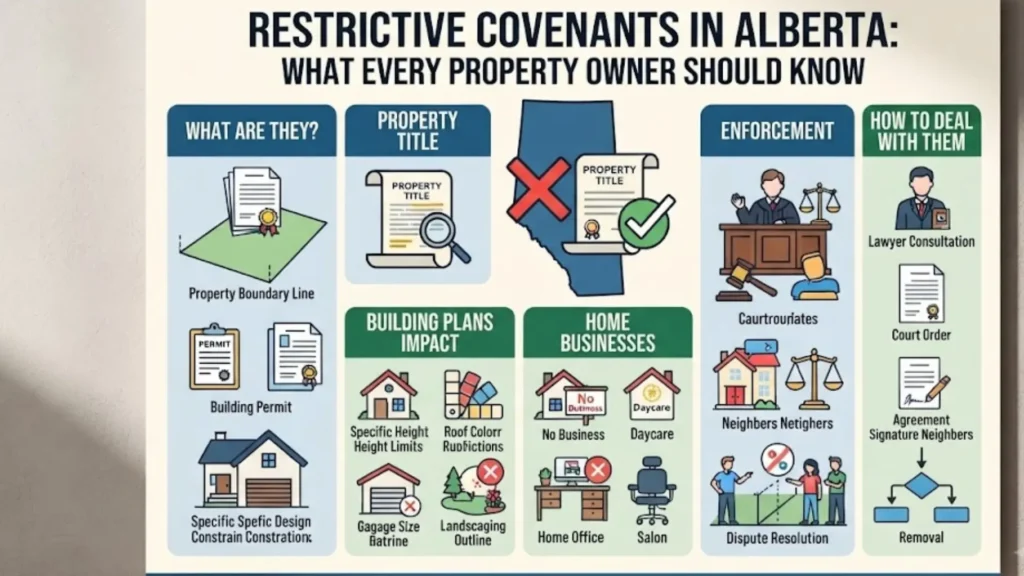
You know about restrictive covenants in Alberta. They are rules on property titles that say what you can and cannot do. They can affect what you build what businesses you can. How you live. They are enforced by the courts. Can be hard to remove. Before you buy a property or start a project check your title. I have seen many people get in trouble because they did not know about the restrictive covenants. Knowing what the restrictive covenants are on your property can be helpful or hurtful. Knowing what you have is the step, to dealing with it.
Frequently Asked Questions (FAQs)
Yes. In Alberta restrictive covenants are legally enforceable long as they make sense and are clear.
Yes,. It is hard to do. You need a court order or an agreement from all the owners. It takes a time and costs a lot of money.
Restrictive covenants do not have an end date. They keep going until someone removes them.
You can try to get it removed but it is not easy. It is better to know about the covenant before you buy the property.
Yes. Restrictive covenants apply to everyone who owns the property no matter when they bought it.

Hafil Perincheeri
Co-Founder & Director
Hafil Perincheeri is an engineer-turned-realtor, investor, and builder based in Calgary, Canada. As Co-Founder and Director of Greencasa, he specializes in home flips, property development, and investment strategies. Since 2019, he has guided clients in home buying, multifamily investing, and financing options like CMHC and MLI Select, ensuring transparent, informed decisions.