


Green Casa Commercial

Get In Touch

Green Casa Popup Form

Latest News & Articles

Discover practical property tips, commercial insights, and industry updates from our experts.

Net Operating Income
Blog, Capital Investment

Net Operating Income vs Gross Operating Income: Which Metric Should Investors Trust?

I have been in your shoes before looking at a property’s financials and feeling completely lost. There are a lot of numbers to look at. Two things you will hear a lot in real estate investing are gross operating income and net operating income in real estate. But here is the thing. They tell different stories about how a property is doing. If you mix them up you could lose money. Gross operating income is the money a property makes while net operating income in estate shows what is left after paying all the bills. In this guide, I will explain what each metric means, how to calculate them and which one you should trust when making investment decisions. By the end you will look at a property’s financials in a way. What Is Gross Operating Income? Let me start with the one. Gross operating income is the money a property makes from all sources minus the money lost to empty units and unpaid rent. Think of it as the money that actually goes into your bank account from the property before you pay any bills. To calculate operating income, you start with the money you would make if every unit were full and every tenant paid on time. Then you subtract the money lost to units and unpaid rent. The formula is: Gross Operating Income = Potential Gross Income- Vacancy and Credit Losses Here is an example. Imagine you own a six-unit building where each unit rents for $2,000 per month. The money you would make if every unit were full is $144,000 per year. But over the year you have one unit empty for two months. That is a loss of $4,000. And one tenant does not pay for a month. That is another $2,000 loss. Your gross operating income would be $144,000 minus $6,000 or $138,000. Gross operating income includes not rent, but also other money the property makes, like parking fees and laundry money. It shows how much money the property can make but it does not tell you if it is profitable. That is where net operating income in estate comes in. What Is Net Operating Income in Real Estate? If gross operating income is the money a property makes net operating income in estate is the money it keeps after paying all the bills. Net operating income in estate is calculated by subtracting all the bills from your gross operating income. The formula is simple: Net Operating Income = Gross Operating Income, Operating Expens But what counts as a bill? The government and real estate professionals include property taxes, insurance, management fees, maintenance and utilities. They do not include mortgage payments, income taxes and big purchases. This is an important difference. Net operating income in estate shows how profitable a property is before considering financing and taxes. Using our six-unit example lets say your annual bills are $42,000. Your net operating income in estate would be $138,000 minus $42,000 or $96,000. The Key Difference: What Each Metric Actually Tells You Here is the part. Gross operating income tells you how money a property can make. Net operating income in estate tells you how much money it actually keeps. Which one should you trust? You should trust both. For different reasons. Gross operating income is useful for comparing properties and understanding how money they can make. Net operating income in real estate is the metric that really matters for deciding if a property is a good investment. Lenders look at operating income in real estate to see if a property can pay its debts. Appraisers use operating income in real estate to determine a property’s value. Here is a scenario that shows why net operating income in estate matters more. Imagine two properties that make the amount of money. Property A has bills of $60,000 so its net operating income in estate is $90,000. Property B has bills of $100,000 so its net operating income in estate is $50,000. Both properties look the same at first. Property A is actually more profitable. If you only looked at operating income you would miss this important difference. The Income Approach to Valuation One of the important uses of net operating income in real estate is to determine a property’s value. The income approach to appraisal calculates a property’s value by dividing its operating income in real estate by a capitalization rate. The capitalization rate is the return on investment that investors expect based on market conditions and property risk. Here is how it works. If a property makes $100,000 in operating income in real estate and the capitalization rate is 5% the property’s value would be $2,000,000. This is why investors focus much on net operating income in real estate. It directly affects a property’s value. Which Metric Should Investors Trust? If you are thinking about investing in a property you should look at operating income in real estate. It is the metric that lenders use to decide if a property is a risk the metric that appraisers use to value properties and the metric that shows if a property can actually make money. Do not ignore gross operating income completely. It is useful for understanding how money a property can make and for comparing properties. A low gross operating income might mean that a property is not making much money as it could be. The real takeaway is this: gross operating income is the starting point but net operating income in estate is the important one. One shows you the money coming in the other shows you the money you actually get to keep. Understanding the difference between operating income and net operating income in real estate is important for any real estate investor. Gross operating income shows how money a property can make while net operating income in real estate shows how much money it actually keeps. Both are important. Net operating income in real estate is the one that really matters for investment 10

Net Operating Income After Tax
Real Estate

Are You Measuring the Wrong Real Estate Return? Here’s What You Should Track Instead

Let me ask you something: when you calculate your property returns are you looking at the right number? Many investors focus on operating income (NOI) and call it a day. But here’s what I’ve learned the way: net operating income after tax (NOIAT) tells a very different story. While traditional NOI shows you operating profitability before taxes and financing operating income after tax reveals what you actually keep after the taxman takes his cut. In this guide I’ll walk you through why net operating income after tax matters how to calculate it and why ignoring it could leave you with a nasty surprise come tax season. Whether you’re a landlord or a seasoned investor understanding this metric is essential for making truly informed investment decisions. What Is Net Operating Income After Tax? Let me start with the basics. Traditional net operating income in estate (NOI) is calculated by subtracting operating expenses from gross operating income. It excludes financing costs and income taxes. This makes NOI a great tool for comparing properties on a basis but it doesn’t tell you what you’ll actually take home. Net operating income after tax (NOIAT) takes things a step further. It accounts for the tax implications of your income giving you a more complete picture of your true returns. While NOI shows you property-level profitability, net operating income after tax shows you investor-level profitability. Think of it this way: NOI is what the property earns. Net operating income after tax is what you keep. In the world of real estate investing what you keep is what really matters. Why Net Operating Income After Tax Matters Here’s the thing about real estate investing: taxes can eat into your returns. If you’re not accounting for them you might think you’re making money when you’re actually just treading water. This is where net operating income after tax becomes essential. Consider two properties with NOI of $100,000. Property A is held in a corporation with a tax rate. Property B is held personally in a tax bracket. The net operating income after tax for Property A might be $85,000, while for Property B it might be $65,000. Both properties look identical on paper. One delivers significantly more after-tax cash flow. This is why net operating income after tax is so valuable. It forces you to consider your tax situation, your holding structure and the true impact of taxes on your investment returns. How to Calculate Net Operating Income After Tax Calculating operating income after tax isn’t as simple as applying your tax rate to NOI. You need to account for factors: Calculate Net Operating Income Start with your net operating income in real estate, Gross Operating Income minus Operating Expenses. Account for Capital Cost Allowance (CCA) CCA is depreciation on your property. Claiming CCA reduces your income but can create recapture when you sell. Your net operating income after tax calculation should reflect the CCA you actually claim. Calculate Taxable Income Your rental income is NOI minus CCA (and any other deductions). This is the amount the CRA will tax. Apply Your Marginal Tax Rate Multiply your income by your marginal tax rate to determine your tax liability. Calculate Net Operating Income After Tax Subtract your tax liability from your tax cash flow to arrive at your net operating income after tax. The Relationship Between NOI and NOIAT It’s important to understand that net operating income after tax builds on NOI rather than replacing it. NOI remains the gold standard for property valuation and lender underwriting.. NOIAT provides the missing piece, the actual after-tax return you can expect. In real estate analysis NOIAT is often used in discounted cash flow (DCF) models to calculate after-tax cash flows. This approach acknowledges that taxes are a cost that must be accounted for when evaluating investment performance. Strategic Tax Planning and NOIAT Understanding operating income after tax isn’t just about calculation; it’s about strategy. The decisions you make about holding structure CCA claims and timing of sales all impact your NOIAT. Holding properties in a corporation can sometimes reduce your tax burden increasing your net operating income after tax. Claiming CCA strategically can defer taxes improving your after-tax returns in the term while potentially creating recapture later. Timing the sale of a property to align with a lower-income year can reduce your tax liability. Increase your NOIAT. Common Mistakes to Avoid I’ve seen many investors make these mistakes when it comes to net operating income after tax. They ignore taxes entirely. Focus only on NOI. They assume their marginal tax rate is the factor that matters. They forget about CCA recapture when projecting returns. They don’t consider the impact of holding structure on after-tax returns. The reality is that net operating income after tax requires planning and professional advice. A good accountant who understands estate can help you structure your investments to maximize your after-tax returns. Conclusion: Net operating income after tax is the metric that reveals your real estate returns. While traditional NOI shows you operating profitability NOIAT shows you what you actually keep after taxes. For investors about understanding their real returns NOIAT is essential. It forces you to consider your tax situation, your holding structure and the true impact of taxes on your investment performance. Don’t make the mistake of focusing on NOI. Your net operating income after tax is what really matters; it’s the number that ends up in your pocket. Talk to a tax professional who understands estate develop a strategy that maximizes your after-tax returns and make investment decisions based on what you’ll actually keep. Frequently Asked Questions (FAQs) What is net operating income after tax? Net operating income after tax (NOIAT) is the profit a rental property generates after accounting for income taxes. It represents what the investor actually keeps after the CRA takes its share.   How is NOIAT different from NOI? NOI measures operating profitability before taxes and financing. Net operating income after tax accounts for the tax implications of income providing 10

Capital Cost Allowance
Blog, Real Estate

Capital Cost Allowance: The Smart Landlord’s Guide to Tax Savings and Avoiding Costly Mistakes

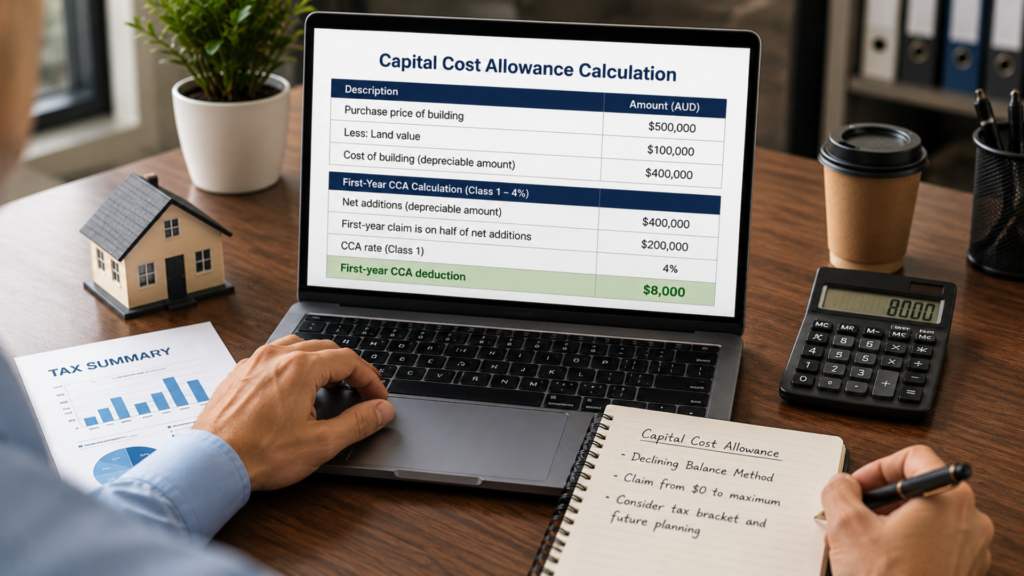
When you look at your property tax return do you ever wonder if you are leaving money on the table? I have been in that situation. The truth is, understanding Capital Cost Allowance is a very powerful tool for Canadian landlords. Whether you own a rental property or a big portfolio of apartment buildings Capital Cost Allowance lets you deduct the depreciation of your rental property over time. This reduces your income and puts more money back in your pocket.. Here is the thing. Claiming Capital Cost Allowance is not as simple as just filling in a number. If you get it wrong you could face problems like recapture or audits. In this guide I will walk you through everything you need to know about Capital Cost Allowance. What Is Capital Cost Allowance? Let me explain this in simple terms. Capital Cost Allowance is like depreciation. It is a deduction that lets you recover the cost of items like your rental building, appliances, and equipment over their useful lives. Think of it this way: your rental property does not stay in condition forever. Roofs wear out appliances break down. Buildings get old. The government recognizes this reality by allowing you to deduct a portion of your propertys cost each year. You need to know that the Capital Cost Allowance applies only to the building itself, not the land. When you buy a property you must decide how much of the purchase price is for the land and how much is for the building. Only the building part qualifies for Capital Cost Allowance. Also claiming Capital Cost Allowance is optional. You do not have to claim the amount. In fact many landlords choose to claim nothing at all depending on their tax situation. How Capital Cost Allowance Is Calculated The calculation for Capital Cost Allowance uses the declining balance method. This means your Capital Cost Allowance claim is based on the remaining undepreciated capital cost of your asset. Here is how it works. Lets say you buy a building for $500,000 with $100,000 for the land and $400,000 for the building. If your building falls into Class 1, the annual rate is 4%. In the year you would typically be eligible to claim Capital Cost Allowance on only half of your net additions. So your first-year Capital Cost Allowance would be calculated on $200,000 at 4% giving you a deduction of $8,000. Here is where it gets important. You can claim any amount from zero up to the maximum. If you are in a tax bracket claiming the maximum Capital Cost Allowance might make sense. If you are already in a bracket or have other deductions you might want to claim less to preserve your undepreciated capital cost for future years. CCA Classes: Which One Applies to Your Property? One of the confusing things about Capital Cost Allowance is figuring out which class your property belongs to. The government groups things into classes each with its own depreciation rate. Here are the common classes for rental properties: Class 1: This is the common class. Most buildings fall into Class 1 regardless of what they’re made of. Class 3:  Buildings made of brick, stone or concrete typically fall into this class. Class 6: Wood-frame. Structures made of galvanized iron belong here. Class 8: This class covers things like furniture, appliances and equipment. Class 50: Computer equipment and systems software fall into this class. Each rental building that costs than $50,000 must be in its own separate Capital Cost Allowance class. This ensures that when you sell the property all previously claimed Capital Cost Allowance is properly taken care of. The Half-Year Rule: What You Need to Know The half-year rule is one of those Capital Cost Allowance details that catches landlords off guard. In the year you buy a property you can usually claim Capital Cost Allowance on only one-half of your net additions to a class. For example if you buy a building for $400,000 in December you would not be able to claim Capital Cost Allowance on the $400,000 in that tax year. Instead you would calculate your Capital Cost Allowance on $200,000 at the rate. CCA Recapture: The Hidden Trap Every Landlord Must Understand Here is where Capital Cost Allowance gets really interesting. And potentially dangerous. Capital Cost Allowance is not a tax deduction. It is a deferral.. When you sell your rental property that deferral can come back to bite you. Recapture happens when you sell a property for more than its capital cost. The Capital Cost Allowance you claimed over the years gets added back to your income in the year of sale. This is taxed as income at your full marginal rate. Not as a capital gain. Let me give you an example. You buy a building for $400,000. Claim $60,000 of Capital Cost Allowance over several years, leaving an undepreciated capital cost of $340,000. You later sell the building for $400,000. The difference between your undepreciated capital cost and the sale proceeds is $60,000. That entire amount is recaptured and fully taxable. The New Accelerated CCA for Purpose-Built Rental Housing Here is some news for developers and investors. The government introduced an increase in the Capital Cost Allowance rate from 4% to 10% for eligible new purpose-built residential rental buildings. If you are building rental housing this is a big deal. A 10% Capital Cost Allowance rate versus 4% means larger deductions in the early years of ownership. Strategic Tips for Maximizing Your Capital Cost Allowance Based on what I have learned here are my top tips for making Capital Cost Allowance work for you: Consider your plans: If you plan to hold the property term claiming Capital Cost Allowance now might make sense. Do not. Increase a loss. You cannot use Capital Cost Allowance to create or increase a loss. Keep classes for each building. If you own properties make sure each building is in its own separate Capital Cost Allowance class. Document everything. The government requires you 10

Best Property Management Company in Calgary
Blog, Real Estate

Reclaim Your Time: How the Right Property Manager Pays for Itself in Calgary

Let me be honest with you, managing properties in Calgary can be hard. I have been there, dealing with tenant calls at midnight arranging repairs and trying to get rent payments while trying to build my collection. At some point every investor asks the question: should I hire a property management company? Finding the property management company Calgary has to offer can change your investment experience from difficult to smooth. Whether you are a landlord with a single property or an experienced investor with a growing collection, the right property management company Calgary can save you time, money and problems. In this guide I will walk you through what to look for in a property manager review Calgary companies and help you decide if professional management is right for your situation. Why Calgary Is One of Canada’s Best Rental Markets Before we dive into choosing a property manager lets talk about why Calgary’s such an attractive market for investors. Calgary offers population growth driven by people moving from more expensive cities like Vancouver and Toronto. The city has rental demand because of an economy that includes energy, technology and finance. Perhaps importantly Alberta has no provincial rent control giving investors more power to set rents based on market rates. These factors make Calgary one of the landlord-friendly cities in Canada. But with opportunity comes complexity; managing properties here requires knowing rules, market trends and tenant expectations. That is where a professional property management company in Calgary can make a difference. What Does a Property Management Company Actually Do? A good property management company Calgary handles more than just collecting rent. Here is what you can expect from full-service management:  Marketing and leasing: Creating listings showing properties and checking tenants. Rent collection: Using safe online payment systems and following up on late payments. Maintenance and repairs: Working with trusted contractors and handling emergencies around the clock Financial reporting: Giving monthly statements annual budgets and documents ready for taxes Tenant relations: Handling complaints enforcing leases and solving conflicts Property inspections: Checking properties regularly to find issues early Legal compliance: Making sure your property meets all local rules and safety standards Some companies go even further offering planning for capital, managing projects and even developing new properties. The right property management company Calgary becomes your partner in growing your investment, not a service provider. Top Calgary Property Management Companies in 2026 Based on industry recognition, customer feedback and years of experience here are some of the best property management company Calgary options in 2026. Equium Group Equium Group has been named Southern Albertas Top Property Management Company for seven years in a row by the Consumer Choice Award. Founded in Calgary in 2011 Equium is an integrated real estate organization that works with condominium, residential and commercial properties. Their current portfolio of properties under management is worth over $6 billion across 22.2 million feet. Equium manages over 8% of all condominiums in Calgary, where than 45,000 Calgarians live, work and play in Equium-managed properties. Their condominium corporations under management range from 2 units to 800 units covering than 20,500 units. The company has been recognized in Canada’s Growing Companies by Macleans Magazine, Canadian Business Magazine, The Financial Times and The Globe & Mails Report on Business Magazine. With 14 years of experience and 185 employees Equium has won 35 awards. Offers 24/7 emergency support. Citysearch Rental Network Inc. Citysearch Rental Network Inc. Is a family-owned business with 24 years of experience. They manage properties of all sizes for owners and investors leasing 5,278 properties and counting. Their services include property management, leasing and corporate relocation services. A Property Manager at Citysearch typically manages 100-200 properties and the company is accredited by the Better Business Bureau with A+ ratings. They aim to respond to all communication within 24 hours during business days. CEO Lisa Hamielec leads an award-winning team focused on increasing the value of properties while improving the lifestyle of the communities they manage. They work extensively with property owners and employees moving to Calgary seeking accommodation. Power Properties Power Properties was named Top Choice Property Management Company of 2025 which’s the third time they’ve received this award. Founded in 1980 Power Properties has been offering easy property management services to property owners, property investors and non-residents with homes in Calgary for over 40 years. Their full-service property management includes everything from move-in to move-out. Power Properties has a 4.2-star rating with 709 reviews showing their dedication to customer happiness. What to Look for in a Property Management Company Finding the property management company Calgary for your specific needs requires looking beyond the marketing materials. Here is what I suggest evaluating: Experience and history  How long have they been around? Do they specialize in your type of property (commercial condominium)? A company that manages 20,000+ units has skills than one managing 100 properties. Fee system  Most companies charge a percentage of rent usually between 8-12%. Some charge fees for leasing, inspections or maintenance coordination. Ask for a list of fees upfront. Quick response  How fast do they answer questions? Do they offer 24/7 help in emergencies? The quality of a property management company Calgary is often judged by how they handle problems. Tenant screening method The best companies have screening including credit checks, checking jobs and looking at rental history. This protects you from tenants. Maintenance network  Do they work with contractors? What is their speed for emergency repairs? A good property management company Calgary has relationships with tradespeople who put their clients first. Technology and reports Do they offer systems for owners and tenants? Can you access money reports repair requests and lease documents easily? Modern property management depends a lot on technology. Red Flags to Watch For Here are warning signs that a property management company Calgary might not be right for you: Reviews and Complaints  Check sites like BBB and review platforms. Companies with unresolved complaints especially about tenant interactions or money matters should be avoided. Unclear charges  If 10

Form T776
Market Updates

Form T776: The Canadian Landlord’s Essential Tax Guide for 2026

Imagine this: tax season is here. You are sitting at your kitchen table with papers, bank statements and rental agreements feeling very stressed. I have been in the situation as you right now. I know how hard it can be. Here’s the truth: learning about CRA form T776 is very important for every landlord who wants to be in the right with the CRA. Whether you are renting a basement apartment, a downtown condo or a vacation property through Airbnb the T776 guide is your friend for reporting rental income correctly and getting all the deductions possible. The rules have changed a lot in 2025 and 2026. Being up to date is more important than ever. In this guide I will explain everything you need to know about Form T776, from what it does and how to fill it out to the new short-term rental rules and the mistakes that could lead to a CRA audit. When you finish reading you will feel sure about handling your rental income tax Canada duties like a person. Understanding Form T776: Your Rental Income Report Card The T776 form, which is called the Statement of Real Estate Rentals, is your report to the Canada Revenue Agency about your rental property activities. Think of it as your check-in with the CRA about your rental business. Every single dollar you get from renting property, whether its monthly rent, parking fees or money from short-term platforms, needs to be on this form. The T776 goes with your T1 tax return and forms the base for figuring out your rental income tax Canada duties. Basically the form decides your rental income by taking away your eligible expenses from your total rental money. Whether you are a landlord with one unit or managing a collection the T776 changes to fit your situation. Keep in mind that each property needs its report and you should keep your records for at least six years in case the CRA asks. What Rental Income Needs to Be on Form T776? This is where many landlords make mistakes: income tax Canada includes more than just the monthly rent. According to the Income Tax Act, you need to report every payment you get from your property. This includes rent from both home and business tenants, cash from short-term rentals on sites like Airbnb and VRBO, parking fees if you charge them separately or include them in the lease, money from deposits when a tenant ends the lease early and payments when a lease is canceled. There is one exception: money held as security deposits in trust isn’t income when you get it. It only becomes taxable if you use the deposit for rent or keep it for damage. All of these sources of income go on Form T776, which you submit with your T1 return. Important New Short-Term Rental Rules You Can’t Miss If you are renting on Airbnb, VRBO, or any short-term site 2025 had changes that each landlord must know. The government now requires you to separate short-term and long-term rental income and costs on Form T776. But here’s the thing: if short-term rentals are not allowed in your province or city, or if they are allowed but you don’t have the license or registration you can’t claim any costs against your short-term rental income. This means you will pay tax since you report the income without being able to take deductions. The new Form T776 now asks property owners to break down income and costs for term and short-term rentals. The CRA is also planning an audit plan that focuses on short-term rentals to make sure income is reported correctly and to stop claims that are not allowed. If you are running a short-term rental you must have a bookkeeping system to track your income and costs separately. Even if you are following all the rules the government still wants this separation on your tax return. Deductible Rental Expenses: What Can You Claim? The real tax benefit of owning property is the deductions, and knowing what you can claim is important for reducing your rental income tax burden in Canada. The CRA lets you deduct costs that help you get rental income. Here is your full list of deductions: Advertising. Costs for online ads, signs, flyers, and other promotional items Insurance. Fees for landlord or rental insurance policies Mortgage interest. Only the interest part of your mortgage payment (the part you pay back is not deductible) Maintenance and repairs. Work to keep the property in good shape Property management fees. Money paid to a company that manages your property Vehicle costs. Trips to get rent checks, repairs or manage the property (needs detailed mileage logs) Home office. If you run your rentals from a home area you can claim a part of those costs Accounting costs. Costs for writing a lease solving tenant issues or doing your taxes Property taxes. Taxes paid to the city during the year Salaries and wages. Money paid to a superintendent or property manager Utilities. Heat, electricity, water when included in the rent Capital Cost Allowance (CCA). Depreciation on the building A common mistake is claiming the full mortgage payment. Only the interest is allowed. If your payment is $2,400 and $900 is for the principal you can deduct $1,500 as interest. Repairs vs. Capital Improvements: Where to Draw the Line This difference causes a lot of problems for landlords. Often leads to big mistakes. The CRA has a line between an expense that is deductible this year and a cost that is part of the property’s cost and then depreciated. A repair brings the property back to its working state, fixing a roof leak replacing a broken furnace painting walls. These costs can be deducted away. An improvement makes the property better than it was before, finishing a basement adding a bathroom installing central air where there was none. These must be added to the propertys cost. Then depreciated over time usually under CCA 10

Market Updates

Calgary’s Housing Market in 2026: A New Era for Homebuyers and Investors

If you have been watching Calgary’s housing market from a distance waiting for the time to get involved here is some information that may surprise you: the Calgary housing market is going through its biggest change in years. After a period of rising prices and intense competition 2026 has brought a time of balance that is creating possibilities for both homebuyers and investors. With empty homes supply finally matching demand and new ways to get financing changing the way people invest in multi-family properties the Calgary housing market is changing the way things work. In this guide I will explain what is actually happening in the real estate scene of Calgary now why it is important for your plans and how you can get ready to take full advantage of this changing situation. Basement Renovation Cost in Vancouver: The Quick Reference Let me describe what is happening. After years of helping sellers the Calgary housing market has clearly moved toward balance in 2026. Fewer people moving into the area is meeting more homes being built, which has been happening for the three years. The Calgary Real Estate Board (CREB) expects sales to reach 22,500 by the end of the year. Even though that number is a little lower than in 2025 it is still a market. What does balance really mean for you? More choices, less stress and more space to talk about prices. The apartment condominium part of the market is now helping buyers, which is making prices drop more. At the time 26,000 units are being built and will be ready in the coming years, which adds a lot of homes to the Calgary housing market. For homebuyers this means you are not having to fight with twenty people for each house. For investors this means chances to get properties at prices. What is Causing the Change in Calgary’s Housing Market? Several things are changing the Calgary housing market in 2026. Knowing about them is important to make good choices. More Houses Being Built Calgary has seen a building boom. The number of high-density apartment-style homes built has increased the number of homes a lot. Much of this increase is in ownership apartments. Even though the number of homes being built is expected to go down this year it will take time to get rid of the extra homes already on the way. This large number of homes is making prices go down for apartments and row-style homes. Less Demand At the time, the number of people coming from other countries has dropped a lot, which is making demand from renters slow down just as new buildings are going up. This is making the number of homes go up and making rents go down. Many landlords are now giving deals to keep the people who are already living in their homes. This has made the demand from investors go down which is making the number of apartment sales go down quickly. Two Different Markets Here is something about the Calgary housing market right now,it is acting like two separate markets. The apartment condominium part of the market is seeing prices drop and helping buyers. The market for detached homes has a different story. Even though the number of sales has gone down the number of homes for sale has also gone down. The conditions are still on the lower side of balanced with some places having sellers market conditions. Detached homes are expected to have the demand and the most activity in sales. Opportunities for Homebuyers in Calgary’s Housing Market If you want to buy a house in Calgary 2026 has some chances. First-time buyers are finding options in the suburbs buying single-family homes for about $800,000. People who are moving up are looking at homes that range from $800,000 to $1,300,000. The Calgary housing market is also seeing a change in how people’re making purchases. More houses are being built in new and resale categories, which is making the resale market more balanced. This means the usual increase in prices that happens in the season is not happening, which gives you time to decide without the stress of constant competition. Royal LePage predicts that the average price of a home in Calgary will go up 2.5 percent by the end of 2026, which’s a little higher than the national prediction of 2.0 percent. This small increase shows that the market is stable and not changing a lot, good news for people who want to get into the Calgary housing market without worrying about paying too much right away. Opportunities for Investors in Calgary’s Housing Market For investors the Calgary housing market has a set of chances. The rental market is full. Investors are not very active in this area right now. That full market creates chances for those who are willing to look beyond single-family homes. The multi-family area is where it gets really exciting. Calgary’s strong demand for rentals, which is driven by people coming to the city and an economy that has energy, tech and finance as big parts is still supporting investments in multi-unit places. The city’s new rules about how land can be used have made it easier to build dense rental housing in places where there is already a lot of land. One of the tools for investors in the Calgary housing market right now is the CMHC MLI Select program. This program lets people who qualify buy buildings with five or more units with as little as 5 percent down and up to 50 years to pay it back. I will go into detail about this program in our next blog but to say it simply it is changing what is possible for people who want to invest in multi-family homes in Calgary. The Rental Market: What It Means for You The Calgary rental market has changed a lot. The number of homes is expected to be 5.7 percent in 2026 which is higher than it has been in the 10

Basement Renovation
Construction Consultancy

Basement Renovation Cost in Vancouver: Your Complete 2026 Homeowners Guide

I am guessing you have been looking at that basement for years thinking about what it could be. A cozy family room, a home gym or maybe even a legal suite that generates income. But every time you start researching you hit the problem: what is the actual basement renovation cost in Vancouver going to be? I have been there. The truth is, Vancouver basements are different from other places. With our weather, older houses and strict city rules the average cost to finish a basement here can vary a lot. In 2026 you are looking at from $40,000 for a basic livable space to over $200,000 for a full legal suite with seismic upgrades. In this guide I will walk you through 2026 pricing break down what drives costs up and help you figure out exactly what your average basement renovation cost should be. Lets turn that dream into a plan. Basement Renovation Cost in Vancouver: The Quick Reference Before we dive into the details let me give you the picture. Based on 2026 Vancouver projects here’s what you can expect to pay across different scopes: Scope Whats Included Cost Range Basic finishing Framing, insulation, drywall, flooring, lighting $40,000–$65,000 Recreational/family room Wet bar, media setup, premium finishes $60,000–$90,000 Legal secondary suite Full suite to City specs $70,000–$100,000 Full suite + seismic + underpinning Lowering slab, full compliance $120,000–$200,000 Basement apartment (premium) Full legal suite, entrance $85,000–$130,000 These ranges include labor, materials, permits and overhead, but not design fees or structural engineering where required. A typical basement renovation cost in Vancouver falls between $60,000 and $100,000 for a finished basement, with budgets spanning $20,000 to over $150,000 depending on your goals. Why Vancouver Basements Are Uniquely Expensive I need to be honest with you: Vancouver basements are not the same as basements in other cities. Several local factors make basement renovation costs here uniquely high. Ceiling Height: The Hidden Cost Driver Older Vancouver homes and there are many of them in East Van, Kitsilano, Grandview-Woodland, and Mount Pleasant were built with basements intended for equipment and storage. Ceiling heights of 5’10” to 6’8″ are common. That’s not enough for a suite and it’s uncomfortable for daily living. Gaining ceiling height means either lowering the slab or benching, both operations. This alone can add $18,000 to $65,000 to your basement renovation cost. Moisture Management: Vancouver’s Rainfall Reality Vancouver gets a lot of rain 1,150mm every year. Basements here accumulate moisture that basements in cities simply don’t experience. Waterproofing is necessary. Interior drainage systems cost $3,000–8,000. Exterior waterproofing runs $10,000–25,000. Addressing water issues after drywall is installed costs 3 to 5 times more. You want to get this right the first time. Breaking Down the Average Basement Renovation Cost by Project Type Basic Finishing: $30,000 – $55,000If you just want a recreation room, home office, or home gym without adding plumbing, basic finishing is your most affordable option. This includes framing, insulation, drywall, flooring, paint, and standard lighting. No plumbing permit is required if you’re not adding fixtures, which keeps both costs and timelines down. Average basement renovation cost for this scope runs $30,000–$55,000. Mid-Range with Bathroom: $55,000 – $90,000Adding a bathroom increases both functionality and cost. This scope includes finishing with a 3-piece bathroom, upgraded flooring, LED pot lights, built-in storage and a wet bar or kitchenette rough-in. Adding a basement bathroom costs $8,000–$15,000 depending on the complexity of plumbing runs. This is the popular scope for Vancouver families adding a media room or family lounge. The average basement renovation cost here is $55,000–$90,000. Legal Secondary Suite: $85,000 – $150,000This is where the basement renovation cost in Vancouver really goes up, but where the returns can be substantial. A legal suite requires an entrance, full kitchen, bathroom, bedroom with egress windows, fire separation, and all code-required features. The City of Vancouver requires: Minimum ceiling height of 6’8″ in living areasEgress windows in every sleeping room ($4,000–$8,000 per window), 45-minute fire separation between suite and main dwelling, hardwired smoke alarms, separate heating zoneThe average basement renovation cost for a legal one-bedroom suite is $85,000–$150,000, with two-bedroom or premium suites reaching $130,000–$200,000+. Permit approval alone takes 6 to 12 weeks. What Drives Up Your Basement Renovation Cost? Beyond the basics, several factors can significantly increase your basement renovation costs. Underpinning (lowering the slab): $30,000–$80,000 Rewiring: +$10,000–$25,000 Asbestos remediation: +$5,000–$25,000 Separate hydro metering: +$2,500–$5,000 Egress window installation: $4,000–$8,000 per window Exterior waterproofing: $10,000–$25,000 Many older Vancouver homes also need electrical service upgrades to handle the added load of a suite or basement development. Permits: What You Need and What They Cost Here’s something you can’t skip: permits. Any structural electrical, plumbing or HVAC work requires a building permit in all Metro Vancouver municipalities. For a basement suite you’ll need: Floor plans (existing and proposed) drawn to scale showing suite layout, egress windows, smoke detectors, CO detectors and fire separations. Proof of lot zoning that permits suite (most RS-1 lots in Vancouver now permit one suite) Plumbing permit for kitchen and bathroom; I’m electrical permit for suite electrical (separate meter or sub-panel) Heat source documentation permit costs typically range from $1,500 to $5,000 for a basement suite and the approval timeline is 6–12 weeks. Factor this into both your budget and your timeline. Is It Worth It? The ROI Story Here’s the news. Despite the basement renovation cost in Vancouver the returns can be exceptional. A finished basement in Metro Vancouver adds $80,000 to $200,000 in resale value. A legal suite generates $1,800–$2,800 per month in income. With construction costs at $85,000–$125,000 the payback period is 4–6 years, than most investment alternatives. The ROI on a basement suite is among the best in Vancouver with some projects delivering 18–30% annual returns before expenses. When you consider that average home prices in Vancouver neighborhoods exceed $1.5 million unlocking your basements potential isn’t just a renovation, it’s a wealth-building strategy. Conclusion Understanding your basement renovation cost in Vancouver is the step toward making your basement dreams 10

Vancouver Basement
Market Updates

From Dark to Dollars – Turning Your Vancouver Basement Into Cash in 2026

I have walked down into my dusty basement and thought, “There is money sitting right underneath my feet”. The truth is, in Vancouver’s competitive real estate market, that unfinished space could be your most valuable asset. To get that value you need to do more than just put up some drywall. In 2026 the cost of a basement renovation in Vancouver can range from $40,000 for a finish to over $200,000 for a premium legal suite. The difference between wasting money and making money comes down to having a plan. In this guide I will show you how to get the most out of every dollar you spend whether you are building a family room, a suite or something in between. Lets turn that basement into cash. Basement Renovation Cost in Vancouver: The Quick Reference Before we dive into the details let me give you the picture. Based on 2026 Vancouver projects here’s what you can expect to pay across different scopes: Scope Whats Included Cost Range Basic finishing Framing, insulation, drywall, flooring, lighting $40,000–$65,000 Recreational/family room Wet bar, media setup, premium finishes $60,000–$90,000 Legal secondary suite Full suite to City specs $70,000–$100,000 Full suite + seismic + underpinning Lowering slab, full compliance $120,000–$200,000 Basement apartment (premium) Full legal suite, entrance $85,000–$130,000 These ranges include labor, materials, permits and overhead, but not design fees or structural engineering where required. A typical basement renovation cost in Vancouver falls between $60,000 and $100,000 for a finished basement, with budgets spanning $20,000 to over $150,000 depending on your goals. Why Vancouver Basements Are Uniquely Expensive I need to be honest with you: Vancouver basements are not the same as basements in other cities. Several local factors make basement renovation costs here uniquely high. Ceiling Height: The Hidden Cost Driver Older Vancouver homes and there are many of them in East Van, Kitsilano, Grandview-Woodland, and Mount Pleasant were built with basements intended for equipment and storage. Ceiling heights of 5’10” to 6’8″ are common. That’s not enough for a suite and it’s uncomfortable for daily living. Gaining ceiling height means either lowering the slab or benching, both operations. This alone can add $18,000 to $65,000 to your basement renovation cost. Moisture Management: Vancouver’s Rainfall Reality Vancouver gets a lot of rain 1,150mm every year. Basements here accumulate moisture that basements in cities simply don’t experience. Waterproofing is necessary. Interior drainage systems cost $3,000–8,000. Exterior waterproofing runs $10,000–25,000. Addressing water issues after drywall is installed costs 3 to 5 times more. You want to get this right the first time. Breaking Down the Average Basement Renovation Cost by Project Type Basic Finishing: $30,000 – $55,000 If you just want a recreation room, home office, or home gym without adding plumbing, basic finishing is your most affordable option. This includes framing, insulation, drywall, flooring, paint, and standard lighting. No plumbing permit is required if you’re not adding fixtures, which keeps both costs and timelines down. Average basement renovation cost for this scope runs $30,000–$55,000. Mid-Range with Bathroom: $55,000 – $90,000 Adding a bathroom increases both functionality and cost. This scope includes finishing with a 3-piece bathroom, upgraded flooring, LED pot lights, built-in storage and a wet bar or kitchenette rough-in. Adding a basement bathroom costs $8,000–$15,000 depending on the complexity of plumbing runs. This is the popular scope for Vancouver families adding a media room or family lounge. The average basement renovation cost here is $55,000–$90,000. Legal Secondary Suite: $85,000 – $150,000 This is where the basement renovation cost in Vancouver really goes up, but where the returns can be substantial. A legal suite requires an entrance, full kitchen, bathroom, bedroom with egress windows, fire separation, and all code-required features. The City of Vancouver requires: Minimum ceiling height of 6’8″ in living areas Egress windows in every sleeping room ($4,000–$8,000 per window), 45-minute fire separation between suite and main dwelling, hardwired smoke alarms, separate heating zone The average basement renovation cost for a legal one-bedroom suite is $85,000–$150,000, with two-bedroom or premium suites reaching $130,000–$200,000+. Permit approval alone takes 6 to 12 weeks. What Drives Up Your Basement Renovation Cost? Beyond the basics, several factors can significantly increase your basement renovation costs. Underpinning (lowering the slab): $30,000–$80,000 Rewiring: +$10,000–$25,000 Asbestos remediation: +$5,000–$25,000 Separate hydro metering: +$2,500–$5,000 Egress window installation: $4,000–$8,000 per window Exterior waterproofing: $10,000–$25,000 Many older Vancouver homes also need electrical service upgrades to handle the added load of a suite or basement development. Permits: What You Need and What They Cost Here’s something you can’t skip: permits. Any structural electrical, plumbing or HVAC work requires a building permit in all Metro Vancouver municipalities. For a basement suite you’ll need: Floor plans (existing and proposed) drawn to scale showing suite layout, egress windows, smoke detectors, CO detectors and fire separations. Proof of lot zoning that permits suite (most RS-1 lots in Vancouver now permit one suite) Plumbing permit for kitchen and bathroom; I’m electrical permit for suite electrical (separate meter or sub-panel) Heat source documentation permit costs typically range from $1,500 to $5,000 for a basement suite and the approval timeline is 6–12 weeks. Factor this into both your budget and your timeline. Is It Worth It? The ROI Story Here’s the news. Despite the basement renovation cost in Vancouver the returns can be exceptional. A finished basement in Metro Vancouver adds $80,000 to $200,000 in resale value. A legal suite generates $1,800–$2,800 per month in income. With construction costs at $85,000–$125,000 the payback period is 4–6 years, than most investment alternatives. The ROI on a basement suite is among the best in Vancouver with some projects delivering 18–30% annual returns before expenses. When you consider that average home prices in Vancouver neighborhoods exceed $1.5 million unlocking your basements potential isn’t just a renovation, it’s a wealth-building strategy. Conclusion Understanding your basement renovation cost in Vancouver is the step toward making your basement dreams a reality. Whether you’re planning a rec room, a mid-range family space with a bathroom or a full legal suite 10

Multifamily and New Builds

Unlock 5% 50-Year Amortization: Your 2026 Blueprint for MLI Select Success

Do you want to buy a big apartment building but think you need a lot of money for a down payment? I used to think that until I found out about the CMHC MLI Select program. In 2026 getting the MLI Select points is the best way for investors to buy multi-family properties with just 5 percent down and loans that can be paid back over 50 years. The program uses a points system with three parts: affordability, energy efficiency and accessibility. If you get 100 points you get the deal. 95 Percent loan-to-value financing, 50-year amortization and a 30 percent discount. In this guide I will show you how to get the MLI Select points, what you need to do to reach each level and how the September 30, 2026 deadline affects your plan. Lets unlock the potential of this great program together. . What Makes MLI Select So Powerful? Let me tell you why this program is so good. Imagine you want to borrow money to buy a $10 million apartment building. The bank would usually want 25 to 30 percent down. That’s $2.5 to $3 million in cash. With MLI Select you can get a loan with 5 percent down. That’s $500,000 for the same building. The 50-year amortization means your monthly payments are much lower so you have money from day one. When you get the MLI Select points you are not just getting a loan. You are changing the way your deal works. The program offers interest rates around 4.25 to 5.00 percent as of April 2026, which is lower than usual commercial loans. The combination of down payments, longer amortization and good rates can make deals work that would not have worked before. Understanding the Three Pathways to Maximum Points The MLI Select points system has three parts. Each one is a way to get the most points. Think of them as three things you can do to reach your goal. You get points for affordability by keeping some units at rents. You get points for energy efficiency by building or fixing up your building to use energy. You get points for accessibility by designing units that’re easy for everyone to use. The minimum score you need is now 50 points, up from 12 points. The three levels of points give you better loans: 50 points gives you 85 percent loan-to-value 40-year amortization and a 10 percent discount. Seventy points gives you 95 percent loan-to-value 45-year amortization and a 20 percent discount. One hundred points gives you the deal: 95 percent loan-to-value 50-year amortization and a 30 percent discount. When you get the MLI Select points every point counts. The difference between 70 and 100 points on a $10 million project can save you around $160,000 to $180,000 in insurance costs. Affordability: The Powerful Way to Get Points Let me be honest with you. The affordability way is often the best way to get the most MLI Select points. It’s the way to get 100 points on its own. CMHC says a unit is affordable if the rent is not than 30 percent of the average renters income in your area. Here’s how the scoring works: if you keep 10 percent of units at rents for 10 years you get 30 points. If you keep 15 percent of units at rents you get 50 points. That’s enough to qualify your project right away. If you keep 25 percent of units at rents for 20 years you get the full 100 points. For investors who want to get the MLI Select points this is often the easiest way. In Calgary, where the renters income is around $77,000 an affordable rent would be around $1,925 per month. In Vancouver, where incomes and rents are higher the math is different. But the idea is the same. The affordability way is a trade-off: you get lower rent on some units but you get a much better loan for the whole building. Energy Efficiency: Going Green to Boost Your Score Energy efficiency is the way to get the most MLI Select points and it can give you up to 50 points. You get points for using energy than the baseline standards. The current standards are the 2015 National Building Code and 2017 National Energy Code. Only until September 30 2026. After that projects have to meet the 2020 standards. The points you get for energy efficiency depend on how much you improve: if you reduce energy consumption by 15 percent you get 20 points. If you reduce it by 25 percent you get 35 points. If you reduce it by 40 percent you get the 50 points. You need to work with an energy advisor to model your building and prove that you met the standards. For investors who want to get the MLI Select points it’s crucial to think about energy upgrades early in the design process. Things like insulation, energy-efficient heating and cooling systems, LED lights, smart thermostats and solar panels can all help you get a higher score. The September 30 deadline makes this important. If you want to qualify under the standards you need to act now. Every month you wait is a month closer to requirements. Accessibility: Designing Units That Are Easy to Use The way to get the most MLI Select points is accessibility, which can give you up to 50 points. Before you can get any accessibility points all your units have to be “visitable”. That means someone can safely enter the unit move around and use the bathroom. Once you meet this standard here’s how the scoring works: if 15 percent of units are accessible you get 20 points. If 15 percent of units are accessible. 85 Percent are designed for everyone or if all units are designed for everyone you get 30 points. You can also get points if you get certified by the Rick Hansen Foundation. A standard certification gets you 20 points and a Gold certification gets 10

Scroll to Top

Compare