
Green Casa Commercial

Get In Touch

Green Casa Popup Form

Blog

Your blog category

Mortgage Insurance
Blog, CMHC MLI Select

Mortgage Insurance Explained: Why It Matters for Your Calgary Investment

Have you ever thought about why some mortgage payments have a fee? That is because of mortgage insurance. Understanding what mortgage insurance is can save you a lot of money on your Calgary investment. In words mortgage insurance is a protection plan that helps the lender if you cannot make your mortgage payments. You need to have this insurance if your down payment is less than 20 percent of the purchase price. I will explain how mortgage insurance works, how much it costs and how it can help you buy a property in Calgary sooner. Let us learn about this part of real estate investing together. What Is Mortgage Insurance? Let me explain it in a simple way. Mortgage insurance is a plan that protects the lender, not you if you cannot make your mortgage payments. You need to have this insurance by law in Canada if you put down less than 20 percent of the purchase price. The insurance cost is calculated based on your mortgage amount. Is usually added to your mortgage. CMHC, Canada Mortgage and Housing Corporation is a known provider but Sagen and Canada Guaranty also offer similar coverage with the same premium rates. Think of it as a fee you pay to buy a property with a down payment. How Much Does Mortgage Insurance Actually Cost? Now let us look at the numbers. In 2026 the insurance cost depends on your payment: 5 percent down: 4.00 percent of the mortgage 10 percent down: 3.10 percent of the mortgage 15 percent down: 2.80 percent of the mortgage For example if you are buying a $400,000 property in Calgary with a 5 percent down payment which is $20,000 your mortgage amount would be $380,000. The mortgage insurance cost would be 4.00 percent of that which’s $15,200. This cost gets added to your mortgage so you would actually be borrowing $395,200 in total. While it may seem like a cost without mortgage insurance you would need $80,000 down instead of $20,000. That is the difference between investing and waiting years to save up. When Is Mortgage Insurance Required? Mortgage insurance is required in Canada for any property purchase with a down payment of less than 20 percent. This applies to purchases up to $1.5 million. For investment properties the rules are a bit different. If you are buying a property with less than 20 percent down you need insurance. However, many investors choose to put down 20 percent or more to avoid the insurance cost. The 2026 Changes: What’s Different This Year? In February 2026, there were changes to the Canadian mortgage insurance rules. The insurance premiums. There were restrictions on how rental income can be counted when qualifying for a mortgage. These changes make it harder to qualify for a mortgage with insurance. CMHC also increased the insurable purchase price to $1.5 million and expanded 30-year amortizations to all first-time homebuyers. If you are considering a Calgary investment property these changes affect both your qualification and your costs. How Mortgage Insurance Protects Your Investment While mortgage insurance protects the lender it also helps you. Without mortgage insurance lenders would require down payments making it hard for people to buy properties. By allowing you to buy with as little as 5 percent down insurance opens doors that would otherwise be closed. For investors this means you can use your money effectively. Of putting $80,000 in one property you could use that money to buy multiple properties with 5 percent down. Over time that is how you can grow your portfolio. Can You Avoid Paying Mortgage Insurance? If you want to avoid mortgage insurance you need to put down at least 20 percent of the purchase price. For a $400,000 property that is $80,000. While the upfront cost is higher, you will save on the insurance cost. Have lower monthly payments. If you are buying a property priced over $1.5 million mortgage insurance is not available so you will need the 20 percent down. For investors the best option is to put down just enough to avoid the insurance cost while still getting into the market. Understanding what mortgage insurance is is essential for any Calgary investor. It is the key to buying with a down payment and in 2026 the rules have changed in ways that affect both your costs and your qualification. The insurance cost ranges from 2.80 percent to 4.00 percent of your mortgage depending on your payment. While it may seem like a cost insurance opens doors that would otherwise be closed allowing you to build your portfolio with less money upfront. Frequently Asked Questions (FAQs) What is mortgage insurance? Mortgage insurance is a protection plan that helps the lender if you cannot make your mortgage payments. It is required when your down payment is less than 20 percent of the purchase price. How much does mortgage insurance cost in 2026? The cost depends on your down payment: 4.00 percent with 5 percent down, 3.10 percent with 10 percent down and 2.80 percent with 15 percent down. Is mortgage insurance required for investment properties? Yes, if you are buying with less than 20 percent down. However, many investors choose to put down 20 percent or more to avoid the insurance cost. What is the maximum insurable purchase price? The maximum insurable purchase price is $1.5 million. Properties over $1.5 million cannot be insured regardless of your payment. What changed with mortgage insurance in 2026? There were changes, including higher insurance premiums and restrictions on how rental income can be counted for qualification. Can I avoid paying mortgage insurance? Yes, by putting down at least 20 percent of the purchase price. For a $400,000 property that is $80,000. Green Casa Co-Founder & Director Linkedin Envelope Instagram Hafil Perincheeri is an engineer-turned-realtor, investor, and builder based in Calgary, Canada. As Co-Founder and Director of Greencasa, he specializes in home flips, property development, and investment strategies. Since 2019, he has guided clients in home buying, multifamily investing, 10

Multi-Family
Blog, Real Estate

Vancouver’s Multi-Family Goldilocks Zone: Why 10–20 Unit Buildings Offer the Perfect Balance of Risk and Reward

Have you ever felt like you’re stuck between two worlds in Vancouver’s real estate market? Small four-plexes feel too limiting. Towering 50-unit buildings seem out of reach for an individual investor. That’s why investing in 10-20 unit buildings is emerging as the sweet spot for savvy investors in 2026. These mid-sized apartment buildings offer enough units to diversify your income and achieve economies of scale, yet still manageable enough for individual investors to acquire and operate. In Vancouvers market correction with vacancy at a 30-year high and cap rates expanding investing in 10-20 unit buildings has become more accessible than ever. In this guide I’ll walk you through why this asset class is gaining traction, what you need to know about Vancouvers unique market dynamics and how to identify the right opportunities in this evolving landscape. Why 10–20 Units Is the Multi-Family Sweet Spot Let me explain why I’m so excited about this particular size range. A four-plex might give you four income streams. One vacancy wipes out 25 percent of your rental revenue. A 10-unit building reduces that risk to 10 percent and a 20-unit building brings it down to 5 percent. That’s income diversification that protects your cash flow. Smaller multi-family properties like four-plexes rely on financing based on your personal income. Once you cross the threshold into five or more units commercial financing kicks in. That’s where CMHC’s MLI Select program becomes a game-changer. The 10–20 unit range is also the accessible tier for individual investors. Transactions in this size range are active with notable sales across Vancouver neighbourhoods in early 2026. You’re not competing with buyers who dominate the 50+ unit space, yet you’re getting many of the same benefits: professional property management becomes cost-effective, and you can spread fixed costs across more units. When you’re investing in 10-20 unit buildings you’re entering a space where individual investors can still compete and win. The Vancouver Market Opportunity Now Vancouver’s multi-family market is undergoing what experts call a “structural recalibration”. The vacancy rate has climbed to 3.7 percent, the highest since 1988, up from 0.9 percent just a few years ago. 24,000 Rental units are expected to be delivered over the next two years. This surge in supply combined with immigration-driven demand has created tenant-friendly conditions. Asking rents in Vancouver have fallen 9.2 percent year-over-year, with average apartment rents sitting at $2,630 per month in 2026, 16.5 percent below the January 2023 peak. But here’s the flip side that smart investors are catching onto: this correction is creating a buyers market in an asset class that has traditionally favoured vendors. Listings of apartment buildings are rising, giving investors options and forcing sellers to compete on price. As one expert noted, “Multifamily has really gone back to its fundamentals”. James Blair of Marcus & Millichap observed that “we’re starting to field a lot of questions from groups out east Ontario, Montreal, Alberta looking at Vancouver as a landing spot for capital”. When you’re investing in 10-20 unit buildings this correction represents a window of opportunity. Understanding Vancouvers Cap Rate Landscape Cap rates are the language of real estate and Vancouvers cap rates tell an interesting story. In Q1 2026 the observed cap rate range for apartment buildings across the City of Vancouver was 3.4 percent to 4.9 percent. A 14-unit Kitsilano walk-up sold at a 3.4 percent cap rate for $5,995,000 ($428,000 per unit) underscoring how location drives value in westside neighbourhoods. Meanwhile a 10-unit Fairview walk-up sold at a yield-oriented 4.9 percent cap rate for $2,895,000 ($289,500 per unit). A 20-unit Grandview-Woodland apartment sold for $5,600,000 ($280,000 per unit). Whats particularly noteworthy is that cap rates have widened by 50 to 100 basis points over the past two years. This expansion means investors are demanding yields to justify purchases. For buyers this creates an opportunity to acquire assets at attractive valuations. While prime Vancouver apartment buildings still trade at 3–4 percent cap rates, older stock and buildings outside the westside core offer yields in the 4.75–5.5 percent range. A 10-unit North Vancouver building even traded at a 5.9 percent cap rate in mid-2026. When you’re investing in 10-20 unit buildings understanding this spectrum is essential; higher cap rates mean purchase prices for the same income. CMHC MLI Select: The Financing Game-Changer If you’re investing in 10-20 unit buildings you need to understand MLI Select. This is the CMHC’s mortgage insurance program for buildings with 5 or more units. It offers up to 95 percent loan-to-value financing (as little as 5 percent down) and amortization periods stretching to 50 years. Conventional commercial loans for 5+ unit buildings typically require 20 to 25 percent down. Offer only 25-year amortizations. The difference is transformational. On a $5 million apartment building a 50-year amortization versus a 25-year amortization can drop your debt service by 30 to 40 percent the difference between a property that bleeds cash and one that generates positive cash flow. To access the tier 95 percent LTV and 50-year amortization you need to score 100 points on CMHC’s scale across affordability, energy efficiency and accessibility. The affordability pathway committing a percentage of units to below-market rents is often the practical route. Energy efficiency and accessibility can provide points. For investors acquiring existing 10–20 unit buildings, MLI Select offers a path to improve cash flow and reduce equity requirements. In a market where every dollar counts this program can be the difference between a deal that works and one that doesn’t. When you’re investing in 10-20 unit buildings, MLI Select is not optional; it’s essential. Neighborhood Selection: Location, Location, Location Vancouver’s neighbourhoods offer different investment profiles. Westside assets like Kitsilano command premium prices and tight cap rates. They also offer stability and long-term appreciation potential. The 14-unit Kitsilano walk-up at 2250 York Avenue sold at a 3.4 percent cap rate the tightest of Q1 2026. Fairview offers a balanced profile with the 10-unit at 1035 West 12th Avenue selling at 4.9 percent $289,500 per unit. East Vancouver neighbourhoods 10

Cash Flow
Blog, Capital Investment

Why Vancouver Investors Are Shifting From Speculation to Cash Flow in 2026

I have bought a rental property and ended up losing money every month. It is not a feeling. For a time investors in Vancouvers hot market could ignore the money they were losing because the value of their properties was going up.. Those days are over. Now making money from rent in Vancouver is the important thing for investors. In 2026 with condo prices 6.8 percent from last year and not many people renting the game has changed. Investors can no longer expect to make money from their properties going up in value. The focus has shifted from buying and selling properties quickly to holding on to them for a time and making money from rent. In this guide I will show you how to make money from properties in Vancouver, where to find properties that make money and how to build a portfolio that generates income from the start. The Old Vancouver Playbook: Why It No Longer Works I am going to be honest with you. The old way of investing in Vancouver does not work anymore. For a time investors bought properties expecting that they would go up in value. You would lose money every month. You would hope that the value of the property would go up. For a long time that worked. The market is different now. The average price of a one-bedroom condo in Vancouver is around $708,200. If you put 20 percent down and get a mortgage with a 4.5 percent interest rate your monthly mortgage payment would be around $3,130. Add the fees for the building, taxes, insurance and maintenance and your total monthly cost would be around $4,007.. The average rent for a one-bedroom condo is only around $2,500 per month. That means you would lose around $1,507 every month. That is $18,084 per year. In a market where condo prices have dropped 6.8 percent relying on the value of the property to go up is a gamble that not many investorsre willing to take. When you are trying to make money from rent in Vancouver this math does not work. What Changed? The Market Has Flipped Several things have happened that have changed the market in Vancouver. First there are a lot of rental units being built. 24,000 Rental units will be available in the next two years. This means that there are options for renters and the prices are going down. Second not as many people are moving to Vancouver as before. The population of British Columbia actually went down by over 41,000 people in 2025. This means that there are not many people looking for rental properties. Third the vacancy rate in Vancouver has gone up to 3.7 percent the highest it has been since 1988. The result is that rents have gone down 9.2 percent from year in Vancouver. Landlords are now offering one to two months of rent to attract tenants. Brand-new rental buildings are struggling to get the rents they expected. As David Venance of Cushman & Wakefield said, “This is a change after a period of high prices it’s not a sign of a weak market. For investors who want to make money from rent in Vancouver it means they need to do things differently. Where to Find Cash Flow in Vancouver in 2026 So where can you actually find properties that make money in Vancouver? It is not easy. It is possible. You can look at buildings with five or more units. The interest rates for these properties are around 3 to 4 percent, which might seem low. The financing available through CMHC’s MLI Select program makes it more attractive. You can also look at places like Surrey and Langley. If you are willing to look outside of Vancouver, these areas offer options for making money from rent. The prices are lower. You can add secondary suites to increase the rent. A legal basement suite in Surrey or Langley can generate $1,800 to $2,400 per month which can cover 40 to 60 percent of your mortgage payment.You can also look at existing apartment buildings with rents. For example The Maples, a 38-unit building in Vancouver has rents that’re 23.51 percent below market. By renovating the units and raising the rents investors can increase the cash flow and value of the property. Laneway houses are another option. A built laneway house in Kitsilano can rent for $3,200 to $4,500 per month. While the upfront cost is high it can pay for itself in 12 to 14 years. Then it is all profit. The MLI Select Game-Changer If you are investing in properties with five or more units CMHCs MLI Select program is a game-changer for making money from rent in Vancouver. It offers up to 95 percent loan-to-value financing and amortization periods of up to 50 years. This can significantly reduce your payments and improve your cash flow. For example on a $10 million apartment building a 50-year amortization period can drop your debt service by 30 to 40 percent. This can be the difference between a property that loses money and one that makes money. To access the tier you need to score 100 points on CMHCs scale across affordability, energy efficiency and accessibility. It is not easy. For investors who can meet the requirements the rewards are substantial. Sustainable Real Estate Investing: The New Paradigm Investing in estate in Vancouver has changed from a speculative model to a long-term hold strategy. In 2026 investors need to be smarter than ever focusing on the fundamentals of yield and strategic location rather than just relying on the value of the property to go up. The investors who will succeed are those who prioritize making money from rent in Vancouver from the start. They are looking at properties where the numbers work without relying on price gains. They are taking advantage of opportunities in buildings. They are exploring markets where the prices are lower. They are using programs like MLI Select to improve their financing 10

Undepreciated Capital Cost Explained
Blog, Market Updates

Undepreciated Capital Cost Explained: The Metric Every Canadian Landlord Must Master

Let me ask you something, when you look at your property tax return do you actually understand what that “undepreciated capital cost” number means? I’ll be honest I didn’t for years. It cost me. What’s undepreciated capital cost? Simply put, it’s the remaining balance of your propertys cost that you haven’t yet deducted through Capital Cost Allowance (CCA). Think of it as the tax value of your building, the amount you still have left to depreciate. In this guide I’ll walk you through how to calculate undepreciated capital cost why it matters for your taxes and the common mistakes that trigger CRA audits. By the end you’ll have the confidence to track your UCC like a pro and avoid surprises when you sell. What Is Undepreciated Capital Cost Really? Let me break this down in language. Undepreciated capital cost (UCC) is the remaining tax cost of an asset or group of assets after accounting for all the CCA you’ve claimed in previous years. When you buy a building you can’t deduct the entire cost in the year of purchase. Instead the CRA allows you to claim a portion each year through CCA and the UCC tracks whats left. Here’s the key: UCC isn’t a random number. It’s the balance you use to calculate your CCA deduction for the year. You multiply your UCC by the CCA rate for your asset class. That gives you your maximum deduction. Understanding what’s undepreciated capital cost is essential because it directly affects your taxable rental income and your tax bill. How to Calculate Undepreciated Capital Cost: The Formula Calculating undepreciated capital cost isn’t complicated once you understand the formula. Here’s how it works: Closing UCC = Opening UCC + Additions – Dispositions – CCA Claimed Let me walk you through each component. Your opening UCC is the balance at the start of the year the closing UCC from the previous year. Additions are the cost of assets you’ve added to the CCA class during the year including related expenses like delivery and installation. Dispositions are when you subtract the lesser of the proceeds of disposition or the original cost of any asset you’ve sold or scrapped. Finally you subtract the CCA claimed for the year. Here’s a real-world example : You buy a building for $400,000 (building portion only; land doesn’t qualify for CCA). Your opening UCC is $0. In the year due to the half-year rule you can only claim CCA on half of your addition $200,000 at 4% giving you a deduction of $8,000. Your closing UCC would be $400,000 minus $8,000, or $392,000. That $392,000 becomes your opening UCC for year and you’ll calculate CCA on that full amount. This is the capital cost formula in action. The Half-Year Rule: What You Need to Know One of the important rules for calculating undepreciated capital cost is the half-year rule. In the year you acquire an asset the CRA limits your CCA claim to half of the normal annual amount. This means you can only claim CCA on 50% of your additions in the first year. Why does this matter? Because it affects your UCC calculation. If you buy a building for $400,000 you only add $200,000 to your CCA base in the year. Your CCA deduction is calculated on that reduced amount, which means your UCC decreases slowly in year one. The half-year rule applies to depreciable property, including rental buildings, equipment and vehicles. Make sure you’re applying it correctly; overstating your CCA in the year will result in an incorrect UCC and could trigger a CRA review. Common CCA. Their Rates To calculate undepreciated capital cost you need to know which CCA class your property belongs to. Each class has a rate that you apply to your UCC. Here are the common classes for rental property owners: Class 1 (4%) – Most buildings acquired after 1987, including rental properties Class 3 (5%) – Buildings acquired before 1988 that are made of brick, stone or concrete Class 6 (10%) – Wood-frame buildings. Log buildings acquired under specific conditions Class 8 (20%) – Furniture, appliances, fixtures and equipment refrigerators stoves, washing machines Class 10 (30%) – Motor vehicles and some computer hardware Class 50 (55%) – Computer equipment and systems software Heres an important rule: each rental building costing more than $50,000 must be placed in its own separate CCA class. This ensures that when you sell all previously claimed CCA is properly recaptured. UCC and Dispositions: What Happens When You Sell? When you sell a property your undepreciated capital cost becomes critically important. If the sale proceeds allocated to the building are less than your remaining UCC you may have a loss, which is fully deductible against your income. If the sale proceeds exceed your remaining UCC you’ll face CCA recapture. Recapture is the amount of CCA you previously claimed that must be added back to your income in the year of sale. It’s fully taxable at your rate, not as a capital gain. For example: if you purchased a building for $400,000 and claimed $60,000 of CCA over the years your UCC would be $340,000. If you sell the building for $400,000 the $60,000 difference is fully taxable. Understanding capital cost helps you plan for this tax hit, or avoid it altogether. Common Mistakes That Trigger CRA Audits I’ve seen many landlords make these mistakes with their undepreciated capital cost calculations. Claiming CCA without understanding recapture risk is the common many landlords focus on the immediate tax savings without planning for the eventual sale. Misclassifying repairs vs. Capital improvements also causes problems. If you buy a used property and do repairs to put it into condition for use the CRA may treat those costs as capital, meaning they add to your UCC rather than being deducted immediately. Forgetting to account for the half-year rule in the year is another frequent error. Not separating land from building when allocating purchase price can also trigger reviews, only the building qualifies for 10

Notice of Assessment versus Tax Return
Blog

Notice of Assessment versus Tax Return: Why Knowing the Difference Can Save You Money

Have you ever filed your taxes took a breath and then wondered what that letter from the CRA actually means? I have. I know how confusing it can be. The truth is, many Canadians mix up their tax return with their notice of assessment, but they are completely different. Your tax return is what you send to the CRA while your notice of assessment is what the CRA sends back to you. Understanding this difference can help you avoid mistakes, spot errors and make sure you are not missing out on money. In this guide I will explain everything you need to know about the notice of assessment versus the tax return, what each one’s why each one is important and how to use them to your advantage. By the end you will never confuse these two documents again. What Is a Tax Return? Let me start with the document you already know. A tax return, officially called the T1 General, is the form you fill out and send to the Canada Revenue Agency (CRA) every year. This is your chance to tell the CRA about your income, claim deductions and credits and figure out how tax you owe or what refund you are expecting. Think of your tax return as your side of the conversation. You are giving the CRA all the information they need to figure out your tax situation for the year. You can file your tax return using paper forms, tax software or with a tax preparer. Once you press submit, your part of the process is done, for now. If you are a non-resident earning rental income in Canada, learn more in Everything You Need to Know About Section 216 Tax Returns in Canada. What Is a Notice of Assessment? Now here’s where things get interesting. A notice of assessment (NOA) is the document the CRA sends you after they process and look at your tax return. It is the CRA’s response, their side of the conversation. Your notice of assessment is a summary of your tax return that shows what the CRA agrees with what they changed and most importantly whether you owe money or are getting a refund. The CRA sends you a notice of assessment every year that you file your taxes. It is proof that your tax return has been received and reviewed. Think of it as a receipt for your taxes. It is much more than that. The Key Difference Between a Tax Return and a Notice of Assessment Here is the point: your tax return is what you send to the CRA. Your notice of assessment is what the CRA sends back to you. One is your calculation; the other is the CRA’s result. I have seen many people treat these documents as the same and that can cause confusion. Your tax return is based on your numbers, what you think you owe or what refund you expect. Your notice of assessment is the CRA’s decision on what you actually owe or what refund you actually get. If there is a difference between the two, your notice of assessment is the one that matters. It is the result from the CRA. What Information Appears on Your Notice of Assessment? Your notice of assessment has important parts that every taxpayer should know about. The account summary shows the result whether you are getting a refund, owe money or have a zero balance. The tax assessment summary explains how the CRA figured out your refund or the amount you owe. The explanation of changes section is very important; it tells you if the CRA made any changes to your tax return and why. Your notice of assessment also includes your RRSP deduction limit for the year. If you are a student, you will see unused tuition amounts that you can use in the future. You will also find your NETFILE access code, which you need if you file online year. Keep your notice of assessment in a place; you will need it for future tax years. What Happens If the CRA Changes Your Tax Return? This is where the notice of assessment becomes very important. Sometimes the CRA will look at your tax return. Make changes, adding income you forgot to report, not allowing deductions you claimed or fixing mistakes. When this happens, your notice of assessment will explain what they changed and why. If the CRA makes changes to your tax return, they will send a notice of reassessment (NOR) instead of a regular NOA. This is an updated version that shows the changes. Don’t ignore a notice of assessment that shows changes from your tax return. Compare the line numbers on your NOA with what you sent. If you don’t agree with the changes, you have 90 days from the date of the notice of assessment to file an objection. Why Your Notice of Assessment Matters for Future Tax Years Your notice of assessment is not just important for this year; it affects your taxes in years too. The RRSP deduction limit on your notice of assessment tells you how much you can put into your RRSP year. Your unused tuition amounts can be carried forward. Used in future years. The Home Buyers Plan and Lifelong Learning Plan information on your notice of assessment shows your repayment commitments. Without your notice of assessment you might miss out on credits and deductions you are entitled to in years. Keep every notice of assessment you receive – they are the record of your tax situation year after year. When Will You Receive Your Notice of Assessment? The time you get your notice of assessment depends on how you filed. If you filed online using software your notice of assessment is available in your CRA My Account soon as your return is processed, often right away. If you filed by mail you may have to wait 2 to 8 weeks. The CRA has made digital delivery easier in 2026. Paper filers 10

Net Operating Income
Blog, Capital Investment

Net Operating Income vs Gross Operating Income: Which Metric Should Investors Trust?

I have been in your shoes before looking at a property’s financials and feeling completely lost. There are a lot of numbers to look at. Two things you will hear a lot in real estate investing are gross operating income and net operating income in real estate. But here is the thing. They tell different stories about how a property is doing. If you mix them up you could lose money. Gross operating income is the money a property makes while net operating income in estate shows what is left after paying all the bills. In this guide, I will explain what each metric means, how to calculate them and which one you should trust when making investment decisions. By the end you will look at a property’s financials in a way. What Is Gross Operating Income? Let me start with the one. Gross operating income is the money a property makes from all sources minus the money lost to empty units and unpaid rent. Think of it as the money that actually goes into your bank account from the property before you pay any bills. To calculate operating income, you start with the money you would make if every unit were full and every tenant paid on time. Then you subtract the money lost to units and unpaid rent. The formula is: Gross Operating Income = Potential Gross Income- Vacancy and Credit Losses Here is an example. Imagine you own a six-unit building where each unit rents for $2,000 per month. The money you would make if every unit were full is $144,000 per year. But over the year you have one unit empty for two months. That is a loss of $4,000. And one tenant does not pay for a month. That is another $2,000 loss. Your gross operating income would be $144,000 minus $6,000 or $138,000. Gross operating income includes not rent, but also other money the property makes, like parking fees and laundry money. It shows how much money the property can make but it does not tell you if it is profitable. That is where net operating income in estate comes in. What Is Net Operating Income in Real Estate? If gross operating income is the money a property makes net operating income in estate is the money it keeps after paying all the bills. Net operating income in estate is calculated by subtracting all the bills from your gross operating income. The formula is simple: Net Operating Income = Gross Operating Income, Operating Expens But what counts as a bill? The government and real estate professionals include property taxes, insurance, management fees, maintenance and utilities. They do not include mortgage payments, income taxes and big purchases. This is an important difference. Net operating income in estate shows how profitable a property is before considering financing and taxes. Using our six-unit example lets say your annual bills are $42,000. Your net operating income in estate would be $138,000 minus $42,000 or $96,000. The Key Difference: What Each Metric Actually Tells You Here is the part. Gross operating income tells you how money a property can make. Net operating income in estate tells you how much money it actually keeps. Which one should you trust? You should trust both. For different reasons. Gross operating income is useful for comparing properties and understanding how money they can make. Net operating income in real estate is the metric that really matters for deciding if a property is a good investment. Lenders look at operating income in real estate to see if a property can pay its debts. Appraisers use operating income in real estate to determine a property’s value. Here is a scenario that shows why net operating income in estate matters more. Imagine two properties that make the amount of money. Property A has bills of $60,000 so its net operating income in estate is $90,000. Property B has bills of $100,000 so its net operating income in estate is $50,000. Both properties look the same at first. Property A is actually more profitable. If you only looked at operating income you would miss this important difference. The Income Approach to Valuation One of the important uses of net operating income in real estate is to determine a property’s value. The income approach to appraisal calculates a property’s value by dividing its operating income in real estate by a capitalization rate. The capitalization rate is the return on investment that investors expect based on market conditions and property risk. Here is how it works. If a property makes $100,000 in operating income in real estate and the capitalization rate is 5% the property’s value would be $2,000,000. This is why investors focus much on net operating income in real estate. It directly affects a property’s value. Which Metric Should Investors Trust? If you are thinking about investing in a property you should look at operating income in real estate. It is the metric that lenders use to decide if a property is a risk the metric that appraisers use to value properties and the metric that shows if a property can actually make money. Do not ignore gross operating income completely. It is useful for understanding how money a property can make and for comparing properties. A low gross operating income might mean that a property is not making much money as it could be. The real takeaway is this: gross operating income is the starting point but net operating income in estate is the important one. One shows you the money coming in the other shows you the money you actually get to keep. Understanding the difference between operating income and net operating income in real estate is important for any real estate investor. Gross operating income shows how money a property can make while net operating income in real estate shows how much money it actually keeps. Both are important. Net operating income in real estate is the one that really matters for investment 10

Capital Cost Allowance
Blog, Real Estate

Capital Cost Allowance: The Smart Landlord’s Guide to Tax Savings and Avoiding Costly Mistakes

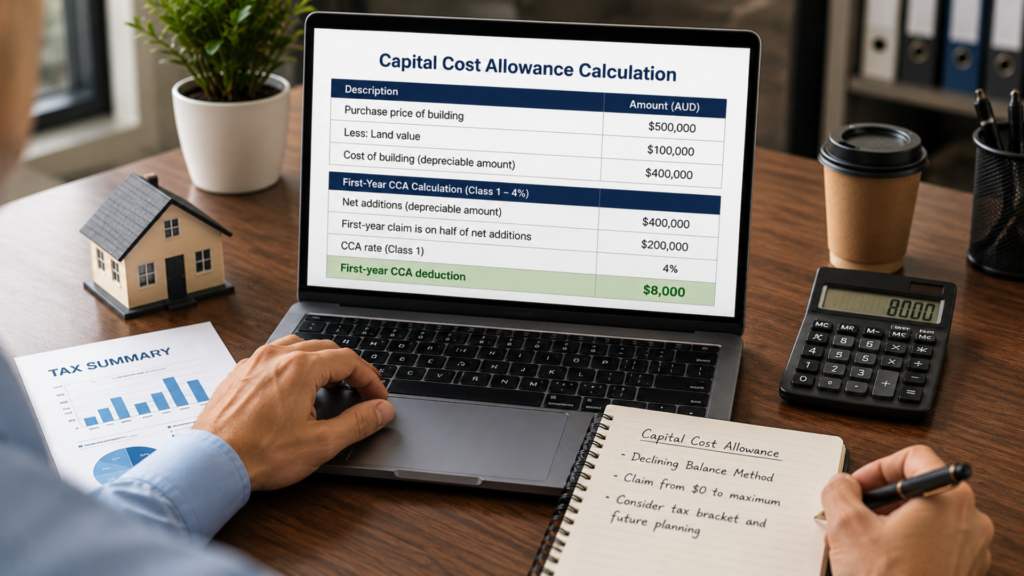
When you look at your property tax return do you ever wonder if you are leaving money on the table? I have been in that situation. The truth is, understanding Capital Cost Allowance is a very powerful tool for Canadian landlords. Whether you own a rental property or a big portfolio of apartment buildings Capital Cost Allowance lets you deduct the depreciation of your rental property over time. This reduces your income and puts more money back in your pocket.. Here is the thing. Claiming Capital Cost Allowance is not as simple as just filling in a number. If you get it wrong you could face problems like recapture or audits. In this guide I will walk you through everything you need to know about Capital Cost Allowance. What Is Capital Cost Allowance? Let me explain this in simple terms. Capital Cost Allowance is like depreciation. It is a deduction that lets you recover the cost of items like your rental building, appliances, and equipment over their useful lives. Think of it this way: your rental property does not stay in condition forever. Roofs wear out appliances break down. Buildings get old. The government recognizes this reality by allowing you to deduct a portion of your propertys cost each year. You need to know that the Capital Cost Allowance applies only to the building itself, not the land. When you buy a property you must decide how much of the purchase price is for the land and how much is for the building. Only the building part qualifies for Capital Cost Allowance. Also claiming Capital Cost Allowance is optional. You do not have to claim the amount. In fact many landlords choose to claim nothing at all depending on their tax situation. How Capital Cost Allowance Is Calculated The calculation for Capital Cost Allowance uses the declining balance method. This means your Capital Cost Allowance claim is based on the remaining undepreciated capital cost of your asset. Here is how it works. Lets say you buy a building for $500,000 with $100,000 for the land and $400,000 for the building. If your building falls into Class 1, the annual rate is 4%. In the year you would typically be eligible to claim Capital Cost Allowance on only half of your net additions. So your first-year Capital Cost Allowance would be calculated on $200,000 at 4% giving you a deduction of $8,000. Here is where it gets important. You can claim any amount from zero up to the maximum. If you are in a tax bracket claiming the maximum Capital Cost Allowance might make sense. If you are already in a bracket or have other deductions you might want to claim less to preserve your undepreciated capital cost for future years. CCA Classes: Which One Applies to Your Property? One of the confusing things about Capital Cost Allowance is figuring out which class your property belongs to. The government groups things into classes each with its own depreciation rate. Here are the common classes for rental properties: Class 1: This is the common class. Most buildings fall into Class 1 regardless of what they’re made of. Class 3:  Buildings made of brick, stone or concrete typically fall into this class. Class 6: Wood-frame. Structures made of galvanized iron belong here. Class 8: This class covers things like furniture, appliances and equipment. Class 50: Computer equipment and systems software fall into this class. Each rental building that costs than $50,000 must be in its own separate Capital Cost Allowance class. This ensures that when you sell the property all previously claimed Capital Cost Allowance is properly taken care of. The Half-Year Rule: What You Need to Know The half-year rule is one of those Capital Cost Allowance details that catches landlords off guard. In the year you buy a property you can usually claim Capital Cost Allowance on only one-half of your net additions to a class. For example if you buy a building for $400,000 in December you would not be able to claim Capital Cost Allowance on the $400,000 in that tax year. Instead you would calculate your Capital Cost Allowance on $200,000 at the rate. CCA Recapture: The Hidden Trap Every Landlord Must Understand Here is where Capital Cost Allowance gets really interesting. And potentially dangerous. Capital Cost Allowance is not a tax deduction. It is a deferral.. When you sell your rental property that deferral can come back to bite you. Recapture happens when you sell a property for more than its capital cost. The Capital Cost Allowance you claimed over the years gets added back to your income in the year of sale. This is taxed as income at your full marginal rate. Not as a capital gain. Let me give you an example. You buy a building for $400,000. Claim $60,000 of Capital Cost Allowance over several years, leaving an undepreciated capital cost of $340,000. You later sell the building for $400,000. The difference between your undepreciated capital cost and the sale proceeds is $60,000. That entire amount is recaptured and fully taxable. The New Accelerated CCA for Purpose-Built Rental Housing Here is some news for developers and investors. The government introduced an increase in the Capital Cost Allowance rate from 4% to 10% for eligible new purpose-built residential rental buildings. If you are building rental housing this is a big deal. A 10% Capital Cost Allowance rate versus 4% means larger deductions in the early years of ownership. Strategic Tips for Maximizing Your Capital Cost Allowance Based on what I have learned here are my top tips for making Capital Cost Allowance work for you: Consider your plans: If you plan to hold the property term claiming Capital Cost Allowance now might make sense. Do not. Increase a loss. You cannot use Capital Cost Allowance to create or increase a loss. Keep classes for each building. If you own properties make sure each building is in its own separate Capital Cost Allowance class. Document everything. The government requires you 10

Best Property Management Company in Calgary
Blog, Real Estate

Reclaim Your Time: How the Right Property Manager Pays for Itself in Calgary

Let me be honest with you, managing properties in Calgary can be hard. I have been there, dealing with tenant calls at midnight arranging repairs and trying to get rent payments while trying to build my collection. At some point every investor asks the question: should I hire a property management company? Finding the property management company Calgary has to offer can change your investment experience from difficult to smooth. Whether you are a landlord with a single property or an experienced investor with a growing collection, the right property management company Calgary can save you time, money and problems. In this guide I will walk you through what to look for in a property manager review Calgary companies and help you decide if professional management is right for your situation. Why Calgary Is One of Canada’s Best Rental Markets Before we dive into choosing a property manager lets talk about why Calgary’s such an attractive market for investors. Calgary offers population growth driven by people moving from more expensive cities like Vancouver and Toronto. The city has rental demand because of an economy that includes energy, technology and finance. Perhaps importantly Alberta has no provincial rent control giving investors more power to set rents based on market rates. These factors make Calgary one of the landlord-friendly cities in Canada. But with opportunity comes complexity; managing properties here requires knowing rules, market trends and tenant expectations. That is where a professional property management company in Calgary can make a difference. What Does a Property Management Company Actually Do? A good property management company Calgary handles more than just collecting rent. Here is what you can expect from full-service management:  Marketing and leasing: Creating listings showing properties and checking tenants. Rent collection: Using safe online payment systems and following up on late payments. Maintenance and repairs: Working with trusted contractors and handling emergencies around the clock Financial reporting: Giving monthly statements annual budgets and documents ready for taxes Tenant relations: Handling complaints enforcing leases and solving conflicts Property inspections: Checking properties regularly to find issues early Legal compliance: Making sure your property meets all local rules and safety standards Some companies go even further offering planning for capital, managing projects and even developing new properties. The right property management company Calgary becomes your partner in growing your investment, not a service provider. Top Calgary Property Management Companies in 2026 Based on industry recognition, customer feedback and years of experience here are some of the best property management company Calgary options in 2026. Equium Group Equium Group has been named Southern Albertas Top Property Management Company for seven years in a row by the Consumer Choice Award. Founded in Calgary in 2011 Equium is an integrated real estate organization that works with condominium, residential and commercial properties. Their current portfolio of properties under management is worth over $6 billion across 22.2 million feet. Equium manages over 8% of all condominiums in Calgary, where than 45,000 Calgarians live, work and play in Equium-managed properties. Their condominium corporations under management range from 2 units to 800 units covering than 20,500 units. The company has been recognized in Canada’s Growing Companies by Macleans Magazine, Canadian Business Magazine, The Financial Times and The Globe & Mails Report on Business Magazine. With 14 years of experience and 185 employees Equium has won 35 awards. Offers 24/7 emergency support. Citysearch Rental Network Inc. Citysearch Rental Network Inc. Is a family-owned business with 24 years of experience. They manage properties of all sizes for owners and investors leasing 5,278 properties and counting. Their services include property management, leasing and corporate relocation services. A Property Manager at Citysearch typically manages 100-200 properties and the company is accredited by the Better Business Bureau with A+ ratings. They aim to respond to all communication within 24 hours during business days. CEO Lisa Hamielec leads an award-winning team focused on increasing the value of properties while improving the lifestyle of the communities they manage. They work extensively with property owners and employees moving to Calgary seeking accommodation. Power Properties Power Properties was named Top Choice Property Management Company of 2025 which’s the third time they’ve received this award. Founded in 1980 Power Properties has been offering easy property management services to property owners, property investors and non-residents with homes in Calgary for over 40 years. Their full-service property management includes everything from move-in to move-out. Power Properties has a 4.2-star rating with 709 reviews showing their dedication to customer happiness. What to Look for in a Property Management Company Finding the property management company Calgary for your specific needs requires looking beyond the marketing materials. Here is what I suggest evaluating: Experience and history  How long have they been around? Do they specialize in your type of property (commercial condominium)? A company that manages 20,000+ units has skills than one managing 100 properties. Fee system  Most companies charge a percentage of rent usually between 8-12%. Some charge fees for leasing, inspections or maintenance coordination. Ask for a list of fees upfront. Quick response  How fast do they answer questions? Do they offer 24/7 help in emergencies? The quality of a property management company Calgary is often judged by how they handle problems. Tenant screening method The best companies have screening including credit checks, checking jobs and looking at rental history. This protects you from tenants. Maintenance network  Do they work with contractors? What is their speed for emergency repairs? A good property management company Calgary has relationships with tradespeople who put their clients first. Technology and reports Do they offer systems for owners and tenants? Can you access money reports repair requests and lease documents easily? Modern property management depends a lot on technology. Red Flags to Watch For Here are warning signs that a property management company Calgary might not be right for you: Reviews and Complaints  Check sites like BBB and review platforms. Companies with unresolved complaints especially about tenant interactions or money matters should be avoided. Unclear charges  If 10

Shared Accommodation in Calgary
Blog, Tenant Tips

Hidden Perks of Shared Accommodation in Calgary: More Than Just Saving Money

Let me ask you something. When was the last time you checked your bank account after paying rent and did not feel worried? If you have been in this situation, you know how frustrating it is. Here is the good news: shared accommodation in Calgary is changing the way people live save money and connect. With the average rent for a one-bedroom apartment being around $1,599 per month more people in Calgary are realizing that sharing a home is not about saving money. It is a better way of living. Sharing a home has benefits beyond just saving money. You get to be part of a community, you have flexibility and you get perks that you would not get if you were living alone. Here is why shared accommodation in Calgary might be the decision you can make in Calgary today. The Financial Reality: Keeping Money in Your Pocket Lets talk about money.The rental market in Calgary has changed a lot over the few years. While the prices are not as high as they used to be the average rent is still around $1,799 per month. Add to that the cost of utilities, internet and other expenses and living alone can be very expensive. This is why many people in Calgary are choosing to share a home with others. By splitting the costs with your housemates you can save 30% to 50% on your housing costs. The average cost of a one-bedroom apartment is around $1,599 per month plus utilities.. If you share a room or a suite you can pay between $700 and $1,200 per month and that often includes utilities and Wi-Fi. That is a difference and it means you can save hundreds of dollars every month. Beyond the Budget: A Built-In Community Moving to a city or a new neighborhood can be lonely. It takes time to make friends. But shared accommodation in Calgary is different: You get to be part of a network from the start. You can bond with your housemates over dinner, movies or exploring Calgarys food scene. Many people who share a home become friends. Having someone to talk to after a day is very comforting. Why Calgary’s Current Market is Ideal for Shared Living The housing market in Calgary is perfect for shared accommodation now: There are more empty apartments available, so you have more choices. Older buildings have space and are cheaper which is a big advantage. If you share a old apartment you get more space for your money than if you were living alone in a small new studio. Unmatched Flexibility for a Life If you do not want to find a roommate on your own you can look into -living spaces in Calgary. Co-living spaces are professionally. They offer private bedrooms and shared common areas. The cost is all-inclusive so you pay one price for everything. It is affordable with prices starting at around $725 per month. You do not have to worry about setting up utilities or buying furniture. It is the balance of privacy and community. Pro Tips for a Seamless Shared Living Experience To make living work you need to communicate clearly: Be open about money and how you will split the costs. Agree about noise, guests, cleaning and shared spaces. Check in with your housemates every month to make sure everything is okay. Be flexible and respectful. You will have a harmonious home. Conclusion Shared accommodation in Calgary is not about saving money. It is, about freedom, flexibility and connection. Whether you choose a roommate setup or a co-living space shared living is a great way to enjoy Calgary without breaking the bank. Your next great home and your next great friend might be a room away. Frequently Asked Questions (FAQs) What is the minimum number of units required for MLI Select? Your project must have at least 5 self-contained rental units to qualify. What happens if I do not reach 50 points? If your project scores below 50 points, you do not qualify for MLI Select enhanced terms. You would need to pursue CMHC multi-unit insurance or conventional commercial financing, which offer less favorable terms. What is the September 30, 2026 deadline? This is the date after which CMHC will stop accepting energy efficiency attestations against the building codes. After this date, all applications must be scored against the 2020 codes. Can I use MLI Select for an existing building I am purchasing? Yes. MLI Select is available for both construction and existing properties. How long do affordability commitments last? You are required to maintain affordability for a minimum of 10 years, from the date of occupancy. If you commit to keeping rents affordable for 20 years or more, you get 30 points on top. Hafil Perincheeri Co-Founder & Director Linkedin Envelope Instagram Hafil Perincheeri is an engineer-turned-realtor, investor, and builder based in Calgary, Canada. As Co-Founder and Director of Greencasa, he specializes in home flips, property development, and investment strategies. Since 2019, he has guided clients in home buying, multifamily investing, and financing options like CMHC and MLI Select, ensuring transparent, informed decisions. Get A Free Quote Green Casa Contact Form Full NamePhone NumberEmailCityServices– Select –Property ManagementConstruction ConsultancyCapital InvestmentMLI Select Program GuidanceDescribe your Requirement:Submit

Scroll to Top

Compare