


Green Casa Commercial

Get In Touch

Green Casa Popup Form

Blog

Your blog category

CMHC MLI Select
Blog, CMHC MLI Select

CMHC MLI Select in 2026: The Financing Tool Thats Transforming Multi-Family Investing in Alberta

I often wonder how some people buy apartment buildings with little money down. The answer is usually the CMHC MLI Select program. If you want to invest in -family homes in Alberta you need to understand this program. It is the important tool for buying or building rental properties in Canada right now. You can buy a property with little as 5 percent equity. In this guide I will explain how MLI Select works in 2026 what the recent changes mean for you and how you can use this program to grow your portfolio. Whether you are an investor or have experience this is information you cannot ignore. What CMHC MLI Select Actually Is Let me explain what CMHC MLI Select is. CMHC does not lend you money directly. A bank or credit union gives you the mortgage and CMHC insures the loan. Because the loan is backed by the government the lender takes on risk. They offer terms, such as higher leverage, longer amortization and lower interest rates. You pay CMHC a premium. The deal becomes cheaper and more forgiving. MLI Select replaced the MLI Flex product in March 2022. It has a points system on top of the insurance. The premium is a percentage of the insured loan. Is usually added to the mortgage. For anyone who wants to invest in -family homes understanding this program is crucial. The Points System: How MLI Select Rewards Better Buildings This is where things get interesting. Every MLI Select project gets points in three categories: affordability, energy efficiency and accessibility. You do not have to meet all three categories. You can focus on one. Combine them to get more points. The points you get the better your financing terms become. For affordability you get points by keeping some units at rents below the median market rent for at least 10 years. If you commit to 20 years you get 30 bonus points. For energy efficiency you get points by building or retrofitting to exceed baseline energy performance standards. For accessibility you get points by building barrier- units. The minimum required score is now 50 points. The Three Tiers: What Each Level Unlocks The points you get determine which tier you qualify for. Each tier unlocks financing. If you get 50 points you can get a 40-year amortization and a 10 percent premium discount. If you get 70 points you can get 45 years and 20 percent off. If you get 100 points you can get a 50-year amortization, up to 95 percent financing and 30 percent off the premium. Let me explain what this means. A 50-year amortization means monthly payments, which makes it easier to qualify for financing. Up to 95 percent financing means you can buy a building with little as 5 percent down. For projects up to $5 million you can put down little as 5 percent. These terms make MLI Select more accessible than commercial financing options. Why Alberta Is the Perfect Market for MLI Select Alberta has advantages that make MLI Select attractive. First there is no rent control. This means you can adjust rents to market rate when units are empty. If market rents increase 5 to 7 percent annually your rental income can increase at that rate. Second Albertas population is growing rapidly. Edmonton and Calgary are expected to grow by 2035. This growth means more people will need properties. The September 30 2026 Deadline: What You Need to Know There is a date to remember: September 30 2026. CMHC announced changes to MLI Select in November 2025. After September 30 2026 new applications will be scored against the 2020 National Building Code and 2017 National Energy Code. This means it will be harder to get points for energy efficiency. Projects that would have qualified for financing under the old rules might not qualify under the new rules. For investors this deadline creates both urgency and opportunity. Projects that qualify under the rules can lock in better terms. How MLI Select Is Reshaping Albertas Rental Supply MLI Select has been responsible for a portion of multi-family new construction in Canada. The program offers interest rates reducing borrowing costs for multi-unit residential property construction, purchase and refinancing. It offers premiums and longer amortization periods based on your level of commitment to affordability, accessibility and climate compatibility. In Alberta MLI Select allows qualifying -family projects to access higher loan-to-value ratios, extended amortization periods of up to 50 years and reduced insurance premiums. This changes how investors structure acquisitions in secondary markets where rental demand remains strong. Real-World Impact: What MLI Select Means for Your Deal Let me give you an example of how MLI Select can transform a deal. With up to 95 percent financing you can buy a $5 million building with $250,000 down. With a 50-year amortization your monthly payments are significantly lower than they would be with a 25-year amortization. This improves your cash flow from day one. The interest rates available through MLI Select are also more competitive. When you combine these factors the program can be the difference between a deal that works and one that does not. Common Pitfalls and How to Avoid Them MLI Select is powerful. It has challenges. CMHC changed its premium schedule in July 2025. Added surcharges. The minimum 50-point threshold means you need to plan. You cannot assume you will qualify. You need a strategy. The affordability pathway often provides the single lever in Alberta but it requires a long-term commitment to keeping units below market rent. The energy efficiency pathway is getting tougher with the September 30 deadline approaching. My advice is to work with professionals who understand the program. They can help you structure your deal to maximize points and unlock the possible terms. Conclusions CMHC MLI Select is transforming -family investing in Alberta in 2026. With its points-based system rewarding affordability, energy efficiency and accessibility the program offers financing terms. For investors who meet the requirements and the September 30 2026 10

Multi-Family
Blog, Real Estate

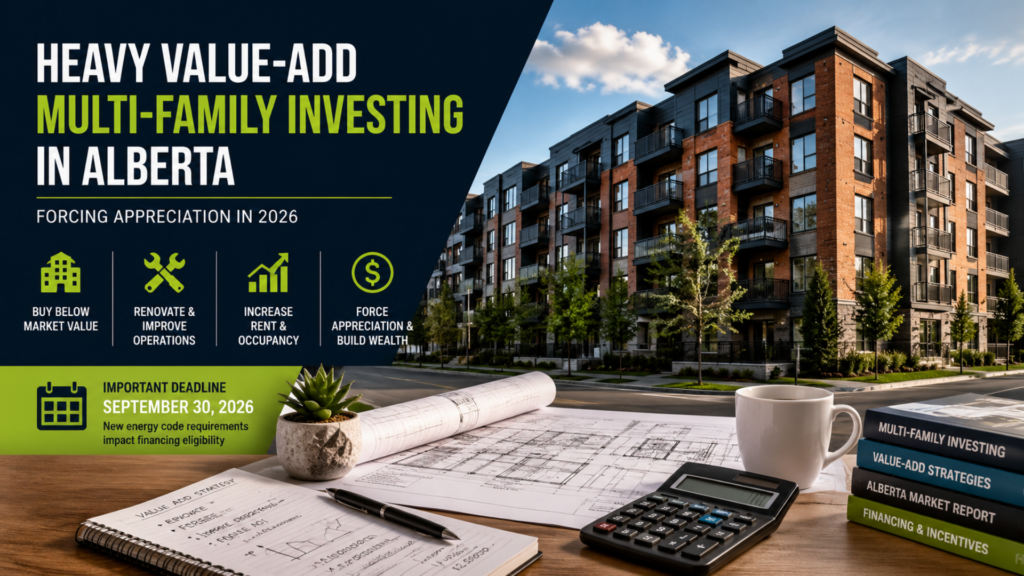
Heavy Value-Add Multi-Family Investing in Alberta: How Smart Investors Are Forcing Appreciation in 2026

Heavy value add family investing in Alberta is really about making older apartment buildings better. You know when you drive by a building and think it could be nice if someone fixed it up. That is what heavy value add family investing in Alberta is all about. I have been watching the market in Alberta. I think 2026 is going to be a great year for people who want to invest in Multi-family properties. What is value add investing in multi family properties? Well, it is not about painting the walls and putting in new appliances. It is about making the whole building work better. You are not just buying a building you are buying a business. The best value add properties are the ones that are not doing well as they could be. The rent might be too low. The management might not be very good. There are a lot of things that can be improved. Alberta is a place to do value add investing in multi family properties The prices are lower than in cities like Vancouver or Toronto. There are a lot of people who want to rent apartments. Many of the apartment buildings in Alberta are old. Need to be fixed up. This is an opportunity for investors. Edmonton and Calgary are two cities in Alberta that’re good for value add investing. Why Alberta Is the Perfect Market for Heavy Value-Add in 2026 The way to make money with value add investing is to buy a building that needs work and then fix it up. You can make the building worth more by increasing the rent. Let me give you an example. Imagine you buy a building with 20 apartments for 2 million dollars. The rent is 850 dollars per month. You spend 500,000 dollars to fix up the building. Then you can charge 1,100 dollars per month. That is a rent increase. The value of the building will go up too. The Profit Formula: How Heavy Value-Add Actually Works Not all renovations are the same. Some will give you a return on your money than others. Kitchens and bathrooms are important. People want to have kitchens and bathrooms. If you put in appliances and fixtures it will make the apartment more attractive to renters. You should also think about the outside of the building. Make it look nice and people will want to live Real Numbers: What a Heavy Value-Add Deal Looks Like There are some risks to value add investing. It can be expensive to fix up a building.. Sometimes things do not go as planned. If you do it right you can make a lot of money. You should have a team of people to help you. This includes contractors and property managers. The September 30, 2026 Deadline You Need to Know About There is something you should know about. The government is changing the rules for buildings. You need to know about this if you are going to invest in a building. The new rules start on September 30 2026. If you can get your building ready before then you might be able to get financing. Conclusion In conclusion value add investing in multi family properties in Alberta is an idea. You can buy a building that needs work and fix it up. Then you can charge rent and make the building worth more. It is not always easy. It can be very profitable. Frequently Asked Questions (FAQs) What is a value-add property? A value-add property is not doing well as it could be. The rent might be too low. The management might not be very good. Why is Alberta a place for value add investing? Alberta has lower prices than other cities. There are a lot of people who want to rent apartments. Many of the apartment buildings in Alberta are old. Need to be fixed up. How much should I spend on renovations? It depends on the building and what you want to do. A typical renovation might cost 25,000 to 30,000 dollars per apartment. What renovations deliver the best return on investment? Kitchens and bathrooms are important. People want to have kitchens and bathrooms. If you put in appliances and fixtures it will make the apartment more attractive, to renters. What is the September 30 2026 deadline and why is the September 30 2026 deadline? The Canada Mortgage and Housing Corporation is making a change to 2020 energy codes after the September 30 2026 deadline. This means that projects that meet the 2015 standards can get better financing terms through the MLI Select program. After the September 30 2026 deadline it will be harder to get points for being energy Green Casa Co-Founder & Director Linkedin Envelope Instagram Hafil Perincheeri is an engineer-turned-realtor, investor, and builder based in Calgary, Canada. As Co-Founder and Director of Greencasa, he specializes in home flips, property development, and investment strategies. Since 2019, he has guided clients in home buying, multifamily investing, and financing options like CMHC and MLI Select, ensuring transparent, informed decisions. Get A Free Quote Green Casa Contact Form Full NamePhone NumberEmailCityServices– Select –Property ManagementConstruction ConsultancyCapital InvestmentMLI Select Program GuidanceDescribe your Requirement:Submit

Home Renovation Ideas
Blog, Real Estate

7 High-ROI Home Renovation Ideas That Actually Pay Off in 2026

Let me ask you this: have you ever spent a lot of money on a home renovation and then wondered if you would ever get that money back? I have been in that situation. It is not a good feeling. The truth is that not all home renovation ideas are the same. Some projects can give you back than double what you spent while others can waste your money with little to show for it when you sell your home. According to the Cost vs. Value Report eight of the ten best home renovation ideas in 2026 are projects that improve the outside of your home. If you are planning to sell your home or just want to make your money work harder it is really important to know which home renovation ideas give you the returns. In this guide we will look at seven high-ROI home renovation ideas that are based on data so you can make smart decisions that actually pay off. Why Smart Homeowners Focus On Curb Appeal Before we look at home renovation ideas lets talk about why projects that improve the outside of your home are better than projects that improve the inside. As Paul Rassam, the founder of RooferBros.com, says: “A new garage door or front door can make a difference because it shows that your home is well taken care of.” Buyers form an opinion of your home in a few seconds after they pull into the driveway. That’s why the best home renovation ideas focus on making a first impression. Projects that improve the outside of your home are also usually less expensive than projects that improve the inside of your home but they can give you a better return on your investment. Garage Door Replacement Is The Best Home Renovation Idea If you are only going to do one of these home renovation ideas you should replace your garage door. The numbers are amazing: a new garage door costs about $4,672. It can add about $12,526 to the value of your home, which is a return on investment of 268%. This is the home renovation idea that gives you the return on investment in the country for the second year in a row. Since the garage door is a part of the front of your home an old door can make your home look like it is not well taken care of. A new garage door can make your home look newer and more expensive. Steel Entry Door Replacement Is A Home Renovation Idea Another project that can improve the outside of your home is replacing your front door with a steel entry door. This costs about $2,435. It can add about $5,270 to the value of your home, which is a return on investment of 216%. This is one of the affordable home renovation ideas that can make a big impact. A new front door can improve the curb appeal of your home. Make it more secure and energy efficient. Buyers feel safer when they walk up to a home with a modern front door, and that can lead to higher offers. Manufactured Stone Veneer Is A Way To Add Luxury To Your Home If you want to add some elegance to your home, you should consider using manufactured stone veneer. This costs $11,000 but it can add about $22,880 to the value of your home, which is a return on investment of 208%. Adding stone veneer to the front of your home can make it look end and custom which can make it stand out from other homes in your neighborhood. This is one of those home renovation ideas that can make buyers stop and stare. They are willing to pay more for a home that looks amazing. Fiber-Cement Siding Replacement Is A Great Home Renovation Idea Replacing your siding with fiber-cement siding is another project that can improve the outside of your home. This costs $19,000 but it can add about $21,600 to the value of your home, which is a return on investment of 114%. This type of siding is also very durable. Can resist fire, which can make it a good choice for homeowners. Buyers are looking for homes that’re low maintenance, which makes this one of the smartest home renovation ideas. Minor Kitchen Remodel Is An Interior Project If you want to improve the inside of your home you should start with a minor kitchen remodel. This is one of the interior projects that can give you a good return on investment. A minor kitchen remodel can include replacing the doors and handles on your cabinets installing appliances updating your countertops and improving your flooring. This can return 113% of its cost which is a lot better than a major kitchen remodel. Buyers are looking for kitchens that’re functional and have modern appliances, which makes this one of the smartest home renovation ideas. Midrange Bathroom Remodel Is A Home Renovation Idea Bathroom remodels are another type of project that can give you a good return on investment. A midrange bathroom remodel costs about $26,138. Can return about 80% of its cost. Master bathroom remodels can return 60% to 75% of your investment. To get the results you should focus on updating the fixtures using neutral tile finishes and improving the lighting. Buyers are looking for bathrooms that’re functional and have a spa-like feel, which makes this one of the smartest home renovation ideas. Midrange Bathroom Remodel Is A Home Renovation Idea Sometimes the simplest home renovation ideas can give you the biggest bang for your buck. Painting the inside of your home with colors can cost about $2 to $6 per square foot and can return about 107% of its cost. A fresh coat of paint can make a room look brighter and more inviting. Buyers like homes that’re clean and neutral, which makes this one of the smartest home renovation ideas. Smart home renovation ideas are not about spending a lot of money. 10

MLI Select
Blog, CMHC MLI Select

The Government Program That’s Changing Multifamily Investing in Canada: MLI Select

If you have been involved in multifamily real estate recently you have probably heard people talking about MLI Select. I have noticed that most investors do not really understand what MLI Select is and how it works. They know it has something to do with CMHC and financing. The details are not clear. This is a missed opportunity because MLI Select is an important financing tool for multi-unit residential properties in Canada right now. It is the program behind apartment construction and refinancing deals in the country. In this guide I will explain what MLI Select is, how the points system works, what is changing in 2026 and how you can use it to improve your deal. What MLI Select Actually Is Lets start with the basics because the name MLI Select confuses a lot of people. MLI Select does not mean that CMHC lends you money directly. Here is how it actually works: a bank or credit union gives you a mortgage and CMHC insures that loan against default. Because the loan is backed by the government the lender takes on risk, which means they can offer you better terms: higher leverage, longer amortization and lower interest rates. MLI Select replaced the MLI Flex program in March 2022 and added a points system. The program is designed to reward projects that contribute to policy goals around affordability, energy performance and accessibility. The more you commit to these environmental goals the better your financing terms become. For example Equitable Bank alone funded $4.3 billion of multi-unit volume in 2025 most of it through MLI Select. Many other lenders are also heavily involved in the program. When people talk about apartments being the number one sector for commercial lender appetite in 2026 MLI Select is the reason that’s possible. The Points System: How You Unlock Better Terms MLI Select uses a points-based system. Your project earns points in three categories. Your total score determines what financing benefits you qualify for. The three categories are: Affordability: you earn points by keeping a percentage of units at rents below the median market rates. The deeper the discount and the longer the commitment period the more points you earn. Energy Efficiency: You earn points by building or retrofitting to exceed baseline energy performance standards. Accessibility: you earn points through barrier- design and accessible unit features. You need least 50 points to qualify for any enhanced terms. The more points you earn the the deal. For example with 50 points you can get a 40-year amortization and a 10% premium discount. With 100 points you can get a 50-year amortization and a 30% premium discount. The 2026 Changes You Need to Know About MLI Select has changed significantly in 2026. If you are not up to speed you could be missing out on serious money or even missing out on financing altogether. The minimum score required is now 50 points up from 12 points. This means you can no longer get terms with a bare-minimum commitment. There are also rules about premium discounts and financing tiers. A 0.25% premium surcharge applies for every 5-year amortization extension beyond 25 years.. There is a important deadline: September 30 2026. After that date CMHC will stop accepting energy efficiency attestations against the building codes. This means that many projects will score energy points under the same building specifications. Why MLI Select Matters for Your Bottom Line Let me give you an example of how MLI Select can make a difference. On a $10 million project with an 80% loan-to-value ratio the mortgage amount is $8 million. A 30% insurance premium discount versus 10% can save you $160,000 to $180,000 in mortgage insurance costs alone. That is before we even talk about the amortization cost and the reduced recourse implications. The 50-year amortization at 100 points can drop your debt service by 8% to 12% compared to 40 years. On an $8 million mortgage that is hundreds of thousands of dollars in annual cash flow improvement. This is why the points system is a financing superpower. For builders doing 5 to 8 unit multiplex projects MLI Select is not optional. It is essential. Without it you are looking at commercial lending: 75-80% loan-to-value ratio, 25-year amortization, higher rates. For a $3 million project that is the difference between $150,000 in equity and $600,000+. Strategic Tips for Maximizing Your MLI Select Score Based on what I have learned from talking to developers and investors who have successfully navigated this program here are some practical strategies: Do not try to max out energy efficiency: you need to combine categories to reach the highest scores. Affordability is your lever: affordability is the only category that can reach 100 points on its own. Plan for the September 30 deadline: if your project is currently in the pipeline and you are relying on the energy code standards you need to submit your application before September 30 2026. Work with an energy advisor: An energy advisor can help you optimize your building design to maximize your points. Talk to your lender: MLI Select applications are submitted through CMHC-approved lenders who use CMHC’s submission systems. Not all lenders are equally knowledgeable about the program. Work with one who has experience. Conclusion MLI Select is a game-changer for mortgage financing in Canada. By projects that contribute to affordability, energy efficiency and accessibility it creates a powerful incentive for investors to build better housing while accessing superior financing terms. Whether you are a first-time multiplex builder or a seasoned apartment investor, understanding MLI Select is not optional. It is the key to making your numbers work in today’s market. The program has gotten more complex in 2026 with minimum scores, stricter energy standards and a looming September 30 deadline. The rewards are worth the effort. Take the time to understand the points system, plan your energy strategy early and work with partners. Your next deal could depend on it. Frequently Asked Questions (FAQs) What is the minimum number 10

Sublease Agreement
Blog, Tenant Tips

What Is a Sublease Agreement? How Does It Work?

You’ve got a dream job in a city, but you’re stuck with a year-long lease and four months to go. Maybe you’re a student who wants to go home for the summer and doesn’t want to pay rent for an empty room. This is where a sublease agreement comes in. A sublease agreement is a contract that lets you, the tenant, rent out your space to someone else called a subtenant for a short time. Before you look for a temporary roommate, you need to know that a sublease agreement comes with big responsibilities and risks. What Is a Sublease Agreement? A sublease agreement is a contract between you and a new person, where you let them use and occupy your property for a shorter term than your original lease. It’s like a mini-lease. You stay responsible to your landlord for paying rent, keeping the property in shape and following all the rules of your main lease. The agreement just helps you share that responsibility with someone for a little while. How Does a Sublease Agreement Actually Work? To understand a sublease agreement, you need to know about the master lease. The master lease is your rental contract with the landlord, and it still applies even after you sign a sublease agreement. This means all the rules in the master lease. Noise rules and pet policies. Apply to your subtenant even if your agreement doesn’t say so. Landlord Consent and Legal Requirements Getting your landlord’s okay is super important. In places, if you don’t get written consent, your landlord can kick you out. I always tell tenants to ask their landlord to explain their situation and present the potential subtenant for approval. What Are Your Rights and Obligations? When you sign a sublease agreement, you’re like a mini-landlord. You have the right to collect rent on time and make sure the subtenant follows the rules. You also have to take care of the property and fix any problems that come up. Your agreement should say who does repairs. You, the subtenant or the landlord. Common Pitfalls of Subleasing Here are the common mistakes people make with their sublease agreement. First many tenants don’t check their subtenants background well. A sublease agreement is only as good as the person signing it. Second tenants often make a agreement that doesn’t cover important stuff like utility payments and guest policies. Third people ignore the move-out condition. Your agreement should say how the subtenant has to leave the property. Conclusion A agreement can be a solution when you need flexibility. You get to cover your rent and the subtenant gets a place to stay without a long-term commitment. You need to get it right. You stay responsible to your landlord. Any failure by your subtenant becomes your failure. By getting written landlord consent, making a sublease agreement checking candidates carefully and following your main lease you can sublet with confidence. Frequently Asked Questions (FAQs) Is a sublease agreement the same as a lease assignment? No. A sublease agreement gives the temporary rights while you keep the main lease. An assignment permanently transfers all your lease rights to a tenant. Can I evict my subtenant if they don't pay rent? Yes. Your sublease agreement lets you evict the subtenant for not paying or breaking the rules. You have to follow local landlord-tenant laws. Does my landlord have to agree to my sublease agreement? In cases, yes. Many main leases require written landlord consent before any sublease agreement is valid. Can I charge rent more than what I pay my landlord? You can. Some leases don’t let you make a profit. Check your lease and local laws. What happens if my subtenant damages the property? You are still responsible to your landlord. Your sublease agreement should include a security deposit from the subtenant to cover damages. Green Casa Co-Founder & Director Linkedin Envelope Instagram Hafil Perincheeri is an engineer-turned-realtor, investor, and builder based in Calgary, Canada. As Co-Founder and Director of Greencasa, he specializes in home flips, property development, and investment strategies. Since 2019, he has guided clients in home buying, multifamily investing, and financing options like CMHC and MLI Select, ensuring transparent, informed decisions. Get A Free Quote Green Casa Contact Form Full NamePhone NumberEmailCityServices– Select –Property ManagementConstruction ConsultancyCapital InvestmentMLI Select Program GuidanceDescribe your Requirement:Submit

Living in Calgary
Blog, Real Estate

Townhouse Living in Calgary: Pros, Cons and Buying Tips

Calgary is a city with different neighborhoods and housing options. Townhouses are a choice for many people. A townhouse is a compromise between a condo and a detached home. I’ve helped many people in Calgary find their townhouse. Today we’ll look at the pros and cons of townhouse living in Calgary. By the end you’ll know what to look for and how to make a purchase. Why Townhouses Are Popular in Calgary The real estate market in Calgary is special. Townhouses are popular for reasons. They offer space than a condo. They are more affordable than a home. They are often in neighborhoods. Young. Professionals like townhouses. They offer a balance of space, cost and location. I’ve seen townhouse communities do well in Calgary. Townhouses are a choice for many buyers. The Pros of Townhouse Living in Calgary Here are the pros. Affordability is an advantage. Townhouses are more affordable than homes. They are also more affordable than condos in prime areas. You get space for your money. You often get a yard or patio. Many townhouses have attached garages. This is a benefit in Calgary winters. You also get a sense of community. Townhouse complexes often have shared spaces. I like the community feel of townhouse living. Townhouses are all about balance. The Cons of Townhouse Living in Calgary There are also cons. You share walls with neighbors. This can be noisy. You have privacy than a detached home. You may have to pay condo fees. These can add to your costs. You have to follow rules. Some complexes restrict pets, parking or renovations. The yard is often small. This may not work for everyone. I’ve dealt with neighbors and restrictive rules. Townhouses have trade-offs. Be aware of these cons. What to Look for in a Calgary Townhouse When buying a townhouse in Calgary look for things. Check the location. Is it near transit, schools and shopping? Calgary is a city. Location matters. Check the condition of the building. Look at the roof, windows and siding. Calgary winters are harsh. These elements need to be in shape. Check the condo fees and reserve fund. A managed corporation is essential. I use a checklist for every purchase. A managed townhouse is not worth it. Do your homework. Calgary Neighborhoods with Great Townhouses Some neighborhoods have townhouses. The Beltline has townhouses. They are close to downtown and amenities. Inglewood has charm with modern townhouses. Evanston and Sage Hill have townhouses. They are popular with families. Mahogany and Seton have lake communities with townhouses. These are great for lovers. I’ve explored these neighborhoods with buyers. Townhouses in these areas are a lifestyle choice. How to Finance a Townhouse in Calgary Financing a townhouse is like financing any home. You can use a mortgage. You need a payment. Condo townhouses have requirements. The building must meet the lender’s criteria. Some lenders are stricter than others. I recommend working with a mortgage broker. They can find the rates. A townhouse without financing is unattainable. Get pre-approved before you start looking. Common Mistakes When Buying a Townhouse There are mistakes to avoid. Skipping the home inspection is an one. A qualified inspector can find issues. Ignoring condo fees is another. These add to your costs. Not reading the bylaws is a mistake. You may be surprised by restrictions. Overlooking the reserve fund is a risk. A low reserve fund means special assessments. I’ve seen buyers make these mistakes. A smart purchase requires planning. Conclusion You now understand townhouse living in Calgary. Townhouses offer space than condos and more affordability than detached homes. They are popular in neighborhoods. Calgary has options for townhouse buyers. Consider the pros and cons, location and financing. I’ve helped many buyers find their townhouse. Your first home is a decision. Take your time. Choose wisely. Calgary has a townhouse, for everyone. Frequently Asked Questions (FAQs) What is a townhouse in Calgary? A townhouse is a -level home that shares walls with neighbors. It’s a housing option in Calgary Are townhouses in Calgary affordable than detached homes? Yes townhouses are usually more affordable than homes in Calgary. Do all townhouses in Calgary have condo fees? No some townhouses are freehold. Have no fees. Others are condo townhouses with fees. What neighborhoods in Calgary have townhouses? The Beltline, Inglewood, Evanston Sage Hill, Mahogany and Seton are areas. What should I look for when buying a townhouse in Calgary? Check the location, building condition, condo fees, reserve fund and bylaws. Green Casa Co-Founder & Director Linkedin Envelope Instagram Hafil Perincheeri is an engineer-turned-realtor, investor, and builder based in Calgary, Canada. As Co-Founder and Director of Greencasa, he specializes in home flips, property development, and investment strategies. Since 2019, he has guided clients in home buying, multifamily investing, and financing options like CMHC and MLI Select, ensuring transparent, informed decisions. Get A Free Quote Green Casa Contact Form Full NamePhone NumberEmailCityServices– Select –Property ManagementConstruction ConsultancyCapital InvestmentMLI Select Program GuidanceDescribe your Requirement:Submit

Tenant Rights
Tenant Tips, Blog

How Tenant Rights Are Protected in Calgary: A Complete Guide

You have just moved into your place and you are feeling happy. The boxes are all unpacked. You are finally settled in. Then something happens. The hot water stops working. Your landlord wants to come into your home at 10 PM without telling you first. This is when you need to know your tenant rights. I have talked to a lot of renters who thought they had no power in these situations. They were wrong. The law protects them. Your tenant rights are like a balance between you and your landlord. They help you only if you know what they are. In this guide we will go through ten tenant rights that every renter should know. We will start from the moment you sign the lease and end when you move out. 1. The Right to a Safe Home The basic thing your landlord has to do is provide a safe home. This means the home has to be good enough to live in. It has to be safe and not have any health problems. You need to have heat in the winter, hot and cold water, electricity and no pests or mold. If your home is not like this you can ask your landlord to fix it. Your landlord cannot just say no. They have to fix it because it’s their job. If they do not fix it you can tell the people in charge of housing in your area. You can even stop paying rent in some places. 2. The Right to Privacy Your home is your space. Your landlord has to respect that. They cannot just come into your home whenever they want. They usually have to tell you 24 to 48 hours before. This is so you can be ready. Your landlord also cannot watch you all the time. Tell you who you can have as guests. If your landlord is coming into your home without telling you they are doing something. You can tell them to stop and write down every time they do it. 3. Protection from Bad Treatment The law says that your landlord cannot treat you badly because of who you’re. They cannot say no to renting to you because of your skin color, religion or where you come from. They also cannot charge you money or make you follow different rules. If you think your landlord is treating you badly you can tell the people in charge. You can even file a complaint. Knowing your tenant rights helps you to stand up for yourself. 4. The Right to Understand Your Lease Before you sign your lease you have to understand what it says. Your landlord has to explain it to you. They cannot hide anything. Make it too hard to understand. You have the right to ask questions and get answers. If your landlord is rushing you to sign that is a sign. Your tenant rights protect you from being tricked. 5. Protection from Being Kicked Out If your landlord wants to kick you out they have to follow the law. They cannot just lock you out. Turn off your electricity. They have to go to court and give you a chance to say what you think. Your tenant rights give you a chance to tell your side of the story. Never let your landlord scare you into leaving without a court order. 6. The Right to Get Your Money Back When you move out your landlord has to give you the money you paid as a deposit. They have to do this within an amount of time usually 14 to 30 days. They can only take out money for things you broke or did not pay for. They cannot take out money for things that are just worn out. You should take pictures of your home when you move in and out to prove what it looked like. 7. Freedom from Revenge If you tell your landlord about something that is broken they cannot get revenge on you. They cannot raise your rent. Kick you out just because you complained. If you think your landlord is doing this you can fight back. You can go to court. Show that they are being mean to you. 8. The Right to Fair Rent Your landlord can raise your rent. They have to be fair. They have to tell you of time usually 30 to 90 days before. If they do not tell you. If they raise it too much that is not fair. You can check the laws in your area to see what you can do. 9. The Right to Work Together You have the right to talk to your neighbors and work together. You can form a group to help each other and make your home a better place. Your landlord cannot stop you from doing this. They cannot be mean to you just because you are working together. 10. The Right to Seek Help If your landlord does something you can get help. You can go to court file a complaint or get help from a lawyer. You can even get money back if you win your case. Do not be afraid to stand up for yourself. Your tenant rights are there to help you. Conclusion Renting a home does not have to be scary. When you know your tenant rights you are in control. You can make sure your landlord treats you fairly. From having a home, to being able to work together with your neighbors your tenant rights are important. Always read your lease carefully write down everything. Do not be afraid to stand up for yourself. A good landlord will respect you for knowing the law. A bad landlord will think before treating you badly. Frequently Asked Questions (FAQs) What should I do first if my landlord does not want to fix something? Send a written request using certified mail. This way you have proof that you asked for a fix. If they still say 10

Lease Agreement
Blog, CMHC MLI Select

Lease Agreement Traps That Will Drain Your Bank Account

I want to tell you a story about a friend of mine. He found this nice downtown loft and he loved it. The light fixtures were great. He signed the lease agreement really fast. In under ten minutes. He did not even read the agreement he just looked at the rent amount. Six months later he found out that he had to pay for a two-thousand-dollar plumbing repair. His rent also went up by fifteen percent because he missed a part in the agreement. We have all been in a hurry to sign the agreement. I want to tell you that the agreement is like a minefield. It can cost you a lot of money if you are not careful. In this guide we will look at ten hidden traps in lease agreements. How to avoid them. 1. Racing Through the Fine Print This happens to all of us. The landlord is waiting for us we have the key. We just want to move in. Rushing through the lease agreement is a big mistake. The fine print is where the landlord hides the costs. These costs include administration fees, cleaning charges and late penalties. I always tell people to read the agreement. It is like a treasure map where every line could lead to something or something bad. You must read each section loud if you have to. It takes an hour to read the agreement and that one hour could save you from a lot of surprise charges. 2. Misunderstanding Who Pays for Repairs The maintenance part of the lease agreement is where the problems start. Some lease agreements use language like “the tenant is responsible for all repairs.” This could mean that you have to pay to fix the roof the heating system or the foundation. I have seen small business owners go out of business because their agreement made them responsible for all the repairs. A fair agreement will separate the repairs that the landlord has to do from the small repairs that you have to do. If your lease agreement does not do this you need to ask for definitions before you sign. 3. Overlooking the “Additional Rent” Trap You have budgeted for the base rent in your lease agreement. If you look at page five you might find the “additional rent” part. This can include property taxes, building insurance and maintenance fees for the areas. I have seen agreements where the additional rent was double the payment. Before you agree to a agreement you need to get a written estimate of all these extra charges. Your agreement should not be a guessing game. You need to know the cost of renting the place. 4. Misreading the Renewal and Termination Rules Your lease agreement will say what happens when the term ends. Some agreements will automatically renew for a year unless you give notice sixty days in advance. Others will require a written termination letter sent in a way. If you miss this deadline in your agreement you will be locked into another year that you might not want. On the hand if you need to leave early your lease agreement might charge you a “liquidated damages” fee that is equal to the remaining rent. You need to study the expiration and exit strategy parts of your agreement carefully. It is very important. 5. Assuming the Lease Agreement Is Non-Negotiable Most renters do not know that the lease agreement is a starting point for a conversation, not a decision. I have negotiated rents, added break clauses and changed the maintenance responsibilities in many agreements just by asking. Landlords want a tenant and they are often willing to change the agreement to get one. Do not be afraid to cross out clauses or add addendums. A flexible agreement that works for both parties is better than an one that leaves you unhappy and struggling. 6. Ignoring the Use Clause Restrictions Your agreement will say how you can use the property. For renters this might mean no home-based businesses or no pets. For businesses it can prohibit activities restrict signs or limit the hours of operation. I have heard stories of people who signed a agreement for a space only to find out they could not cook food on-site because the agreement said it was for office use only. Always check your intended use with the permitted use clause in the lease agreement. If the language is too narrow ask for it to be broadened before you commit. 7. Failing to Document the Property’s Condition Your lease agreement will usually say that you have to return the property in the condition it was in except for normal wear and tear.. Without evidence of the original condition you are at the landlord’s mercy when it is time to move out. I always take a video and photos of the property before I move in. I attach these to the  agreement as an appendix if possible. If the landlord tries to charge you for a -existing stain your documented evidence will protect you. 8. Missing the Notice Period for Moving Out This trap is very common and very frustrating. Your lease agreement will have a clause that says how days before moving out you have to give written notice. Often thirty, sixty or even ninety days. If you forget many agreements will automatically renew for a month. Charge you an extra month’s rent. I recommend setting a reminder six months into your lease to check the notice period. Your agreement will not remind you. If you miss the window you will pay dearly for that mistake. 9. Ignoring Subletting and Assignment Clauses Life can change quickly. Maybe you get a job in another city or your partner moves in. Your lease agreement will have rules about who can live on the property. Many agreements require the landlord’s written permission for any subtenant or additional occupant. If you bring in a roommate or sublet without approval you are breaking the 10

Best City to Live in Canada
Blog, Market Updates

How to Decide the Best City to Live in Canada for Your Life

You are ready to move to a city in Canada. You have saved some money, done some research, and narrowed down your options. You are still stuck. How do you actually decide which city is right for you? I have been in your shoes before. I have looked at a map of Canada. Felt completely overwhelmed. Today I want to share with you the process I use to choose a city. It is not about looking at rankings or lists. It is about figuring out what Canada and its cities can offer you. Step One: Get Honest About Your Priorities in Canada Before you look at any city in Canada, you need to look at yourself. I know it sounds simple. Most people skip this step. What do you actually want from your life in Canada? Do you want a paced career or a slower, simpler life in a Canadian city? Do you want to be surrounded by nature or by culture in Canada? Do you want to own a home in Canada? Are you happy renting in a Canadian city? I have moved cities in Canada based on what I thought I wanted, only to realize I was wrong. The best city to live in Canada for you is the one that best matches your priorities. You need to think about what you want from your life in Canada. Step Two: Consider Your Career in Canada Realistically You need to earn a living in Canada. So think about your career in Canada. Are you in a field that’s in demand in Canada? Where are the jobs in Canada? Toronto is a city for finance and media in Canada. Vancouver is strong in tech and film in Canada. Calgary is excellent for energy and tech in Canada. Montreal is a hub for aerospace and creative industries in Canada.  Halifax is growing in healthcare and tech in Canada. The best city to live in Canada for your career might be different from that of someone else in Canada. Your career in Canada is important. Step Three: Look at Housing Costs in Canada Honestly Housing is probably your biggest expense in Canada. So you need to be honest about what you can afford in Canada. Vancouver and Toronto are cities in Canada. Calgary and Halifax are affordable cities in Canada. Montreal and Ottawa are in the middle of Canada. Do not stretch yourself thin in Canada. I have seen people move to cities in Canada and struggle financially. It is not worth it in Canada. The best city to live in Canada for your budget is one where you can afford to live in Canada. You need to think about your budget in Canada. Step Four: Think About the Climate in Canada Canada is a country of extremes in climate. Some cities in Canada have winters. Others have freezing, snowy winters in Canada. If you hate snow, you might love Vancouver in Canada. If you love winter sports, you might enjoy Calgary or Montreal in Canada. The weather in Canada affects your mood, your activities, and your lifestyle in Canada. The best city to live in Canada for you is one where you can handle the weather in Canada. Climate in Canada is important. Step Five: Explore Lifestyle and Recreation in Canada What do you like to do in your time in Canada? Do you love hiking and skiing in Canada? Calgary and Vancouver are perfect for that in Canada. Do you love arts and culture in Canada? Montreal and Toronto have world-class museums and festivals in Canada. Do you love the ocean in Canada? Vancouver and Halifax have you covered in Canada. Do you love life in Canada? Ottawa and Halifax offer a pace in Canada. The best city to live in Canada is one that supports your hobbies. You need to think about your lifestyle in Canada. Step Six: Visit Before You Commit to a City in Canada I cannot stress this enough in Canada. Visit the cities in Canada you are considering. Spend at least a week in Canada. Explore neighborhoods in Canada. Take transit in Canada. Eat at restaurants in Canada. Talk to people in Canada. Get a feel for the vibe in Canada. The best city to live in Canada is one you have experienced firsthand in Canada. Visiting is important in Canada. Step Seven: Trust Your Gut in Canada After all the research and visits in Canada, trust your instincts in Canada. Sometimes a city in Canada just feels right in Canada. You cannot always explain it in Canada. You know it in Canada. The best city to live in Canada is the one that feels like home to you. Trust your gut in Canada. Conclusion You now have a process for choosing the city to live in Canada for your life. Start by getting honest about your priorities in Canada. Consider your career in Canada, housing budget in Canada, climate preferences in Canada, and lifestyle in Canada. Visit your choices in Canada. Trust your instincts in Canada. Calgary offers affordability and adventure in Canada. Vancouver offers beauty and a mild climate in Canada. Toronto offers energy and opportunity in Canada. Halifax offers charm and community in Canada. Montreal offers culture and a European vibe in Canada. Ottawa offers stability and balance in Canada. The best city to live in Canada is the one that fits your life. Take your time in Canada. Do your research in Canada. When you find a place in Canada, embrace it in Canada. Your new life in Canada is waiting. Frequently Asked Questions (FAQs) How do I decide which city to move to in Canada? Start by thinking about your priorities in Canada. Consider a career in Canada, housing in Canada, climate in Canada, and lifestyle in Canada. Visit your choices in Canada before deciding. What is the most affordable major city in Canada? Calgary and Halifax are among the affordable cities in Canada. Both offer housing and living 10

Scroll to Top

Compare